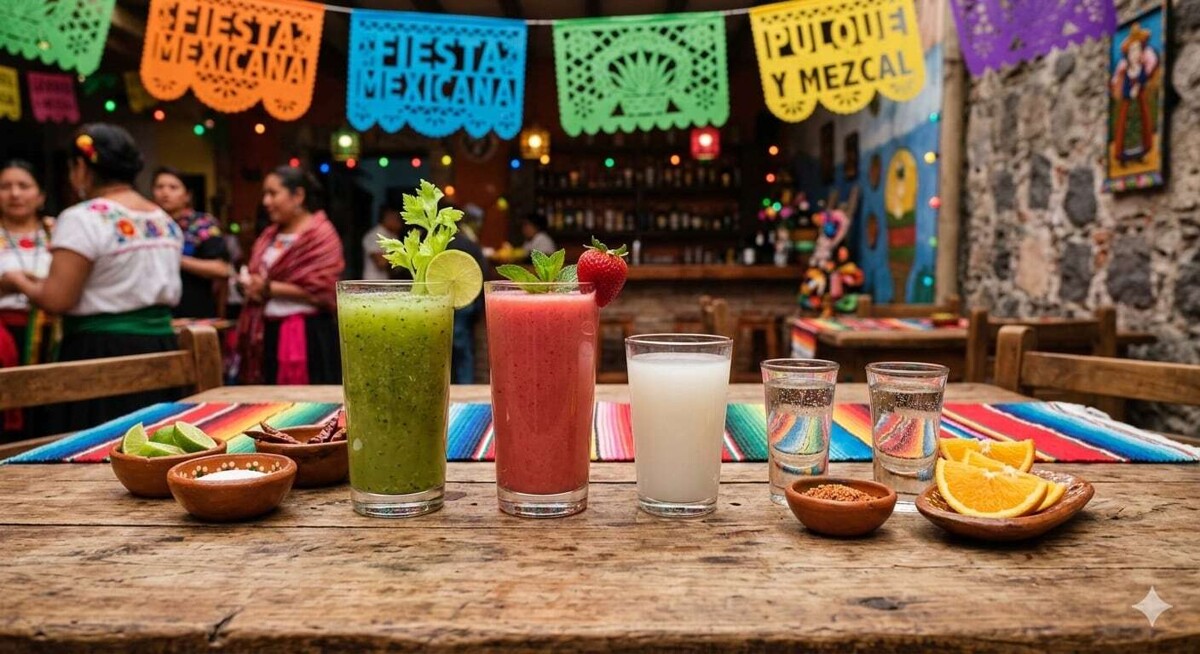
In Mexico, there are beverages that are not just served; they also tell stories. These are mezcal and pulque, which belong to that special category of symbols that cross generations, regions, and social classes. One was born and consolidated as a distilled agave drink with a strong artisanal identity; the other comes from pre-Hispanic times as a beverage deeply linked to the maguey, the countryside, and community life. Together, they represent an essential part of the national culture, one that remains alive at fairs, markets, pulquerías, mezcalerías, and popular celebrations. This cultural centrality is not just a social perception: the Ministry of Agriculture recognizes that the heritage value of magueys and their uses is part of the intangible cultural heritage of the Mexican people, while the INPI highlights the historical, economic, and cultural importance of pulque for Mexico's indigenous peoples. This symbolic weight is also reflected in the numbers; according to the organizers of the Pulque and Mezcal Festival, in 2024 Mexico recorded a production of 11.3 million liters of mezcal, while pulque reaches an approximate annual production of 194 million liters. Beyond the volume, what's important is that these drinks are not relics of the past, but living expressions of consumption, artisanal work, and cultural belonging.
Mezcal: Ancestral Tradition Mezcal has become one of the Mexican beverages with the greatest international projection, but its roots remain deeply local. The Ministry of Agriculture explains that the Denomination of Origin for mezcal is not just a commercial or legal recognition, but also an act of reviving and dignifying ancestral knowledge. Furthermore, the federal government itself emphasizes that the United States is the main importer of Mexican mezcal, confirming the expansion of this distillate beyond the country's borders. Culturally, mezcal cannot be separated from agave or the production methods inherited through generations; the Official Gazette of the Federation defines mezcal as a Mexican distilled beverage obtained from cooked and fermented agaves, and the Ministry of Agriculture insists that agave and its derivatives support manifestations of enormous historical and heritage value for different regions of the country. That is why, when a festival brings together mezcal masters from Oaxaca, Puebla, Guerrero, and Michoacán, it is not just offering tastings; it is putting an entire geography of knowledge, techniques, and aromas on display that are part of the Mexican cultural mosaic. In this eighth edition, varieties such as espadín, tobalá, tepeztate, cuishe, madre cuishe, cedrón, jabalí, mexicano, and coyote were presented, a sample of the diversity that makes mezcal something more complex than a gastronomic fad.
Pulque: A Millennial Drink If mezcal represents the contemporary boom of Mexican agave, pulque embodies its most ancient roots. The Ministry of Agriculture describes it as a pre-Hispanic beverage that has remained an essential part of Mexican heritage and culture, while the INPI stresses that its history is deeply linked to the indigenous peoples and the maguey as the central plant of community life. Pulque also has a very particular symbolic charge, evoking the central plateau, the haciendas, the work of the tlachiquero, popular fiestas, and a tradition that managed to survive even during periods of disrepute. The Ministry of Agriculture itself admits that one of the historical challenges for producers is to combat the negative image that was built around this drink for years. Today, however, pulque is experiencing a new stage; flavored pulques and new presentations have brought this drink closer to young, urban audiences without completely breaking with its artisanal essence. That is why this festival highlights that among the most popular flavored pulques are those with pine nut, pistachio, marzipan, coconut, mango, passion fruit, tomato, and guava, proof that tradition and reinvention can coexist.
The Festival as a Mirror of Culture The Eighth Edition of the Pulque and Mezcal Festival, held in Mexico City, served as a concrete demonstration of that cultural vitality. According to the organizers, the objective was to bring the public "with mysticism and craving" closer to the culture of agave and its ancestral beverages, through a curation focused on artisanal processes and the quality of the exhibitors. This emphasis matters because it reveals that the interest in mezcal and pulque is no longer limited to nostalgia; today, the conversation is about origin, territory, responsible production, heritage, and cultural appropriation. In this sense, the festival was not just a commercial showcase, but also a way to confirm that both drinks continue to have a privileged place in Mexican identity. The meeting in the capital will not be the only one of the year; the organizers informed that this eighth edition is part of a trilogy of events in 2026: the next meeting will be in July and the cycle will close in September, with new sessions for lovers and connoisseurs of pulque and mezcal.