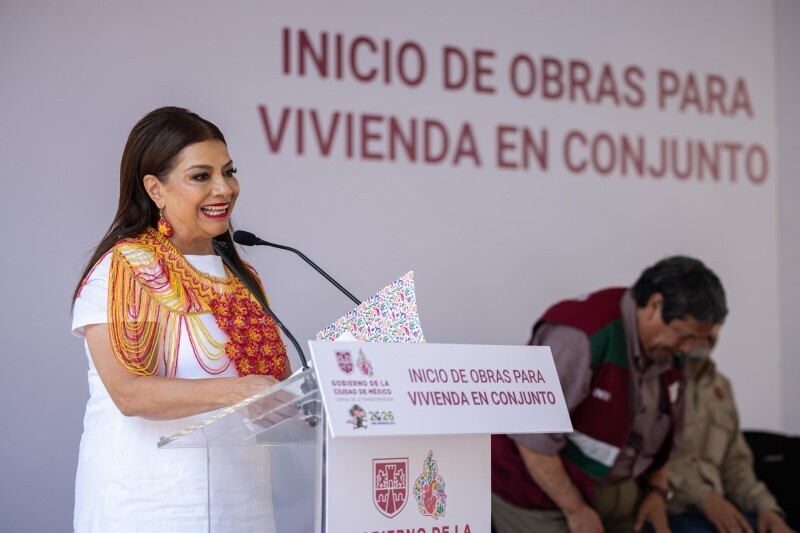
Head of Government Clara Brugada announced the construction of adequate, affordable, dignified, and reasonably priced housing in Mexico City, well-connected and below market value. She detailed that these buildings will be part of the 200,000 housing units her administration will carry out by 2030 across the national capital. This Tuesday, the Head of Government, Clara Brugada, initiated the construction of 250 homes in the Colonia Guerrero and the Historic Center. The investment for this project will be one billion pesos and aims to benefit 900 people within a year. Simultaneously, Brugada announced that her government will build 4,500 homes in the Historic Center during 2026. The Head of Government announced a series of measures to address one of the main demands of the local population: access to housing. "We want to build social housing in the center, we have to combat gentrification and depopulation that the Center has had," she added, stating that the homes will be "environmentally friendly" as they will include solar panels and rainwater harvesting systems. Finally, the Head of Government confirmed that next week she will send to the local Congress the law of fair, reasonable, and affordable rents that she announced last year following the first protests against gentrification. "Their objective is to guarantee better housing and a dignified life for the population," she assured. Since last year, a series of protests against gentrification—especially led by youth—access to housing has become one of the most important issues for the capital's government. "The great dream is that we live 15 minutes from work, from the most comprehensive public spaces, and we don't lose so much time due to distance," declared Brugada, ensuring that these policies seek to combat "poverty in general and recover family time for families." An ambitious plan that seeks to address one of the main demands of the population, especially young people for whom it is increasingly difficult to access their own home. The plan will face the evictions of local communities from a legal standpoint, with a cap on rent increases below the inflation level, the creation of a tenant's ombudsman, and the regulation of digital short-term rental platforms. Two months before the World Cup, Brugada highlighted a 6% decrease in high-impact crimes. In this way, Brugada seeks to address a demand that has grown in recent times and seems far from being solved in the national capital due to the increase in international tourism and the arrival of the World Cup starting in June. In Colonia Guerrero, the former mayor inaugurated the works and the rehabilitation of 250 homes, which will be part of the construction of a total of 4,500 houses located in the Historic Center. However, there are differences within the ruling party and pressures from various sectors, which is why the announcements of this Tuesday were postponed on more than one occasion, as a government source recognized to this publication. Tabe demands more resources for the World Cup, but CDMX dismisses it: "The budget is enough". On the one hand, this Tuesday Brugada, along with the Secretary of Housing, Inti Muñoz, announced the rehabilitation and construction of 250 homes on five different plots located between Colonia Guerrero and the Historic Center. This is an important issue for the 4T and especially for the former mayor of Iztapalapa, who began her political career in social movements in favor of dignified housing in San Miguel Teotongo. It is also one of the main demands of the youngest sectors of the population, who suffer daily from rising rents and the eviction of their families or communities in the historic colonies of the capital. In this context, these announcements are made, seeking to address the problem and the construction and rehabilitation of new units and a new legal framework. These lands, the authorities detailed, were damaged in the 1985 earthquake but never managed to enter a renewal or reconstruction program.