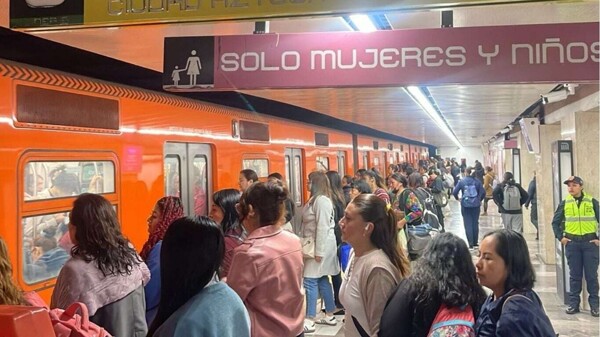
Users, in general, do not take care of the trains, they mistreat them, and prevent the doors from opening,” stated in an interview with Ciro Gómez Leyva this Wednesday, April 15. Rubalcava explained that this type of action directly impacts the operation of the capital's Metro service, as any damage can take trains out of circulation.
“If we have a train whose door is damaged, it is no longer in condition. And this has been accumulating a number of trains that we have to go repair,” he explained.
Adrián Rubalcava admits that investment must be increased for the Mexico City Metro. The head of the Metro emphasized that, in addition to wear and tear from use, it is necessary to increase investment to improve the conditions of the Collective Transport System and recover the reliability it had previously. Therefore, he detailed that more than 55 billion pesos have been allocated to projects such as the modernization of Line 1, as well as resources for Line 3, which in its first stage involves an investment of 5 billion pesos.
Rubalcava explained that one of the main agreements is to allocate greater resources to comprehensive maintenance, not only of the trains, but also of the infrastructure. This includes work on tracks, electrical systems, track alignment, ballast and sleeper replacement, as well as the inspection of components that may be affected.
He also highlighted the need to modernize trains with many years of service, starting with systems such as automatic piloting, key mechanical components like the bogie, differentials, and traction axles.
“The Metro is evolving; it evolves on Line 1, but we find lines like Line 3, where the condition of the trains is not the best,” he noted.
Finally, he warned that this process requires considerable investments, as each train has different needs: “All this is not contemplated in a small budget, it is a very large budget. A train with an open door cannot be in circulation,” he emphasized.
In addition, the Metro director added that failures in key systems such as automatic piloting have also been detected, which has forced the withdrawal of trains for review in workshops.
“If we have a problem with automatic piloting because there is a failure, because the systems no longer match, we have to review it when that train arrives at the workshop. The director of the Collective Transport System (STC) Metro, Adrián Rubalcava, explained that part of the deterioration presented by the trains in the capital's transport is due to the daily use by users, who, he said, do not take care of the units.
“Let's add the daily deterioration. We have to start thinking: this train is missing this thing, this train is missing that other one”.