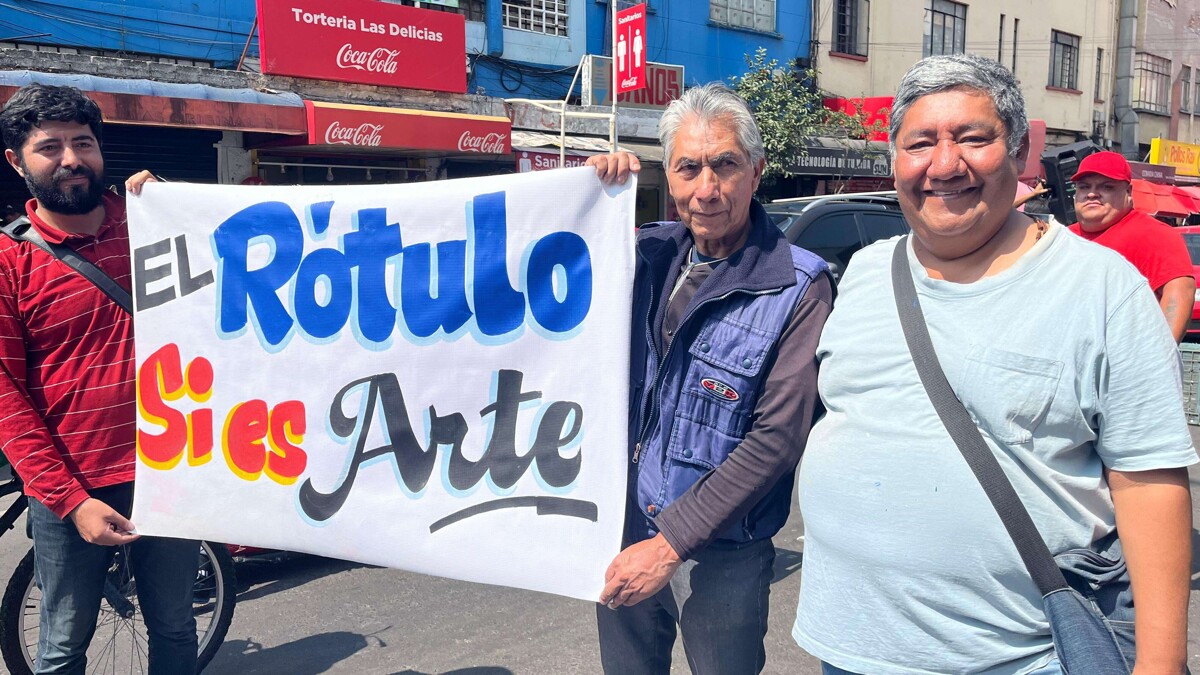
There are those who have decided not only to preserve it, but to bring it into the realm of contemporary art. This is precisely what Mexican artist Alfredo Romero proposes, whose practice revolves around the research, documentation, and re-signification of the traditional sign as a living visual language. His most recent work starts from something concrete: the recovery of an original Corona sign, intervened based on its natural wear, its layers of history, and the symbolic charge accumulated over decades on the skin of some anonymous city wall. The piece is not a recreation or a nostalgic quotation. Before the existence of vinyl cut, printed canvas, or neon signs, the facades of Mexico spoke through the brush. Practiced in the country since the early 20th century, sign painting is the craft of designing and painting simple commercials, full of color and ingenuity, where images coexist with varied typography on the walls and glass of stores, taquerías, fondas, and all kinds of local businesses. What began as a neighborhood advertising solution became, over time, one of the most authentic and recognizable visual languages of Mexican urban culture. However, the arrival of digital design and mass printing progressively displaced them. Today, signs are victims of a sort of cultural asepsis in which authorities have privileged visual strategies oriented towards tourism and the homogenization of the city. Despite everything, the craft resists. It is the result of a research, rescue, and restoration process that goes beyond material conservation: it proposes the re-signification of the object as a cultural document. Through it, Romero puts the past and present of Mexican graphic design in dialogue, rescuing the value of error, the mark of time, and the irreplaceable hand of the sign painter, that figure that was invisible for decades to the formal circuits of art. Demasiado Fino: the street enters the gallery The piece is presented within Demasiado Fino, a collective exhibition organized by MEXICO IS THE SHIT and TODOBIEN ESTUDIO that brings together artists who work from popular graphics, applied art, and the intersections between design, street, and visual culture. The event takes place at Mérida 151, Local B, Colonia Roma Norte, one of the neighborhoods that best embodies that constant tension between the popular and the contemporary in Mexico City. The sign adds more than 500 years of presence in Mexico, from colonial markets to the pulquerías of the Porfiriato and the cantinas of the post-revolution, and there is currently an initiative for the sign painter's craft to be declared Intangible Cultural Heritage of Mexico City. And when the city begins to recognize, even if belatedly, what was on the verge of being erased.