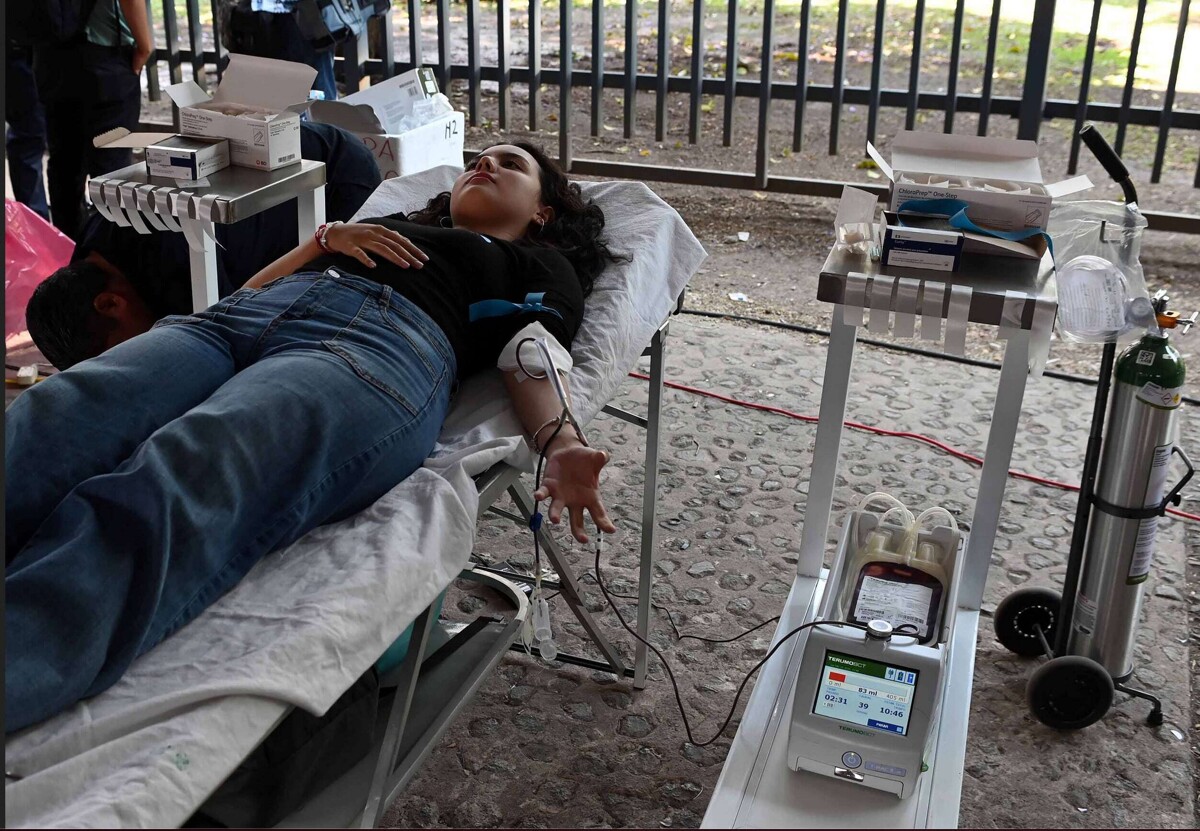
The National Autonomous University of Mexico (UNAM) has launched a blood drive at Ciudad Universitaria, in a context marked by the structural deficit of altruistic donation in the country, where less than 10% of donations are made voluntarily. The campaign, set up at Las Islas and running until this Thursday, the 26th of the current month, aims to mobilize the university community and society in general to strengthen the availability of blood in the health system, an essential resource for specialized medical care.
Altruistic Donation Deficit in Mexico In Mexico, blood donation continues to depend predominantly on replacement schemes, meaning that relatives or acquaintances must meet the requirement for a patient to access medical services. This model contrasts with international recommendations that prioritize voluntary donation as the basis of a safe and sustainable system. During the inauguration of the drive, UNAM's Secretary of University Services and Community Attention, Fernando Macedo Chagolla, emphasized that the country faces low altruistic participation, which limits the constant availability of blood for medical procedures, surgeries, and highly specialized treatments. "Basically, it's said that less than 10 percent make altruistic donations," he noted.
Institutional Articulation and Operational Capacity The campaign involves specialized personnel from the Mexican Institute of Social Security (IMSS), as well as organizations such as the National Blood Transfusion Center (CNTS), IMSS-Bienestar, the National Transplant Center, and the National Pediatric Institute. According to university authorities, this articulation seeks to ensure that the donation process is carried out under first-class medical standards, with security protocols, clinical evaluation, and appropriate follow-up. UNAM's General Director of Health Care, Gustavo Olaiz Fernández, highlighted that the drive aims to attract at least a thousand donors in its first phase, a figure that corresponds to the operational capacity installed during the four-day event. Additionally, he announced that this strategy will be extended to the Higher Schools of Studies (FES) during the month of April, with the goal of expanding the territorial reach of the campaign.
Requirements and Call to the Public The National Blood Transfusion Center establishes that interested donors must be between 18 and 65 years old, weigh more than 50 kilograms, be in good health, and carry official identification. A minimum four-hour fast is also required, as is no recent consumption of alcohol or medication, and no tattoos in the last year. UNAM reiterated the call to its community and to society in general to participate in this drive, with the objective of increasing the number of voluntary donors and contributing to reducing the blood deficit in the country, a problem that continues to impact the health system's response capacity.