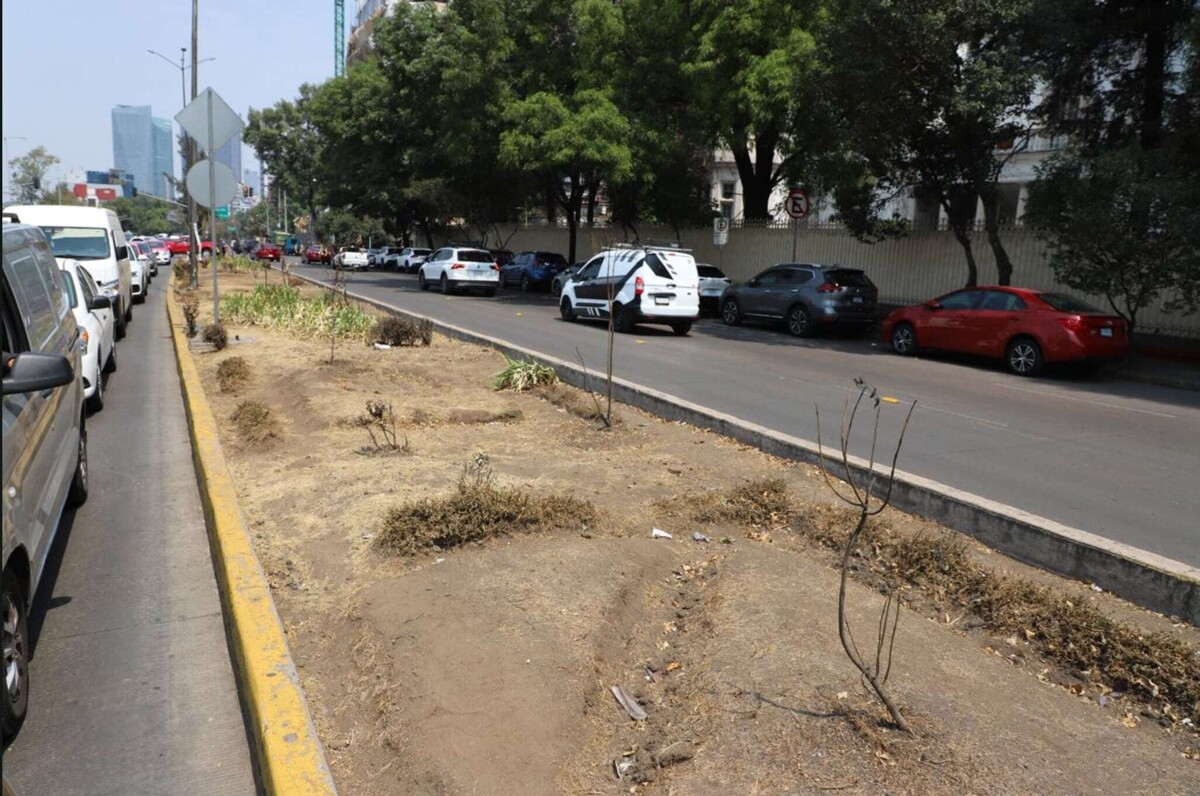
In parallel to these works, on the main avenues of the capital, dry medians, poorly maintained gardens, and green areas with visible signs of deterioration persist. The backlog can be observed on high-traffic roads such as Paseo de la Reforma, Periférico, Circuito Interior, Avenida Chapultepec, and Insurgentes, where several sections present dry vegetation, areas without continuous plant cover, and gardens with irregular maintenance. Although the Government of Mexico City, through its head of government, Clara Brugada, has announced last-mile interventions, hydraulic rehabilitation, and improvements in priority environments, the condition of some medians and green areas shows that ordinary maintenance remains pending in various parts of the city. Specialists have warned for years about the importance of urban greenery not only in landscape terms but also environmental ones. These are spaces that are part of the city's daily landscape and affect both the urban image and the environmental function of highly trafficked corridors.
Deterioration of green areas on key avenues Regarding this situation, the collective Más Verde—made up of residents, environmentalists, and people interested in caring for the environment—has pointed out the lack of sustained maintenance in these areas. In several points of the capital, the deterioration of these spaces is already visible and places the topic on the table regarding the scope of urban preparation for the tournament. “It is not just about intervening in specific points heading to the World Cup, but about guaranteeing the permanent care of the green areas that are part of the daily life of the city,” expressed the collective. The situation occurs in parallel to the official discourse on the recovery of public space, green infrastructure, and urban improvement associated with the capital's preparation for the international event.
UNAM has pointed out that green areas contribute to regulating temperature, capturing water, mitigating socio-environmental impacts, and improving the quality of life, in addition to their distribution in the city being unequal, which makes their conservation in areas with less access to public space relevant. In this context, the maintenance of medians, gardens, and green corridors takes on additional weight heading to the 2026 World Cup, where the general state of the main avenues will also be part of the city's urban image. With the start of the 2026 FIFA World Cup scheduled for June 11, 2026, Mexico City is continuing infrastructure, mobility, and urban image works on strategic corridors and in the environment of the Azteca Stadium, venue for the opening match.