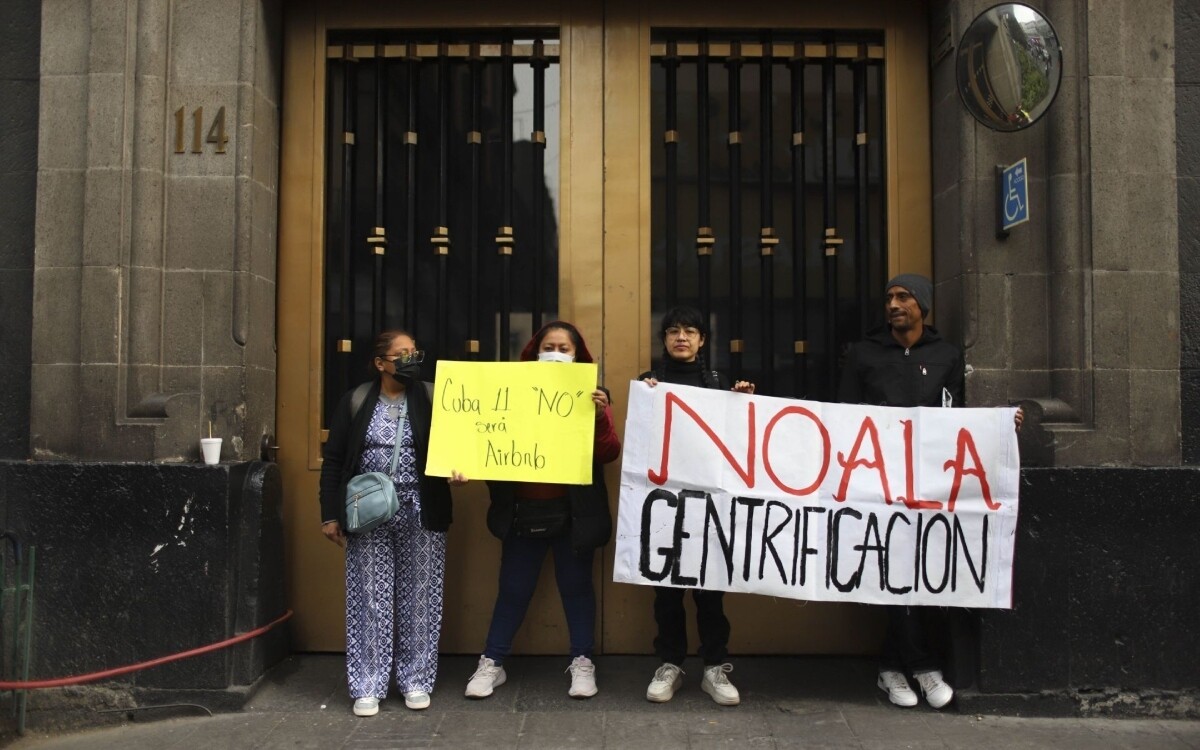
Dozens of people blocked the Supreme Court headquarters on Monday to secure the postponement of the discussion of a project that protesters accuse of 'legitimizing' forced evictions that are increasing ahead of the 2026 FIFA World Cup. After nearly four hours of blocking all access to the highest court, the members of the Court announced in session the withdrawal of the discussion of the project in question, led by Minister María Estela Ríos González. 'It has already been canceled, but (...) what we are asking is that the direction of the project be re-evaluated,' stated Arturo Aparicio, a legal advisor to evicted residents in several areas of the capital. This project arose in response to the unconstitutionality action 73/2019, filed seven years ago by the Mexico City Human Rights Commission, against the elimination of a series of guarantees in eviction cases. Those guarantees were contained in Article 60 of the Constitutional Law on Human Rights and its Guarantees of Mexico City, which came into force in February 2019 and was amended in May of the same year. Aparicio emphasized that his main demand is 'to return to the original wording of Article 60 so that there are no more evictions in Mexico City that violate human rights.' Eduardo Alanís, an activist with the Anti-Gentrification Front, argued that the mentioned project seeks to 'legitimize' arbitrary evictions by validating that current legislation is 'constitutional,' even though it allows expulsions without guarantees, such as a prior trial. 'That project turns its back on us who live in this city and is in favor of real estate companies (...) All of this is happening because of five World Cup matches (that will be played in Mexico City),' stated Alanís. Before entering the Court with a delegation of neighbors and activists to dialogue with the ministers, Aparicio reiterated the demand that the Supreme Court recognize that the 2019 reform 'violated the principle of progressivity and not regressivity.' The lawyer clarified that this does not mean that individuals will lose their property, but that there must be 'real legal guarantees' for tenants, such as prior notice of eviction and the right to be heard in a trial. Rufina Galindo, who was evicted from her home in the Historic Center in 2023, called on the first Court elected by popular vote in Mexico to prioritize the interests of the citizenry. 'I ask our authorities, the ministers who were elected by the people, to think of the people, who are the ones who need them (...) to fight for their rights for a dignified home,' she emphasized. Among other impacts, the 71-year-old woman warned that evictions are 'traumatic' and leave 'psychological scars' and fear of the authorities. The protest, which began at 8:00 local time, continued until 15:00, with a road closure in front of the Supreme Court, awaiting the exit of the delegation that entered to dialogue with the ministers.