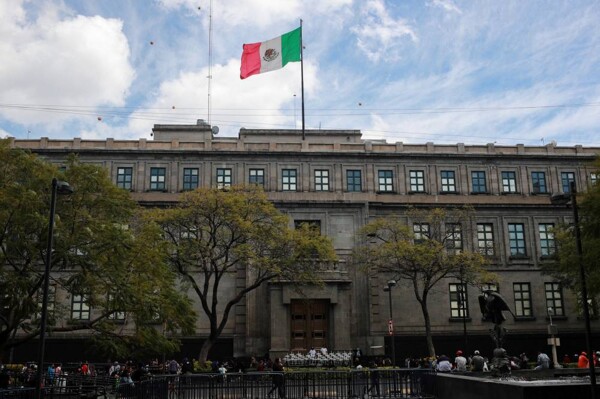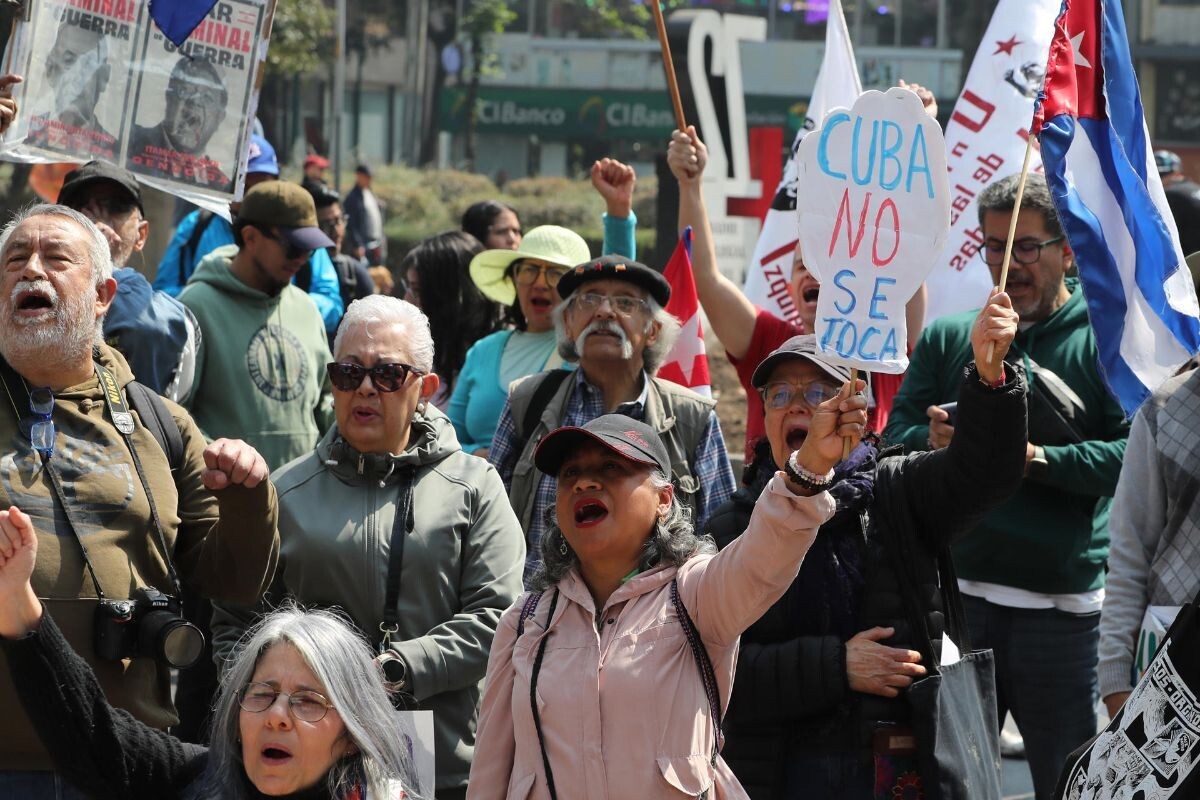
Hundreds of protesters gathered on Sunday outside the former U.S. Embassy in Mexico, in the Mexican capital, to protest against the tightening of restrictions from Washington towards Cuba and to demand that the country maintain its support for the island amid pressure from the U.S. government.
With flags, banners, and slogans, attendees told EFE that the objective was to express solidarity with the Cuban population and reject what they described as a policy of “suffocation.”
Several interviewees agreed that Washington's measures not only affect Cuban authorities but also the daily lives of the population, and noted that access to fuel impacts transportation, electricity, and the operation of basic services.
Aline Pérez, a member of the Mexican Movement of Solidarity with Cuba, stated that the blockade has direct consequences on fuel supply and hospital operations, and argued that the lack of energy and logistics can affect treatments and medical procedures.
“We have been calling on other organizations to express, first and foremost, support for Cuba, for the Cuban revolution. Now what they are saying is that they will fine anyone who wants to trade oil with Cuba, directly or indirectly. We are completely against this tightening of the blockade, the suffocation that (Donald) Trump is imposing on the entire Cuban people (...) he already has a naval blockade with Venezuelan oil. It is intolerable,” she expressed.
Isabel Pedro also participated in the protest, calling for strengthening solidarity with Cuba and repudiating measures she described as inhumane.
She considered Mexico's position to be insufficient and described it as “tepid,” although she said she understands the diplomatic implications, and therefore asked that actions be clearer to avoid interruptions in oil supplies or other support.
Pedro and Pérez also agreed that U.S. pressure on Cuba, in their view, is part of a broader policy affecting the entire Latin American region.
In her argument, Pedro stated that decisions about the island are connected to other international conflicts, and urged people to inform themselves and exert pressure through consumption practices, such as avoiding U.S. products or brands.
Another point of agreement among interviewees was the argument of a “debt” or gratitude towards Cuba for support provided in Mexico and other regional countries.
Pérez cited experiences of Cuban literacy campaigns and medical brigades in emergencies, as well as the presence of healthcare personnel in remote communities.
Along those lines, Angélica Cerón stated that it would be unfair not to support Cuba, mentioning the medical aid and the island's contribution to public health, and called for a “common front” from Latin America and the Caribbean.
Cerón argued that oil support should be understood as a humanitarian issue, associating it with energy and mobility, and said she agreed that Mexico should continue to support the island.
At the same time, Manlio Quiroz demanded a “firmer” stance against Washington's pressure, as he described U.S. policy as an abuse against Latin America, warning that the escalation of pressure could extend to other countries.
The protest comes after President Donald Trump warned of imposing tariffs on goods from countries that send oil to Cuba.
On Saturday night, the U.S. president also stated that he had directly asked President Claudia Sheinbaum to halt crude oil shipments to the island, after Mexico became the main source of energy support for Cuba.
In this context, Sheinbaum refused to discuss the matter directly with Trump and announced that her government is preparing to send humanitarian aid “in a week,” including food and basic products; while seeking to “diplomatically resolve” the resumption of oil shipments to Cuba.