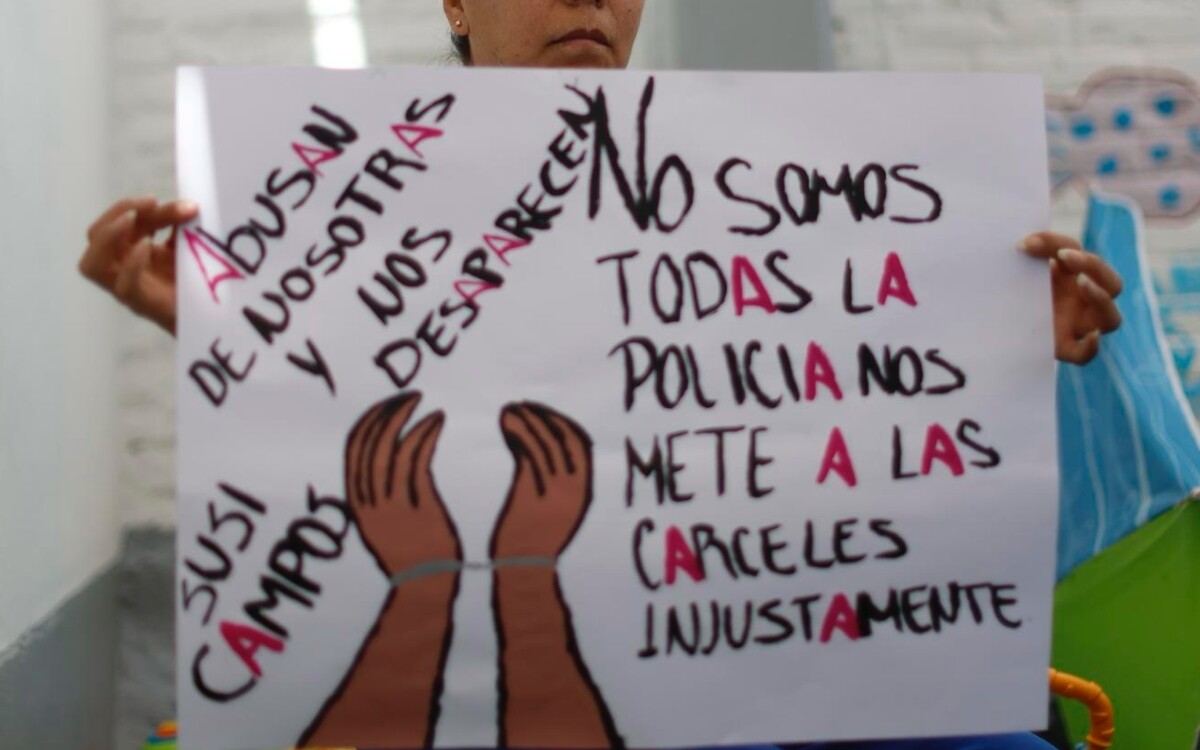
Women deprived of liberty will march on March 8th in the streets of Mexico City to denounce the violence, neglect, and inequalities they face within the justice system. “They unjustly lock us up, abuse us, and make us disappear,” says Susana Campos, an inmate at the Barrientos Penitentiary in the State of Mexico, as she proposes a slogan she will draw on a cardboard with her fellow inmates. Although they cannot march, a group of women from various prisons across the country is preparing posters that will be carried through the streets on 8M by members and allies of the organization La Cana. Susana Pérez recalls that when Claudia Sheinbaum won the presidency of Mexico in October 2024, several women in the prison listened with hope to her phrase, “We all arrived.” “But we haven't seen her lean towards the prisons,” she points out. Although some participated in the first elections in penal institutions, they say they still do not feel heard by the president, whose crocheted figure by participants in La Cana's workshops is one of the best-sellers. The idea of Campos materialized in a poster with handcuffs and the phrase: “We are not all. Neither oppressed nor oppressors!”. Campos explains to EFE that the slogan summarizes what she considers an unfair process, as the police “see someone passing by” and says, “Well, I’m taking them,” as was her experience. “I was framed. No one sees it,” shares the woman who claims she was violated during her arrest and has been waiting for a sentence for 21 years. On another poster, several women draw a woman with a blindfold, surrounded by phrases like: “Your Honor, how do I prove my innocence if you don't hear my voice?”. “They listen to the accusing side, they listen to the police, but not to us,” says Yajaira Arredondo, who also claims to have suffered violence during her arrest: “They beat me, they kept me blindfolded, and they didn't even know if I was guilty or not.” Like Yajaira, Janeth López believes that women face an additional stigma in the judicial system and that in some cases, sentences respond more to social pressure than to conclusive evidence. “That they really investigate the accusations and that the right to be considered innocent until proven otherwise is upheld,” she demands. All agree that when a woman commits a crime, she also faces a social trial for not fulfilling the role “expected of her,” and that men usually receive lesser sentences and wait less time for a verdict. According to La Cana's 2025 report, 46.3% of women deprived of liberty in Mexico do not have a final sentence—nearly 10 percentage points more than men. Furthermore, although they represent only 5.9% of the country's prison population (13,985 women), seven out of ten do not receive visits. Some also denounce that the justice system does not act when they or their families are victims. María Eugenia Bustamante, who has been without a sentence for four years, has been searching since 2023 for her 19-year-old daughter, Jessica Chávez Bustamante, who disappeared in the State of Mexico, and affirms that the investigation into the case has not advanced. “We are looking for you, Jessica,” will be another of the signs that La Cana will carry this 8M, in a country with more than 133,000 disappeared persons, of which 25% are women, and more than half under 24 years old, according to official figures. For the organization's co-founder, Mercedes Becker, taking these messages to the streets on 8M is also a way to “raise our voice for women deprived of liberty, who are often the most forgotten populations, but who also endure very significant violence.”