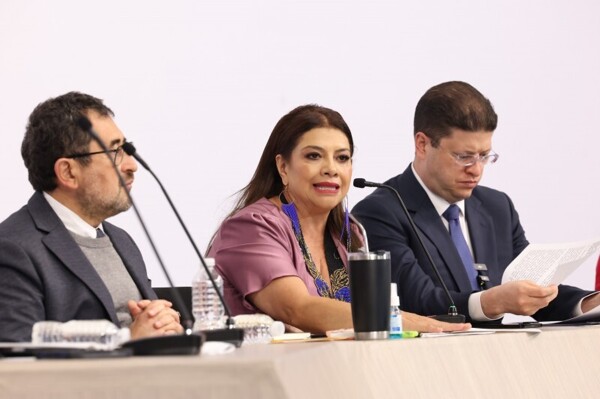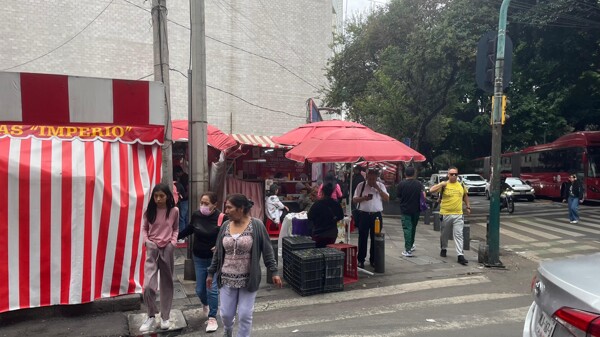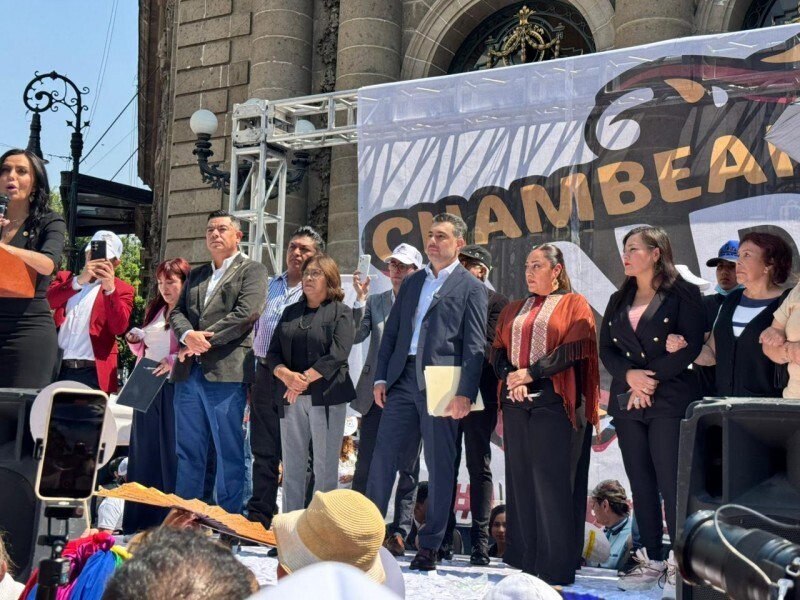
We are going to take our place, the place of pride and dignity because we are honorable people who work and generate economy for this city," stated Sánchez Barrios, who announced that street vendor organizations will do so "peacefully, organized and in accordance with the law because the initiative presented is not to take anything away from anyone, but to recognize what already exists." "Today we are here because this struggle is still alive," she emphasized from the steps of the local Congress, where she led an event attended by dozens of street vendors who gathered to support the initiative. As LPO could find out, the proposal that the deputy presented this Tuesday seeks to "recognize street vending as dignified work" within the right to the city with a clear legal framework that allows it to have rights and obligations. "This city does not rise by itself, it rises every day with the work of popular commerce," assured the legislator. In recent times, street vending of various goods and products in different areas of the City and the Historic Center has become a challenge for the government of Clara Brugada. "Crime is indifference, inequality and wanting to erase those who sustain this city," she added. In this way, the ruling party is analyzing the proposal at the Palace of Donceles together with the Head of Government to determine if it will finally move forward or discard it again. In the previous Legislature, it was also presented, but it did not prosper. The same would happen with the current approach to "public space", which would stop addressing it solely as a transit area to allow its use as a space for "work and livelihood." This Tuesday, Diana Sánchez Barrios mobilized dozens of people to the Palace of Donceles. The initiative would modify some existing regulations, such as the right to the use of public roads, which would also recognize the economic and social development of citizenship. "Working is not a crime, seeking a livelihood is not a crime, selling on the street is not either," said the deputy, an ally of Morena in the Palace of Donceles, who this time hopes for better results. The government of CDMX led by Clara Brugada seeks to advance on one of the demands and most important challenges of recent years: street vending. This generates an intention in the ruling party to regulate the activity and reach agreements with the different sectors involved. After the tensions, Rojo de la Vega and Brugada smoothed things over in a meeting. It is in this context that the reform promoted by Sánchez Barrios re-enters, which is already known as "Chambeando Ando." "Vendors are hardworking and honest people," she completed. For now, sources from the ruling party in the Palace of Donceles highlight that it is a proposal that has the almost unanimous support of the organizations that bring together popular commerce, which could facilitate its treatment and the search for a solution to a problem that demands attention and responses from the central government. During this same event, the coordinator for Morena, Xóchitl Bravo, announced that the 4T will hold "work tables to be able to generate conditions to legislate" in coordination with the involved organizations. In this framework, the Morena parliamentary group began to analyze this Tuesday a constitutional reform presented by the sector leader and deputy for the 4T, Diana Sánchez Barrios, who seeks to recognize said activity as a formal, dignified job with regulations, benefits, and obligations in the national capital. "They did not count on one thing: popular commerce does not give up," she said. In these months, the activity has grown considerably, which has generated citizen complaints in different colonies and from private sector organizations. "We have a commitment and that is not to fail the people because you put us here to legislate and we are always going to do it hand in hand with the people," emphasized the deputy from Tlalpan, who announced that her bloc "is going to defend the right to dignified work of the people." "We are no longer going to ask for permission to exist." In addition, an operation led by the mayor of Cuauhtémoc, Alessandra Rojo de la Vega, ended with violent incidents and mutual complaints.