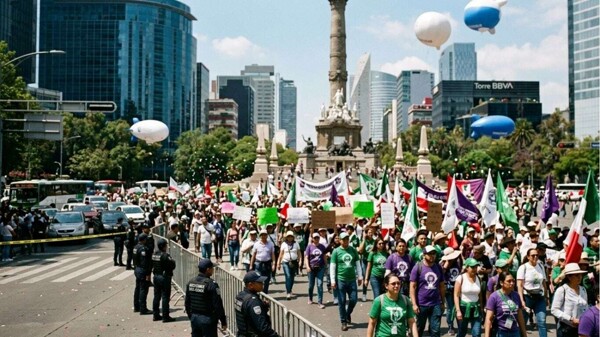
The Mexico City Human Rights Commission (CDHCM) considers that the decision of the United Nations Committee on Enforced Disappearances to request that the situation in Mexico be brought before the United Nations General Assembly opens an opportunity to strengthen a comprehensive state policy against the crisis of disappearances. In a statement released on Saturday, the body indicated that this process "sets conditions to strengthen dialogue and cooperation to consolidate a comprehensive state policy," with the participation of families, better articulation between government levels, and effective results in search, investigation, and victim care. The CDHCM emphasized the seriousness of enforced disappearances as human rights violations and the need to reinforce state actions to guarantee "truth, justice, and measures of non-repetition" in a context it described as an urgent challenge. For the CDHCM, this scenario requires a "comprehensive, articulated, and sustained" public response, with a systemic vision that addresses the complexity of the phenomenon and strengthens coordination among different levels of government. The capital's body reaffirmed its commitment to contributing to institutional strengthening and addressing structural causes, with the goal of ensuring "the dignified and just return of all disappeared persons to their homes." The position comes after the UN Committee reported on April 2 its decision to submit the Mexican case to the General Assembly through the intervention of the Secretary General, after activating Article 34 of the International Convention for the Protection of All Persons from Enforced Disappearance. In its resolution, the Committee concluded that "there are well-founded indications that enforced disappearances have been and continue to be perpetrated in Mexico as crimes against humanity," by identifying persistent patterns of violence, structural impunity, and possible links between authorities and criminal groups. However, the international body itself clarified that it did not find evidence of a federal policy aimed at committing these crimes, although it did document cases with the direct or indirect participation of public officials. In this scenario, the CDHCM considers that the Committee's call creates a juncture for a "constructive and participatory dialogue," aimed at generating new routes of collaboration in the face of problems such as impunity and the lack of protection for victims. "The context of disappearances that the country is going through requires maintaining an open disposition to scrutiny and cooperation," the body stated, highlighting the role of international human rights mechanisms in this agenda. The Commission recognized advances in Mexico City, such as coordination efforts between the Search Commission and the capital's prosecutor's office, although it warned that these must translate into concrete results. The body also indicated that it maintains active files related to immediate search, due diligence, forensic capabilities, and victim care, in addition to having issued recommendations on the matter. The Committee's decision has generated diverse reactions. The Government of Mexico, through a joint communiqué from the Secretariat of the Interior and the Secretariat of Foreign Affairs, rejected the report, considering it "biased" and accused it of omitting recent institutional advances. The federal government pointed out that the international procedure does not correspond to the current reality of the country and defended the reforms implemented since 2019, including mechanisms such as the National Search Alert, the strengthening of the National Forensic Data Bank, and the creation of identification platforms. In the same vein, the National Human Rights Commission (CNDH) also rejected the Committee's conclusions, considering them based on a partial interpretation and that national mechanisms were not exhausted before resorting to international instances. It also questioned the Committee's consistency in pointing, on one hand, to the absence of a systematic federal policy, and on the other, to the existence of patterns that could constitute crimes against humanity. In contrast, organizations such as Amnesty International backed the Committee's decision and called on the Mexican State to accept international cooperation, warning that the crisis of disappearances affects more than 132,000 families in the country. The Committee recognized the State of Mexico's normative efforts, but concluded that they have been insufficient in the face of a problem that continues to grow, including the increase in victims and the forensic crisis. In this context, it proposed that the General Assembly evaluate mechanisms for technical cooperation, specialized assistance, and financial support to strengthen the search, identification, and investigation of cases, as well as the protection of families and accompanying organizations.