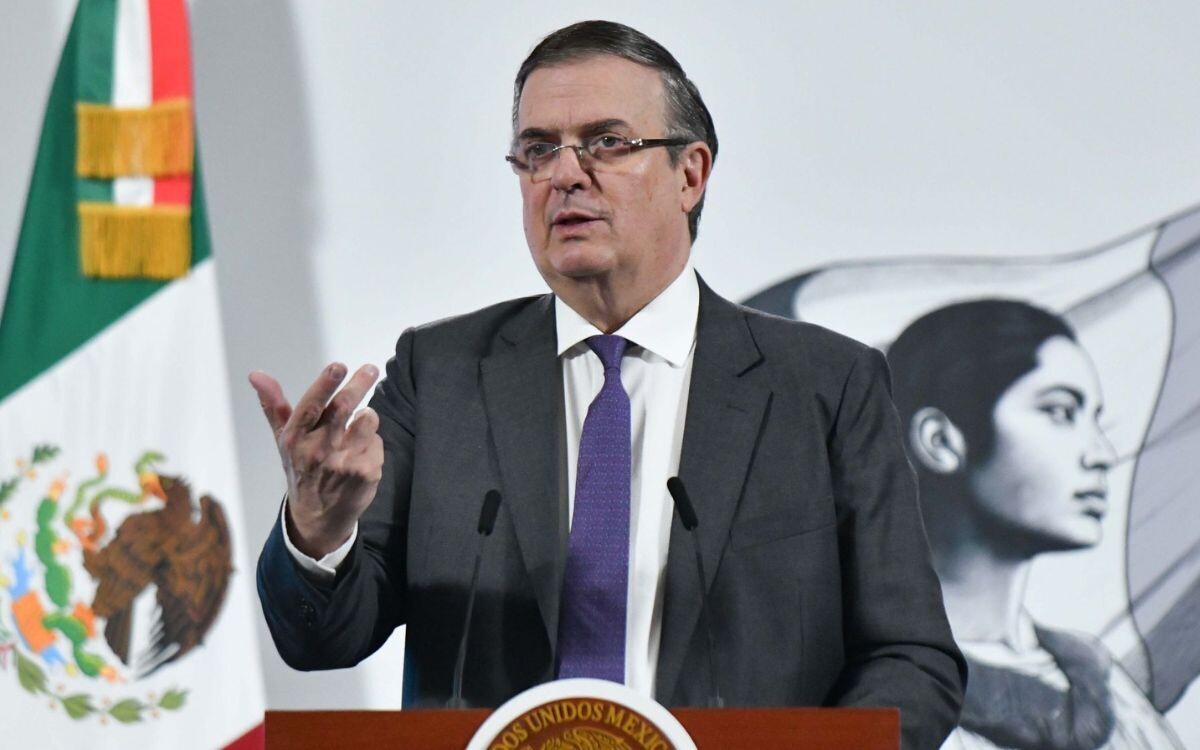
The Secretary of the Economy, Marcelo Ebrard, explained in the morning conference the scope and objectives of the tariff package sent to the Congress of the Union by President Claudia Sheinbaum. This package was approved after a process of discussion and adjustments with sectors, and he reiterated that it is not specific to any Asian country.
According to the official, the measure aims to combat unfair competitive practices that have affected various industrial sectors, and “protecting 350,000 jobs in Mexico is the ultimate goal,” he said during the presidential morning conference.
It was the subject of a long process of discussion, review, and final approval with a series of adjustments. Ebrard indicated that the decision came in response to the “insistence of the textile and garment industry, the footwear industry, the steel industry, and now also the automotive industry,” sectors where employment impacts have been observed.
He clarified that it is not a lack of competitiveness, but rather imports priced below international reference prices.
“There is no level playing field, and when the playing field is uneven, you have to correct, remedy that disadvantage or that injustice,” he said.
The secretary detailed that in the last two years, steel imports grew by 12.4%; imports of clothing, including digital platforms, by 20.8%; and footwear imports by 22.3%.
In the case of the automotive industry, the growth in imports was 34%, and he pointed out that “if this continues, by the end of 2026, along with the automotive industry, we would be losing 350,000 jobs,” he warned.
Regarding this sector, he recalled that Mexico is the world's fifth-largest vehicle producer and emphasized its weight in employment, saying that “the automotive industry is one-third of the jobs in Mexico's manufacturing.”
He added that the strategy of some companies is to “sell below inventory or cost to gain market share and then raise prices,” which displaces national production.
Ebrard specified that the package is not designed against specific countries, since “Mexico does not set tariffs on a country, the objective is not to charge more from a country that manufactures a certain product,” he explained.
He pointed out that tariffs are applied by product and only to imports from countries with which Mexico does not have a trade agreement.
“We do not have a geopolitical design, what we do is put a tariff to protect an industry in Mexico, it does not matter in which country it is produced,” he clarified.
He specified that Mexico does not have trade agreements with Russia, South Korea, China, India, Indonesia, Brazil, Thailand, Ukraine, and Turkey.
The official reported that 17 strategic industrial sectors and 1,466 tariff lines were identified.
Among the changes made during the legislative process, adjustments in auto parts, steelmaking, textiles, clothing, and aluminum stood out, in order to “avoid unwanted impacts.”
He also noted that there was dialogue with business organizations such as CONCAMIN, CANACERO, the automotive and auto parts industry, as well as with supermarkets and department stores.
In addition, communication was maintained with countries whose products could be affected, including China, South Korea, Indonesia, and India.
Ebrard assured that the inflationary impact will be limited and said that “we made a calculation of pressure per fraction and what we are estimating is that it will be more or less two-tenths,” he said, considering that “the cost is minor compared to the protection of employment.”
“Not to allow prices below inventory and cost” is, he affirmed, a priority.
Finally, he linked the tariff package to the Plan Mexico, whose objective is to increase national content in productive chains, strengthen the “Made in Mexico” brand, and increase national investment.
“Producing more in Mexico every time is to substitute imports and reinforce our supply chain,” he concluded.
In this regard, President Claudia Sheinbaum stated that the tariff measures were defined in coordination with the productive sector and through international dialogue.
“They are taken in agreement with different business or industrial sectors in our country, from small to large, to strengthen employment and the development of Mexico,” she pointed out.
She added that the federal government has maintained communication with other countries, and mentioned that “in all cases we have dialogue with South Korea, with China, with Vietnam; well, Vietnam is part of another trade agreement that Mexico has, but with all countries we are in practice in contact.”
The head of state indicated that these conversations have been held directly, even during recent tours, such as the one carried out over the weekend in Chihuahua.