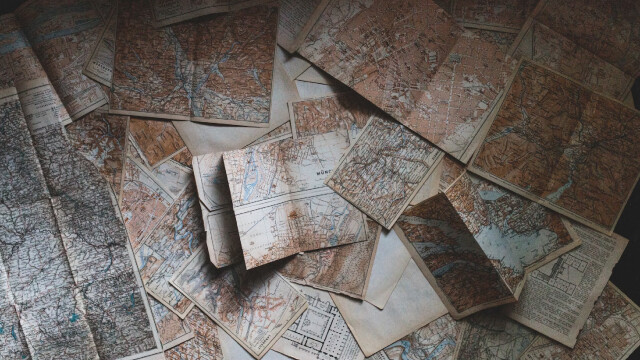
Without maps, people would have to rely on natural references such as the sun, stars, relief, or rivers, but this would require a much higher level of attention and learning. Navigation would be local and limited. Getting quickly to a specific place would be a skill reserved for a few who know the environment in depth. Geographic knowledge would disappear.
Maps not only indicate paths; they also explain the world. They are tools that condense knowledge, reduce uncertainty, and expand human possibilities. Maps not only show us where we are, but they also allow us to decide where to go, both literally and symbolically. Below is a deep, realistic, and human analysis of how the world would be if maps had never existed.
Human navigation without maps Before maps, navigation depended almost entirely on memory, observation, and direct experience. The relationship with the environment would be more intimate and direct. This world without maps would not necessarily be worse, but it would be radically different—slower, more local, and more dependent on human contact.
The invisible value of maps The existence of maps is often taken for granted. Without them, progress, cooperation, and global understanding would be much more limited. Thinking about a world without maps is actually an invitation to recognize how much they influence our way of living, moving, and understanding the world we inhabit.
Authority over a territory would be based more on physical presence than on formal agreements. Collective identity would be more local, less tied to a nation, and more to the immediate community.
Knowledge transmission Without maps, spatial knowledge would depend almost entirely on oral tradition. From daily commutes to how we understand the planet, maps are so integrated into our lives that we rarely stop to question their absence. Thinking about a world without maps is imagining a reality profoundly different from the one we know.
Without maps, many innovations simply would not exist. Territorial planning, the efficient distribution of food, disaster response, and infrastructure development would be slow, imprecise, and costly processes. Even common concepts like globalization or the digital economy would be unthinkable without a clear representation of physical space.
Identity and territorial power Maps also fulfill a symbolic and political function. They define territories, boundaries, and belonging. The idea of a shared planet would take much longer to consolidate. This would have a direct effect on education.
Comparison: world with maps vs. world without maps Key aspect | With maps | Without maps --- | --- | --- Orientation | Precise and accessible | Limited and subjective Travel | Fast and safe | Slow and risky Trade | Global and efficient | Local and restricted Education | Visual and structured | Oral and fragmented Technology | Advanced and connected | Basic and isolated Urban planning | Ordered and strategic | Chaotic and reactive
Daily life without maps Simple activities like visiting someone, finding a new business, or planning a route would be daily challenges. Directions as we know them wouldn't exist; the reference would always be relative and changing. This would affect basic services like medical emergencies, security, and transportation.
It's not just about sheets of paper with lines and names, but mental, cultural, and technological tools that structure how we move, learn, and organize as a society. The lack of maps would not only mean losing a visual reference; it would imply a complete transformation of concepts like orientation, territory, identity, trade, and knowledge.
Impact on travel and trade Without maps, long-distance travel would be extremely risky. Learning about other regions would be complicated, based on oral accounts and subjective descriptions, not clear visual representations.
Maritime navigation: an extreme challenge Navigating the open sea without maps would be one of the most dangerous activities. Thanks to them, we understand continents, oceans, borders, and scales. This would severely limit maritime exploration and contact between continents. The result would be a world where oceans act more as insurmountable barriers than as connecting bridges.
Technology without maps Currently, much of the technology depends on maps: from transportation apps to logistics, agriculture, and resource management systems. People with a good sense of direction would have a high social status. However, the stress of getting lost or arriving late would be constant, affecting productivity and emotional well-being.
Urban planning Without maps, urban development would be chaotic. Streets would grow organically, without a clear order, guided only by immediate need. Locating a hospital, a school, or a market would be complicated even for the inhabitants themselves.
Creativity and human adaptation Despite all the difficulties, humanity would find alternative ways to adapt. Life would become slower, but also more dependent on human interaction. Asking for directions would be an essential skill, and spatial memory would be valued as one of the most important abilities. Complex systems of signals, physical marks, and detailed narratives would develop to describe spaces. Creativity would emerge in the form of stories, songs, or rituals that help remember paths and places. Expressions like "walk until the air smells different" or "turn where the path becomes narrower" would be common, but also ambiguous. In this scenario, getting lost would not be an exception, but a frequent condition.
Consequences for knowledge and society The cumulative advance of knowledge would be much slower. The absence of visual records would limit human capacity to analyze, compare, and plan in the long term. Knowledge would be passed down from generation to generation, but this would make it vulnerable to distortions, losses, and reinterpretations. Each generation would have to relearn routes, locations, and spatial relationships from scratch. The consequence would be a fragmented world, where each region develops in isolation, with more closed economies and less diversity of goods. Products that we today consider common would be rare or nonexistent in many areas.