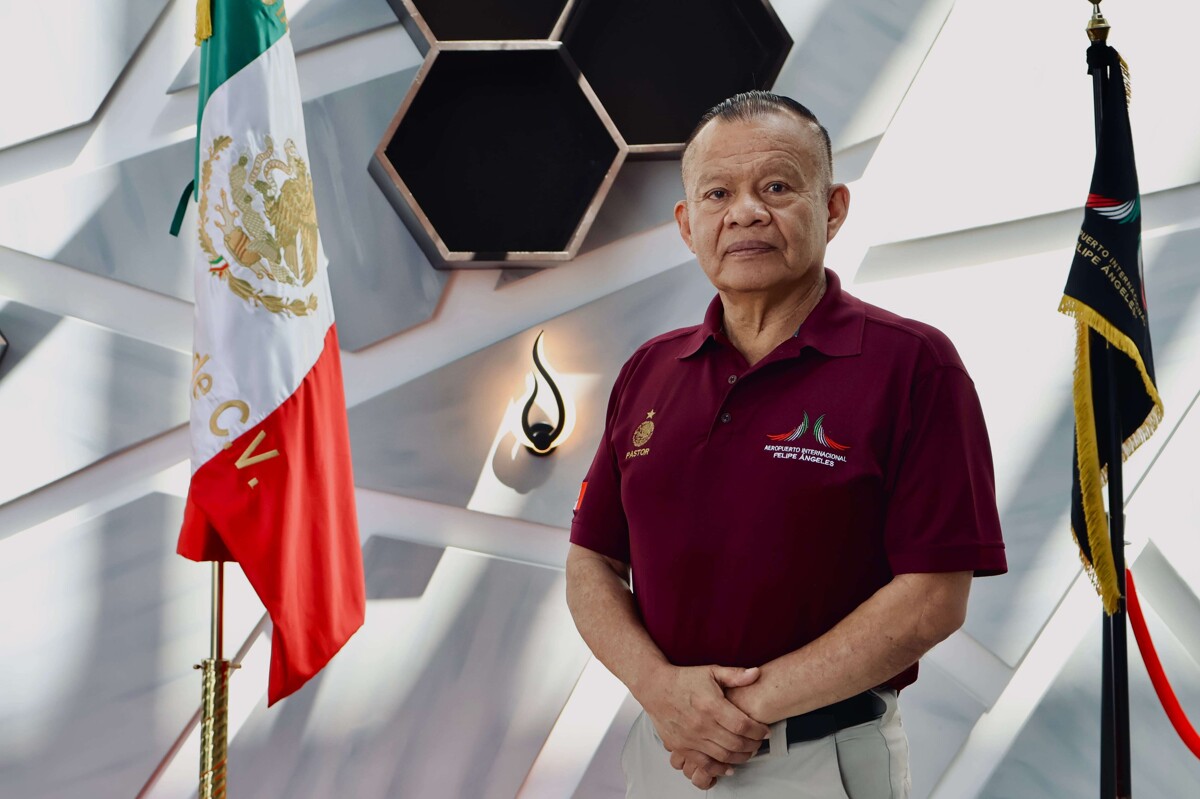
Since its opening in March 2022, the terminal has registered over 18 million passengers, while continuing to strengthen its operations and prepare for international events such as the FIFA World Cup 2026. In an interview with Publimetro, the general director of AIFA, Brigadier General Isidoro Pastor Román, spoke about the airport's progress, its positioning in passenger and cargo transportation in Mexico, as well as the challenges and opportunities the terminal faces in the coming years. Four years after the International Airport Felipe Ángeles began operations, what is your overall evaluation of the project? — As it is a public enterprise, we have internal and external oversight bodies. This information generated distrust among some users. However, with over 18 million passengers having passed through the airport since 2022, that perception has changed thanks to the direct experience of travelers. Today we have satisfaction levels between 93% and 95%, measured internally and also by the Airports Council International (ACI), which evaluates what happens in more than 2,000 airports worldwide. AIFA was recognized as one of the most beautiful airports in the world. Since then we have met the established requirements, particularly regarding the projection of passengers and cargo. In the Mexican Airport System, there are around 80 airports. What does this achievement represent and how is that distinction maintained? — We seek to permanently maintain the architectural design, cleanliness, maintenance, and presentation of the airport in optimal conditions, because we know that the passenger experience depends not only on the air operation but also on the environment they find upon arriving at the terminal. In 2024, the International Airport Felipe Ángeles received an international recognition that placed it among the six most beautiful airports in the world, which generated great curiosity among national and international travelers. Today we see that more and more visitors are coming to AIFA to tour the terminal, take photographs, and learn about the different services the airport offers. This demonstrates that AIFA not only functions as a transport infrastructure but also as a point of interest for those who wish to see a representative work of the country's airport infrastructure. What technological strategies are being implemented for AIFA to consolidate as one of the best airports in the region? — When we began operations, the airport's technological platform was unique in Latin America. We have a biometric system that allows the passenger to perform practically their entire travel process — from check-in to reaching the final waiting lounge — with minimal human interaction. In addition, we have baggage scanners that identify dangerous substances in seconds through the analysis of atomic weight and material density. This allows the security process to be faster and more comfortable for passengers, who no longer have to remove laptops, cables, or take off their shoes during the screening. How is AIFA's international connectivity being strengthened? — Currently, the airport has five regular international routes: Santo Domingo and Punta Cana, in the Dominican Republic; Bogotá, in Colombia; Havana, in Cuba; and Caracas, in Venezuela. In addition to these regular flights, we also operate non-regular or charter flights, which are usually scheduled for vacation seasons or for specific operations. Is AIFA ready for this event? — Since the start of operations, the airport has been prepared to handle large-scale international events like the FIFA World Cup 2026. For 2026, we project to mobilize around 8.3 million passengers, which represents approximately 40% of the airport's installed capacity, so we still have sufficient margin to handle an increase in demand. Furthermore, we have an agreement with FIFA, by which AIFA was selected as a host airport for special operations, especially for aircraft transporting delegations, heads of state, businesspeople, and visitors traveling on private aviation. What coordination exists in terms of security for this event? — The Ministry of National Defense has an entity specifically constituted for the World Cup, and we have been working in very close coordination with them, as well as with other security instances. The advantage of the airport is that we already have established protocols for this type of operation, because we have previously received heads of state and government. How will the airport be decorated for the World Cup? — In the coming weeks, FIFA will begin to place promotional elements related to the World Cup inside the airport. There will be giant soccer balls, jerseys alluding to outstanding players, and historical balls used in previous World Cups, which will be on display for visitors. What attractions can visitors find at AIFA? — We have three information modules inside the terminal building, where visitors can learn about the different options the complex offers. Among the main attractions are the Mammoth Museum, the Military Aviation Museum, and the exhibition of Historic Trains, located within the military city complex. Additionally, the airport has a public square similar to the Zócalo, where families can stroll and enjoy the environment, especially at night when the control tower and runways are illuminated. Finally, what message would you send to those who do not yet know AIFA? — We have a website where you can consult the social communication area's phone numbers to schedule guided tours of the airport. For those who do not yet know it, we invite them to visit it, either to tour its facilities or simply to enjoy its public spaces. This is an airport that belongs to all Mexicans. One of the entities that reviews how the airport is operating is the Federal Civil Aviation Agency. When we processed the paperwork to obtain the concession title —which later became an assignment— we presented a document called the Master Development Program. An example is the flight to Sofia, in Bulgaria, which is operated occasionally. Our objective is to continue strengthening international connectivity as passenger demand grows. How can passengers get to the airport? — We have two main access routes: the Mexico-Pachuca highway and the Mexiquense Outer Circuit, which connects with the Periférico Norte. There is also a third, less congested route, which passes through Puente de Fierro, in Ecatepec, and continues through Tonanitla, allowing arrival at the airport in approximately 10 to 12 minutes from that point. We also have public transportation through Mexibús, which connects with Ciudad Azteca and traverses areas like Ojo de Agua and Tecámac. Users can also reach Ciudad Azteca via Metro Line B and from there connect with Mexibús to the airport. In the coming months, the opening of the Lechería–AIFA section of the Suburban Train is also planned, which will allow travel from Buenavista to the airport in approximately 40 minutes. We are on the doorstep of the 2026 World Cup. In that program, the concessionaire commits to meeting goals and objectives. We have been meeting what was programmed each year, with the exception of the first year, when the airport did not yet have the organizational structure authorized by the Ministry of Finance and Public Credit and then the Ministry of Public Function. Once we had a redesigned strategic planning area, we redesigned the program to bring it closer to operational reality. With the results in passenger transport, we occupy seventh place among these terminals. In cargo transportation, since the last quarter of 2023, we have been in first place. In 2024, we consolidated with the handling of 447,000 tons of cargo, which confirms us as number one in cargo within the Mexican Airport System and number two among more than 360 airports in Latin America. What has been the biggest challenge you have faced at the helm of AIFA and what do you consider your greatest achievement so far? — The main challenge was to dis inaccurate information that was spread about the airport in its first months of operation. It was said, for example, that the airport was flooded, that the control tower was tilted, or that there were obstacles for air operations. Four years after its inauguration, the International Airport Felipe Ángeles (AIFA) is advancing in its consolidation process within the national airport system, driven by growth in cargo handling, route expansion, and the increase in the flow of travelers.