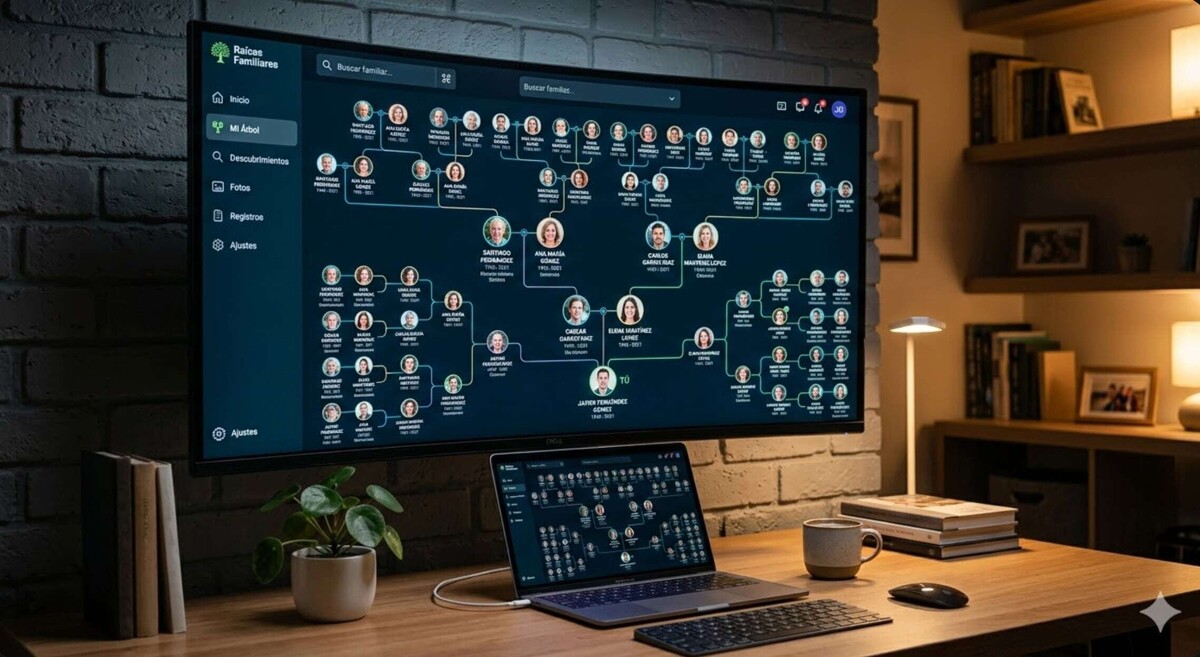
What once required time, resources, and specialized knowledge can now be started from home with the help of digital platforms and global collaboration. This phenomenon reflects a broader trend: while technology connects people with the present in an immediate way, it also drives us to look to the past to better understand individual and collective identity.
Family History at the Intersection of Technology and Identity At its core, the growing interest in discovering the origin of surnames reveals a deeper quest: to understand who we are and where we come from. In a country like Mexico, where identity is built from multiple roots, this exploration not only recovers forgotten stories but also opens new ways of connecting with the past in a completely digital era.
Behind many of these names lie stories of identity changes, family traditions, and connections that, over time, have been lost or transformed. For many people, reconstructing their family tree has become a tool to preserve family memory and better understand their place within that history.
Technology Drives the Search for Family Roots The development of digital tools has changed the way the past is researched. In a context marked by globalization and constant mobility, more and more people in Mexico are asking about the origin of their surname and the family stories that might be hidden behind it. What was once a task limited to physical archives or specialized research has today become an accessible search thanks to technology.
The interest in reconstructing family history not only responds to personal curiosity but also to the need to understand identity in a country characterized by cultural mixing, migrations, and encounters between different regions of the world.
Surnames in Mexico: Between Migration, History, and Memory In Mexico, surnames reflect complex historical processes that range from colonization to the most recent migratory flows. Currently, there are platforms that provide access to digitized historical archives, compare records, and connect information that was previously difficult to trace. This phenomenon was one of the main axes at international events such as RootsTech 2026, focused on genealogy and technological innovation, where the use of platforms like FamilySearch was highlighted, facilitating the exploration of the origin of ancestors.
What can you discover by researching your surname? The tools available today allow access to different levels of information about family history:
- Possible links with distant ancestors: through the comparison of historical and migratory records.
- Family and emotional patterns: knowing the past can help understand inherited dynamics.
- Construction of a family tree: with dates, photographs, and connections between generations.
- Historical documents and unpublished photographs: available thanks to collaborative databases.
- Options for nationality: some records can be useful in legal procedures to obtain another citizenship.
A Growing Trend in the Digital Age Access to these tools has democratized genealogy.