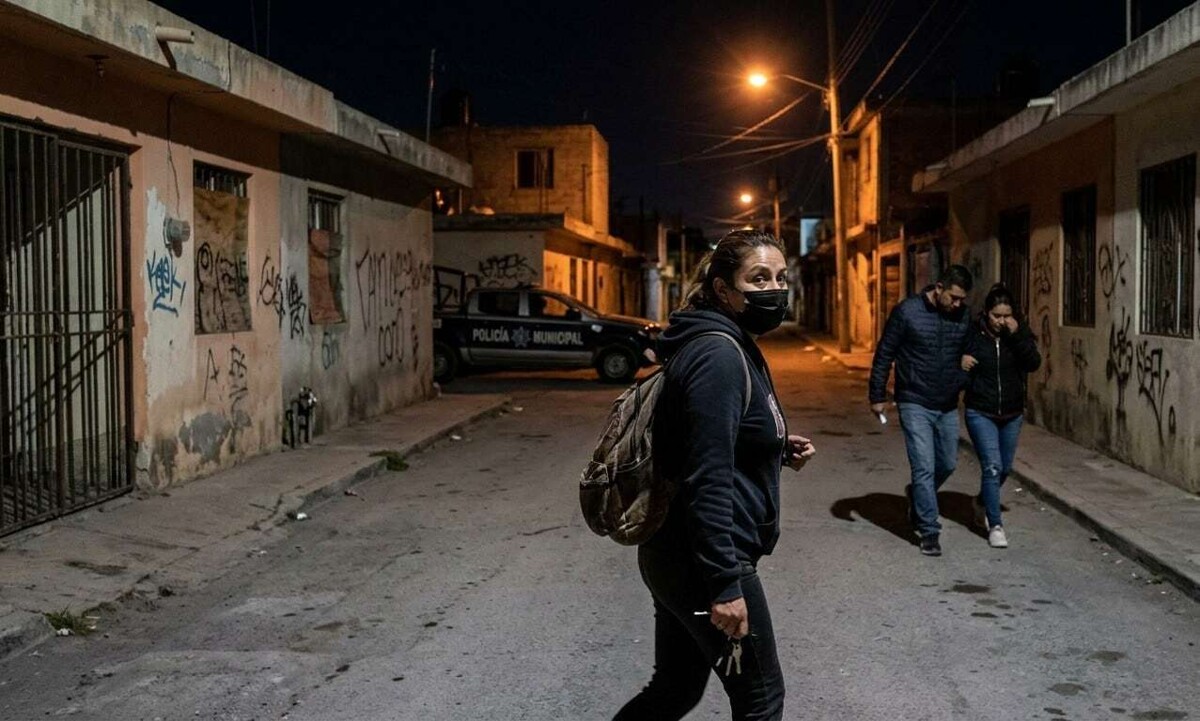
Public transportation is insufficient or non-existent, forcing residents to spend up to four hours daily commuting to their jobs. Unpaved streets and lack of lighting pose a daily risk, while water cuts are frequent and leaks in drainage networks seem endless. Power supply failures affect numerous communities, with blackouts that can last for days. Parks that appeared in sales plans either never arrived or were abandoned after being used as a commercial lure. «This set of deficiencies is not minor: it constitutes a perfect ecosystem for violence to flourish,» warn urban development experts. It is no coincidence that these same municipalities lead the crime statistics in the state. Physical, mental, and economic deterioration The silent urban crisis has tangible consequences for the health of its inhabitants. The endless routine of problems generated by living in places that do not guarantee basic services deteriorates the physical and mental health of families. The domestic economy fractures due to thefts, urgent medical expenses, and the costs derived from an infrastructure that fails daily. Call to attention Faced with this scenario, the organization Centro Cívitas launched a forceful appeal to authorities at all levels, stating that approving developments without minimum services is not urban development, but «institutional abandonment disguised as growth». The institution makes a specific call to the municipalities and the Government of Nuevo León to stop being negligent and not authorize housing developments where life cannot flourish. It demands the Federal Government and Infonavit stop perpetuating precariousness by financing housing that distances citizens from urban centers. «Infonavit must focus on affordable housing in the centers of the metropolis, where people have real access to services, employment, and community life,» the communiqué states. Cívitas also calls on Ineg to include municipalities such as Pesquería, García, and Juárez in the National Urban Public Safety Survey (ENSU). «The size of their population demands that their problems be measured, made visible, and addressed with the same seriousness as any other city,» the organization emphasized. «A community without basic services is a community that has been denied the possibility of being a citizen. Between 2010 and 2020, six municipalities in Nuevo León experienced a demographic explosion that surpassed any reasonable projection. García, Juárez, Pesquería, El Carmen, Salinas Victoria, and Ciénega de Flores saw their population grow by up to 700%, transforming into poles of attraction for thousands of families seeking to escape the high costs of the Monterrey metropolitan area. However, behind the figures of «urban success» hides an alarming reality: infrastructure and public services have not grown at the same rate as the population. What seemed to be the solution to the right to own housing has become, for hundreds of thousands of families, a daily hell of water cuts, drainage leaks, lack of electricity, non-existent transportation, and a growing wave of insecurity. Figures that overflow the periphery According to Centro Cívitas, the phenomenon of hyper-growth is evident: García grew from 143,694 to 397,205 inhabitants. Juárez grew from 256,970 to 471,523. But the most extreme cases are seen in: Pesquería, which grew from 20,843 to 147,624. El Carmen, which grew from 15,092 to 104,478. Salinas Victoria and Ciénega de Flores also doubled and tripled their population in just a decade. «The result is a disorderly urban sprawl on the periphery, where families, driven by the lack of affordable options in urban centers, have 'solved' their housing need, but at an unbearable cost: losing access to all other rights,» Cívitas states. A life of shortcomings In colonies like Haciendas del Renacimiento in García, residents have had to install their own surveillance cameras due to the lack of an effective police response. Security is not the only shortcoming. And that, too, is a responsibility of the State».