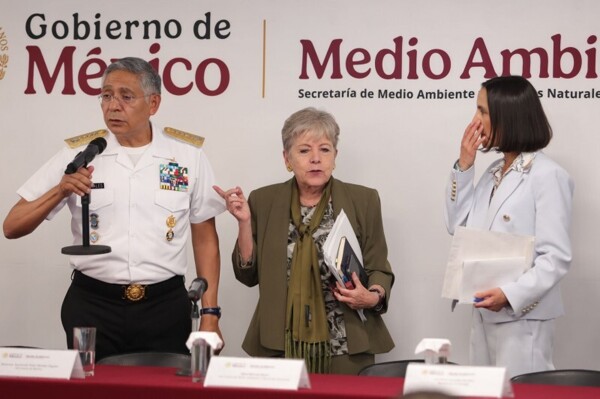
Mexican authorities attributed the oil spill in the Gulf of Mexico to three main sources: the illegal dumping from a vessel and two natural seeps, known as chapopoteras. So far, it has not been possible to identify the responsible vessel, as there were at least 13 ships anchored in the area at the time. Of these vessels, four remain in Mexican waters and are being inspected by the Mexican Navy, while international cooperation has been requested for the rest. What are the chapopoteras that may have caused the spill in the Gulf? The second source of pollution is the chapopoteras, located five miles from Coatzacoalcos. They originate when hydrocarbons migrate from deep reservoirs through fractures or geological faults. In the sea, they can be seen as bubbles, oil slicks, or small continuous flows. According to Pemex, these seeps are common in the southwestern Gulf of Mexico, mainly in the Campeche Sound, off the states of Tamaulipas and Veracruz, and have historically been used to identify areas with potential for exploitation. The Cantarell area, the most significant focus. The third source, considered the most significant by the government, is located 60 miles from Ciudad del Carmen, in the Cantarell area. Inspections are carried out using underwater drones and specialized divers. According to the timeline presented by the Secretariat of the Navy, the first reports of oil slicks date back to January 3 and March 2 in Coatzacoalcos. The contamination has spread to the beaches of Tabasco, Veracruz, and Tamaulipas, driven by winds and ocean currents. The Secretary of the Navy, Raymundo Pedro Morales Ángeles, detailed that the first focus corresponds to a vessel that carried out an illegal dumping on March 3 off the coast of Coatzacoalcos. Subsequently, on March 3, contamination was detected in Paraíso, Tabasco; on March 10 and 11 in Alvarado, Veracruz; on March 18 in Tuxpan; and on March 24 at Miramar beach in Ciudad Madero, Tamaulipas. Permanent environmental observatory in the Gulf of Mexico. Admiral Morales Ángeles reported that so far 430 tons of hydrocarbons have been collected and 223 kilometers of beach have been cleaned. Likewise, surveillance is maintained along 600 kilometers of coastline and permanent overflights are conducted to detect and contain new slicks before they reach the coast. Meanwhile, the director of Pemex, Víctor Rodríguez Padilla, stated that the company has hired 300 people from local communities for cleanup efforts and has held meetings with fishermen from Agua Dulce, Coatzacoalcos, and Pajapan. Eleven fishing cooperatives with more than 300 members were also identified, who are being supported through a public program that allocates 15 million pesos, in addition to the delivery of 10,000 liters of fuel to maintain productive activity. The Secretary of the Environment, Alicia Bárcena, announced that the Agency for Safety, Energy, and the Environment (ASEA) will file complaints with the Attorney General's Office (FGR) against whoever is responsible for the spill. These natural oil and gas seeps have presented intermittent emissions, which are currently contained, although it is not ruled out that they may reactivate. UNAM describes chapopoteras as natural hydrocarbon seeps that emerge from the marine or subsoil to the surface. It also announced the creation of a permanent environmental observatory in the Gulf of Mexico. Bárcena indicated that so far, no severe environmental damage has been detected, although assessments of possible impacts on flora and fauna continue. At this point, the emissions have been constant since January, but they increased last month. Authorities are analyzing whether this increase is due to a natural intensification or a possible structural failure in an oil platform. Meanwhile, Semarnat and the National Commission of Natural Protected Areas (Conanp) maintain constant monitoring of the region's most sensitive ecosystems. With information from EFE.

Mexican Authorities Identify Three Causes of Gulf Oil Spill
Mexican authorities determined that the hydrocarbon spill in the Gulf of Mexico was caused by three factors: an illegal vessel discharge and two natural seeps. Authorities are investigating, cleaning the coastline, and establishing permanent environmental monitoring to prevent future incidents.