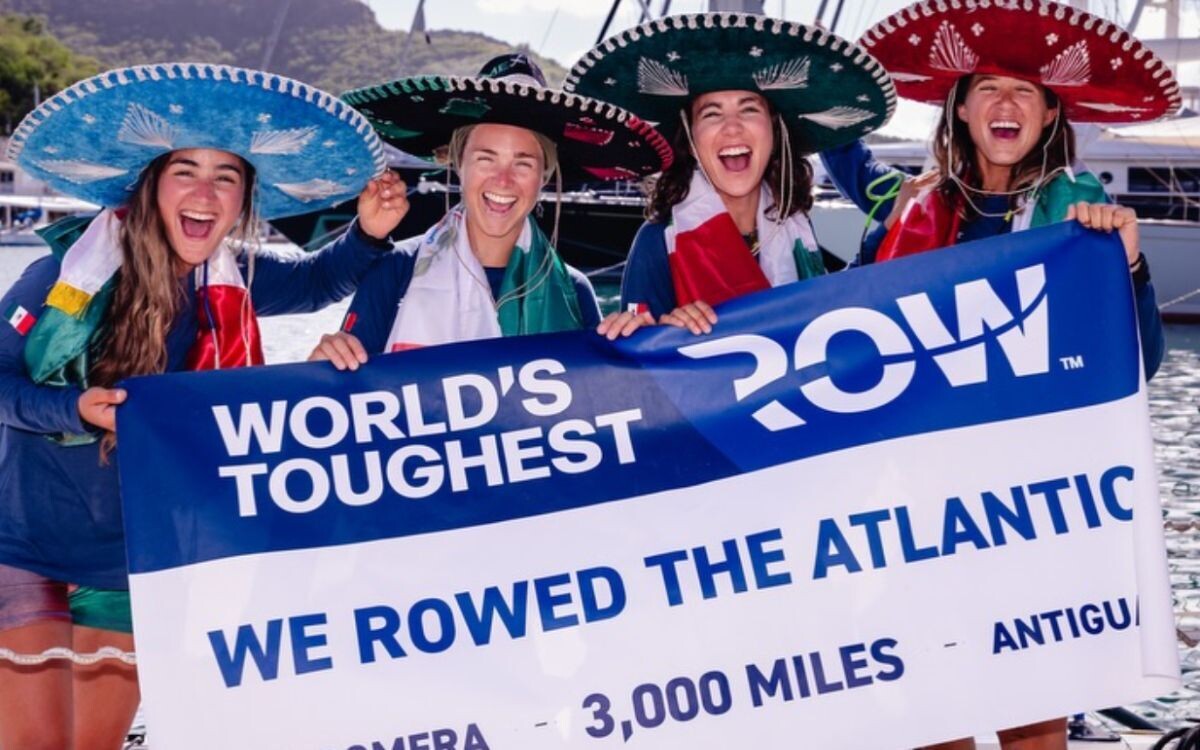
The Mexican women's team Oceanida made history by becoming the first Latin American team to row across the Atlantic Ocean. Their journey spanned approximately 4,800 kilometers, starting from La Gomera in the Canary Islands (Spain) and ending in Antigua and Barbuda in the Caribbean. The expedition, organized by Atlantic Campaigns and known as World's Toughest Row, began on December 12, 2025, and concluded on January 28, 2026. The team is composed of Eugenia Méndez, Andrea Gutiérrez, Ana Lucía Valencia, and Lucila Muriello.
Prior to this achievement, Abraham Levy had been the only Mexican to complete this crossing solo, and no Mexican woman had ever done so. During the voyage, a fleet of sailboats accompanied the teams at a distance to prevent issues from escalating into emergencies without operating as rescue vessels.
"We believe in the right to live without violence and in the possibility of breaking the social restrictions that still persist in Mexico," the team stated. With every kilometer rowed, they sought to inspire more women to dare to pursue their goals, while also highlighting the urgent need to care for the Earth and protect the ocean as a key element for the planet's balance. "We believe in our women, our Earth, our seas, and our strength," they say, inviting others to "cross their own oceans."
During the Atlantic crossing, all teams face sleep deprivation, salt sores, and constant physical strain, as well as the mental challenge of living at sea for weeks. Each vessel features small cabins, which serve as their only refuge from the sun and sea conditions, with limited space for carrying only essentials. The boats are fully equipped and cannot receive external assistance for repairs, food, or water. They are equipped with watermakers that convert seawater into drinking water, solar panels that power GPS and essential electrical equipment, and tracking devices to monitor their location. Onboard food consists mainly of dehydrated meals from the Mexican brand Tente En Pie, designed for long expeditions for their energy value, low weight, and easy preparation.
The Mexican women rowed for a total of 45 days, 1 hour, and 35 minutes. Upon their arrival in Barbuda, family members and followers greeted them with applause, flags, and hugs after disembarking from the boat, celebrating both the sporting achievement and the symbolic impact of their journey.
Oceanida was born from two motivations: the care for the Ocean and the desire for more women to achieve their goals with equal opportunities. The team also collaborates with social initiatives such as the Fondo Guadalupe Musalem, which supports indigenous and Afro-Mexican youth in Oaxaca to continue their studies, and Sirenas de Natividad, a collective that promotes women's participation in marine activities and ocean conservation. Environmentally, Oceanida joined the Big Plastic Pledge, committing to reduce waste generation, particularly single-use plastics, before and during the crossing.
In their manifesto, the members of Oceanida state that their journey serves the purpose of crossing an ocean to showcase strong, resilient, and free women. Prior to the crossing, all team members took courses in first aid at sea, survival, navigation, and radio communication. Time off from rowing is dedicated to boat maintenance, food preparation, navigation, logging the journey, and communication with land. The team worked in two-hour shifts, rowing for about 12 hours a day, alternating rest between day and night.