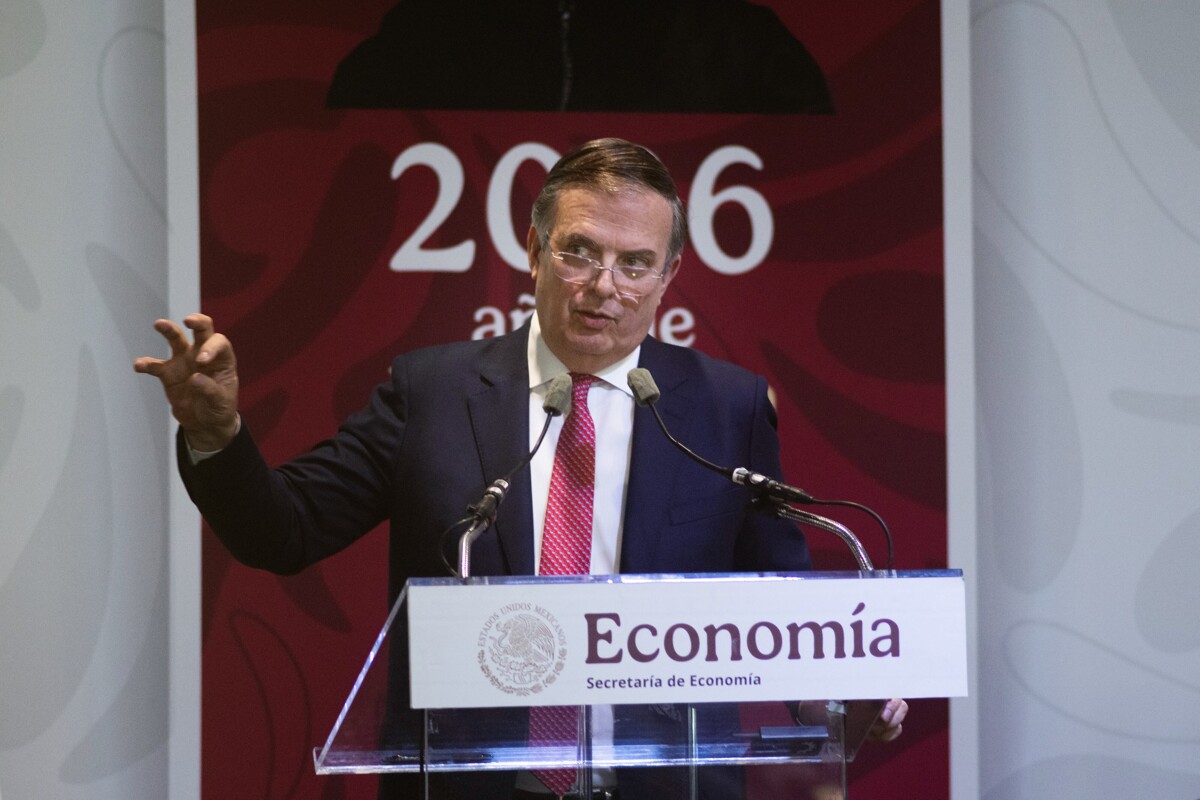
Secretary of Economy Marcelo Ebrard assured that there are "good signs" for the USMCA review process after holding meetings in Washington with US authorities. The Mexican official highlighted that the start of technical talks represents a significant advance in itself, by confirming the willingness of both parties to maintain the most important trade agreement for the region. "We agreed on a first session or round of talks. I found the atmosphere very interesting, very cordial..., the fact that it has started seems to me very good news," he said. The United States presented 54 topics of concern, compared to 12 raised by Mexico, among which stand out tariffs in strategic sectors such as steel and automotive. "We have made a lot of progress on those points since last year..., what we advanced last year is going to facilitate the way," he indicated. Despite the positive tone, Ebrard acknowledged that negotiations will not be without friction. Mexico maintains as its central goal the complete elimination of any tariffs within the bilateral relationship, while Washington has shown more protectionist stances in certain sectors. "It is not necessarily going to be 'honey on top', because we have different visions," he admitted. In this sense, he ruled out that the recent resolution of the US Supreme Court that limits the use of emergency tariffs would substantially modify the negotiating position of that country and argued that bilateral trade already operates largely under tariff-free conditions thanks to the current treaty. Necessary, reorganization. In an international environment marked by geopolitical conflicts, hardening of trade policies, and increasing economic fragmentation, Marcelo Ebrard warned that the world trade system is facing a phase of structural transformation that will force a rethinking of its operational bases, particularly within the World Trade Organization (WTO). During his participation in The Forum of Binational Trade Chambers in México, the official stated that the current scheme shows signs of exhaustion due to its "propensity to block" and the slowness in resolving disputes, factors that make global operations more expensive. "We have to have an organization that perhaps will have to change many of its foundations, it has too much propensity to block, measures take too long to be resolved, and that is very expensive for everyone," he said in reference to the next WTO ministerial meeting. Ebrard outlined a change in Mexico's stance towards international trade, moving from a pessimistic scenario observed in 2025 towards an "optimistic and realistic" vision for 2026, based on the expectation that the global system can reorganize itself without incurring the high costs that were previously anticipated. The head of Economy anticipated that Mexico will take this position to the next WTO ministerial meeting, where it will defend the need to strengthen the organization's operational effectiveness. "We are the number one customer of the US. No one buys more from the United States than Mexico. Mexico buys from them more than China, Japan, or Germany together," he stated. This level of productive integration (where nearly half of the content of Mexican exports to the US comes from US inputs) reinforces, according to the secretary, the logic of continuity of the agreement. The official also recalled that prior to the formal start of the review, both parties had already made progress in identifying sensitive points. "We are very integrated."