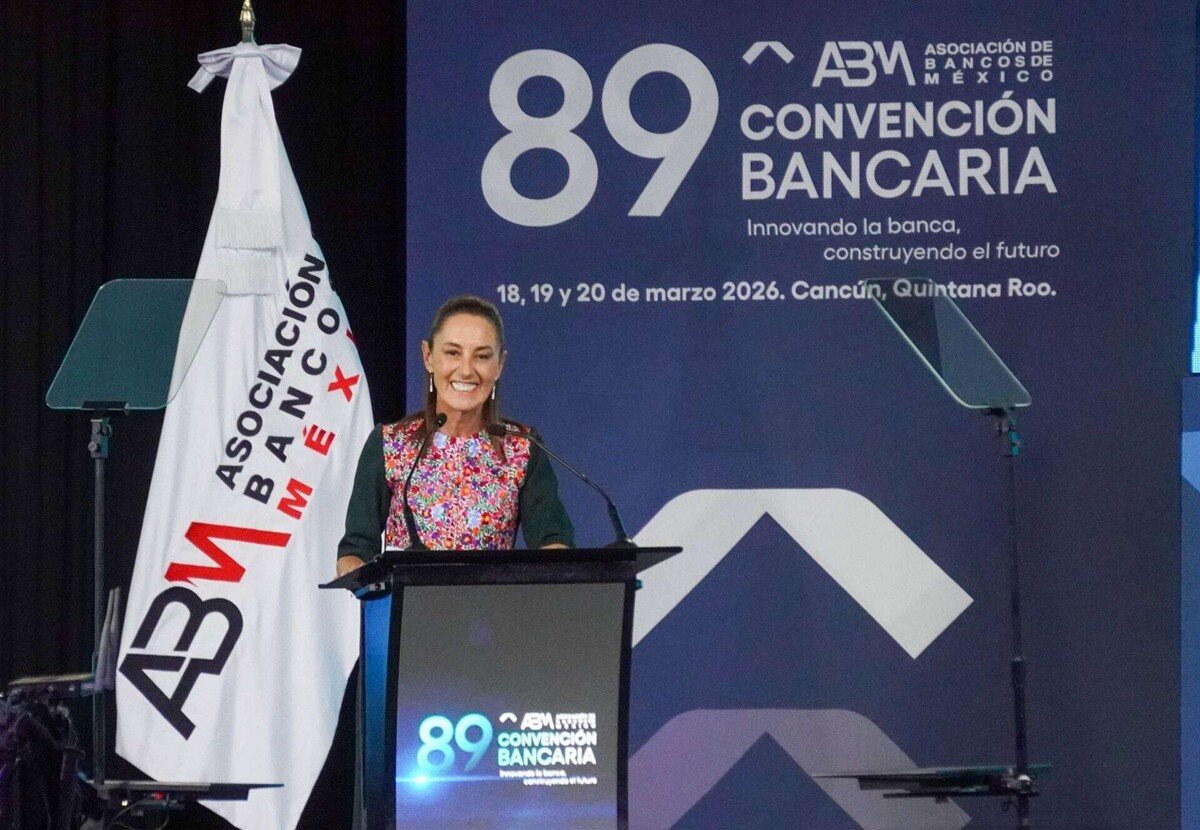
Mexico is betting on digitalization, strengthening productive chains, and creating incentives for investment. Ultimately, investment rests on two fundamental principles: clear rules and legal certainty that protects the investor from changes in the regulatory framework. In her speech, the president outlined with greater clarity the operational axes to translate this vision into growth with shared prosperity. She pointed out that for the 2026–2030 period, public and mixed investment could exceed five trillion pesos in strategic sectors such as energy, transport, water, health, and education, with a focus on the catalytic role of public investment as a trigger for private capital. She emphasized the development of new public and mixed investment schemes, including a significant expansion of road investment in coordination with Banobras and the Secretariat of Infrastructure, Communications, and Transport, as well as the modernization of the development bank—particularly Nacional Financiera—to boost credit and innovation. Throughout 2025, this vision translated into concrete instruments: the Plan Mexico, the Infrastructure Investment Plan for Development with Well-being 2026–2030, and sectoral programs in electricity and roads. On the eve of the Convention, the Federal Government sent to the Congress the Law to Promote Investment in Strategic Infrastructure for Development with Well-being. The conditions are aligned to unleash a new investment cycle in productive projects. The context is clear. Beyond its details, the initiative aims to clearly define the role of the private sector in infrastructure financing. For infrastructure development in Mexico, the 89th Banking Convention could become a turning point in the relationship between the public and private sectors. In this context, an announcement with structural implications stands out: moving towards mandatory digital payments for fuels and tolls, a measure that articulates infrastructure and digitalization and could transform operational efficiency and economic formalization. In the same vein, the Secretary of the Treasury, Edgar Amador, emphasized that macroeconomic stability is an enabling condition to unleash investment. In turn, the Undersecretary Maricarmen Bonilla complemented this vision in the infrastructure panel by detailing elements of the new law, particularly the role of its Planning Council and the mechanisms designed to distribute risks between the public and private sectors. Thus, an ambitious six-year infrastructure investment program is on the table. The Banking Convention suggests a turning point: today, political will, capital availability, and a legal framework that seeks to reduce uncertainty coincide. For 2026 alone, the additional investment expected is 2% of GDP, a significant increase. In recent years, the lack of clarity about the role of the private sector generated a pause that delayed key projects in sectors such as roads, water, and electricity generation. If this convergence is sustained, it could reactivate the execution of productive projects on a large scale. But what is relevant is not only the magnitude, but the definition of the scheme. That is, in essence, the most relevant signal. Since her campaign, President Claudia Sheinbaum has emphasized the importance of strengthening roads, hospitals, and ports as the basis for growth with shared prosperity.