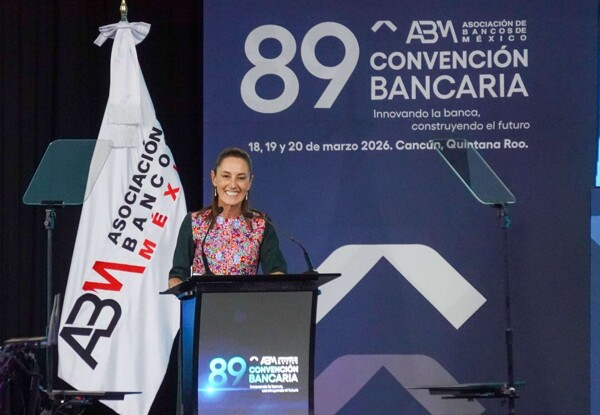
The 89th Banking Convention opened with a repeated message from President Claudia Sheinbaum: Mexico needs more credit. The country's banking system—dominated by foreign institutions—only allocates the equivalent of 38% of GDP in credits for investment, housing, and personal consumption. Other Latin American economies have a much deeper banking system; in Chile, for example, private credit exceeds the size of its economy at 110% of GDP; in Brazil, it's around 75% of GDP, and Colombia also surpasses us with credits equivalent to 40% of its GDP. In her speech, President Sheinbaum addressed the bankers diplomatically: 'The Mexican banking system, she told them, still has a lot to give the country (...), and so the best news is that you are going to increase credit from 38% to 45%.' It remains to be seen if the bankers are willing to comply with this agreement, although it does not depend solely on them. The country not only requires more credit but also better allocation by sector and better terms for its granting. In addition to being insufficient, the savings of Mexicans managed by banking institutions are preferentially channeled into credits for which they charge higher commissions and interest rates, such as credit cards, car purchases, and personal loans. Before the pandemic, there was a balance in the growth of credits granted to companies for productive purposes and those channeled to consumption, but since then, the latter have grown twice as fast as those that support investments. Private investments decreased by 1.7% during 2025, at the same time ceasing to be the main factor demanding credit. This is an imbalance in which credit is not contributing its crucial function of boosting the productive capacity of the national economy. That relationship between demand and allocation of corporate credit is symptomatic of lagging productivity and competitiveness of the productive plant, lags that make the profitability of new investments uncertain with a narrow internal market and a convulsive world like the one we live in. Credit cannot, of course, ensure the competitive efficiency of new investments or trigger growth on its own, but its intervention with other factors is crucial. Large companies have preferential access to credit and other financial instruments; large corporations generate high growth rates and achieve high returns, which remain concentrated in them. This is what explains the enormous flow of foreign direct investment that has been arriving in our country, breaking records every year; there is no 'political distrust' that cannot be overcome by an attractive rate of return. For the rest of the business community, the best opportunity for growth of their investments and profitability is the chaining of activities between large, medium, and small companies; the development of SMEs, linked to that of large ones, disperses and integrates achievements. The banking system would contribute to raising the growth and productive efficiency of the Mexican economy with greater credit penetration among SMEs, of which very few currently have access to financing, and when they do, after covering outrageous requirements, they must pay interest rates of around 18% to 20%; in Chile, that type of company pays annually from 6% to 12% in interest. And it is that the bankers attending the recently held Convention consider credits to small and medium-sized companies to be high risk and prefer to promote those made through credit cards or personal loans for car purchases or whatever the accredittee needs, charging them much higher interest rates, not only than those paid by companies, but than those paid in other nations in Latin America. If we were in Colombia, for example, we would pay an annual interest of between 25% and 35% on unpaid balances of a common credit card. But in Mexico, clients of the same Visa or Mastercard card—issued by some bank—have to pay from 35% to 65%. These differences enclose extraordinary profits for banks in Mexico, derived from the so-called 'financial spread' or the difference between the rate used by the Bank of Mexico as a reference for the cost of money throughout the economy—which is currently 7% per annum—and the rate of up to 65% they charge on unpaid credit card balances. Incidentally, in Colombia, the central bank's reference rate is 9.25%, which leaves banks a much smaller 'spread' than in Mexico. Therein lies the mystery by which every year BBVA informs its shareholders that the profits from its operations in Mexico are the highest it obtains in almost thirty countries where it has branches or subsidiaries; in 2025, BBVA reported global profits of 10.5 billion euros, of which Mexico contributed 5.26 billion, almost 50% of the bank's global profits. It is very clear that the banking system has a lot to give Mexico, just as it is clear that, due to its costs, it is a drag on private and public efforts to reactivate economic growth with social well-being.