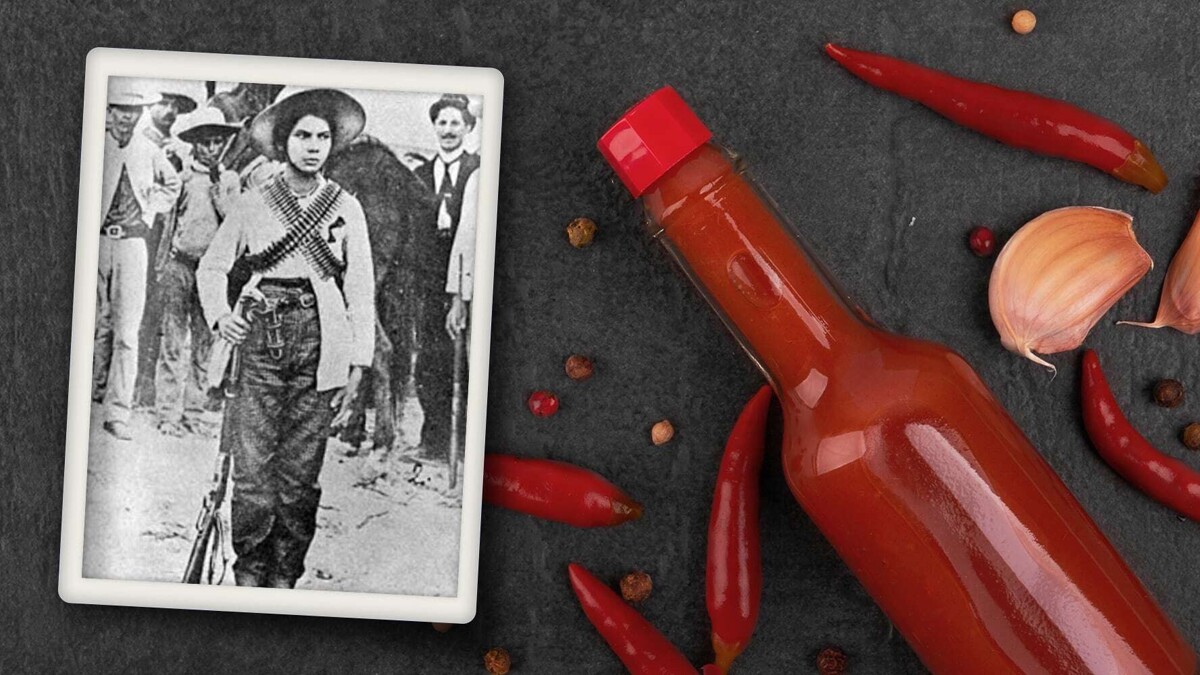
The name Valentina may seem common, even popular in Mexico; however, it was chosen for a specific reason: to pay homage to one of the most audacious female guerrillas who participated in the Mexican Revolution. Why was the salsa named Valentina? The Tamazula group selected the name for the salsa inspired by an incredible story: that of Valentina Ramírez Avitia, 'a revolutionary woman who, dressed as a man, with cartridge belts on her chest and a palm hat that hid her braids, threw herself into combat,' they explained in a post on X. Although incredible, the story of the also nicknamed 'Lioness of Norotal' — or, in more recent times, 'the Mexican Mulan' — surpasses any fiction film and is an example of courage and determination. Valentina Ramírez was born in San Antonio, Tamazula, Durango, in 1894. Thus, the condiment was born. Manuel Maciel Méndez is the mind behind the Valentina salsa. He began making salsas as part of a family business in Guadalajara, for which he used puya and árbol chiles. The recipe was a success, and in 1960, he launched this preparation as a brand called Tamazula, which was well-received by its customers. From this, Manuel Maciel began developing new products. Thus, one of the most popular was born: the Valentina salsa, which contains árbol chile, acetic acid, iodized salt, seasonings, and spices, according to its label. Over time, and due to its popularity, new versions have been developed: it can now be found in a powder presentation and a special variant for seafood. What would prepared chicharrones, popcorn, and instant soups be without this salsa? Author Martha Eva Rocha Islas points out that the revolutionary herself stated that she left the conflict 'for being a woman.' An investigation by the newspaper El Clarín indicates that Valentina was discovered by one of her comrades, who denounced her to the troops, which led to her expulsion; however, this version remains a theory. What happened to Valentina Ramírez after the Mexican Revolution? After her participation in the Revolution, Valentina continued her life, and it was not until 1964 that she was recognized for having fought against the regime of Porfirio Díaz. 'Valentina was recognized as a Veteran of the Revolution during the first period, from November 19, 1910, to May 15, 1911, and received the Decoration for Revolutionary Merit from this Secretariat,' affirms SEDENA. Writer Martha Eva Rocha Islas adds that upon receiving the decoration, Valentina commented: 'It fills me with satisfaction and pride, because after having served in the maderista army as a private, despite my condition as a woman, at 70 years of age I see that kindly I am taken into account.' The life of Valentina is honored not only through the name of the popular salsa but also inspired a song of the same name that portrays her as a soldadera. What is the story of the Valentina salsa? The Judicial Power adds that she obtained the rank of lieutenant after the fight at the Cañedo Bridge. After this combat, Valentina retired from the army, according to SEDENA. That spicy flavor, with slightly acidic notes, is ideal for snacks, and one of the most popular brands is the Valentina salsa. With its two labels — yellow and black, the latter warning that it is 'very spicy' — it has conquered Mexicans, as it can be used for almost any preparation, including seafood and, of course, fast food like hot dogs, pizzas, and even french fries. But have you ever wondered why the condiment is named this way? With this identity, she was able to participate in the fight to overthrow the regime of Porfirio Díaz. The Secretariat of National Defense (SEDENA) indicates that she fought from May 20 to 23, 1911, in the taking of Topia and Tamazula, as well as in Culiacán. Her life was normal until the Mexican Revolution broke out; at only 17 years old, she decided to give her destiny a complete turn by enlisting, according to the Judicial Power of Mexico City. She joined the forces of General Ramón F. Iturbide on January 12, 1911, as a soldier; however, she managed to be allowed to fight regardless of her gender. Lately, we have been asked about the origin of our name. Valentina salsa is inspired by Valentina Ramírez Avitia, a revolutionary woman who, dressed as a man, with cartridge belts on her chest and a palm hat that hid her braids, threw herself into combat.