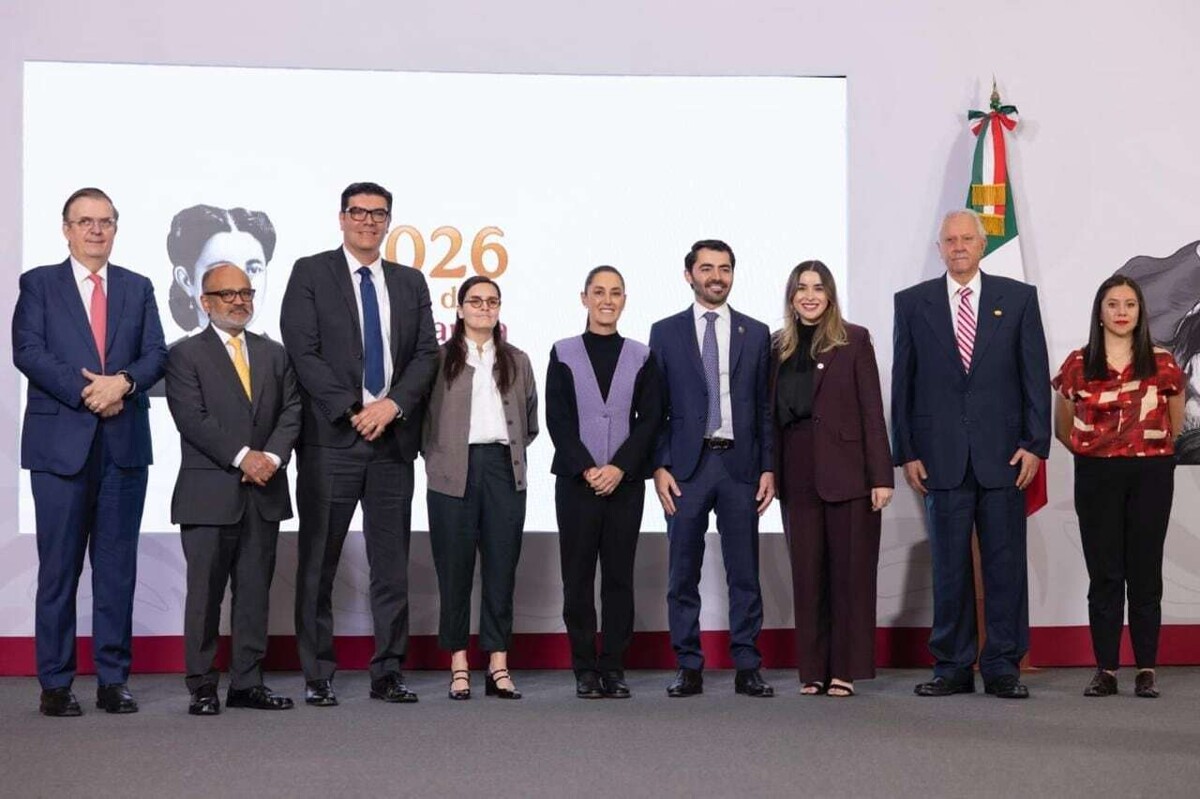
The federal government announced the Immediate Attention Program for the Protection of the Heavy Vehicle Industry, a package that includes a series of measures such as tax incentives, access to financing, and stricter regulation. The objective is to accelerate the modernization of the transport fleet and strengthen the national productive chain. During the morning conference, Mexico's president, Claudia Sheinbaum, accompanied by the Secretary of Economy, Marcelo Ebrard, presented the program, which is part of the so-called Plan Mexico and has been well-received by manufacturers, distributors, and transporters. The core of the program is the allocation of 2 billion pesos in accelerated depreciation schemes, a mechanism that will allow companies and transporters to more quickly deduct investments in new buses and trucks manufactured in the country. Alejandro Malagón, president of CONCAMIN, emphasized that “programs like the one announced today send a positive signal to the industrial sector by incentivizing fleet renewal, strengthening the supply chain, encouraging the production of heavy vehicles made in Mexico, and facilitating access to financing”. Similarly, Rogelio Arzate, executive president of ANPACT, stated that “the set of measures is a positive signal for the modernization of the vehicle fleet, the strengthening of the national productive plant, and the creation of more competitive conditions for road transport”. The executive emphasized that the sector is strategic for the national economy, as it moves more than 80% of goods and supplies, as well as millions of passengers nationwide. One of the most relevant benefits is the direct boost to national production. By prioritizing the purchase of units manufactured in Mexico, the program strengthens the installed productive capacity, protects jobs in an industry that involves around 200,000 people, and stimulates activity in linked sectors such as auto parts, logistics, and services. In parallel, the government seeks to close the door to market distortions by establishing estimated prices for imported used heavy vehicles, mainly from the United States. “We need to strengthen safety conditions for drivers and pedestrians, reduce emissions, and protect our national industry from the import of used vehicles; this is a level playing field”. From the industrial sector's perspective, the program sends a clear signal of positive certainty. Chambers and associations have reiterated their willingness to collaborate with authorities in designing mechanisms that guarantee the permanence of these incentives and expand their reach in a sector that, due to its weight in the economy, will continue to be key to Mexico's logistical and industrial development. This component is crucial in a context where road safety is one of the main challenges of road transport. The sector, which groups organizations like CANACAR, CANAPAT, ANTP, AMDA, and CONATRAM, agreed that the program represents a strategic decision for the country and is positive. According to the main organizations, beyond the amounts, the scope of the program lies in its ability to articulate different fronts: financing, regulation, industrial policy, and sustainability. Together, these elements outline a path to transform road transport into a more efficient, safe, and environmentally aligned sector. The challenge now will be its implementation and continuity. To this amount, 250 million pesos channeled through Nacional Financiera are added, which could trigger up to 4 billion additional in credit, to reach an estimated fund of 6 billion pesos. The combination of tax incentives and financing seeks to address one of the sector's main lagging issues: the average age of the fleet, which is around 19 years, with units operating under obsolete, highly polluting technologies with lower safety standards. From the government's side, the bet combines industrial development and sustainability. “This is a very important program that will help us to reduce pollutants and improve the conditions of cargo road transport, while also increasing vehicle production in Mexico and expanding the production chain,” stated Claudia Sheinbaum. In turn, Marcelo Ebrard detailed the economic and social scope of the program: “The objective is to protect the employment and income of thousands of Mexican families. This industry involves around 200,000 people. This measure aims to curb underinvoicing at customs, a practice that has affected both manufacturers and small and medium-sized transport companies. In environmental terms, the impact is also significant. The replacement of old units with Euro VI technology, electric, hybrid, or natural gas vehicles will allow for a reduction of up to 90% in polluting emissions compared to the current fleet, contributing to improve air quality and public health. To this is added the progress in the safety standard for heavy vehicles, which will raise the technical standards of the units circulating on national highways.