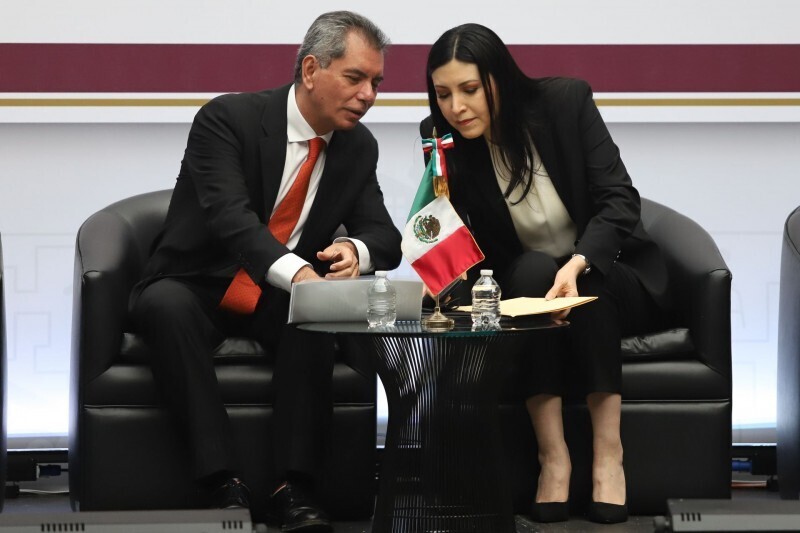
Since January 2022, upon taking office, the consensus among bankers and investors was that, despite never having a public profile befitting her responsibility, her decisions were technically impeccable. That thesis began to wobble this Thursday when she advocated for an interest rate cut despite inflation not appearing to be a problem overcome, and fundamentally, in the face of a turbulent world due to the war in the Middle East. The market is nervous about the final outcome of the Bank of Mexico's Governing Board, with the three deputy governors closest to the National Palace voting in favor of the cut. Understandable: Banxico does not have a constitutional mandate to foster growth, but to preserve the value of the currency by lowering inflation. Moreover, underlying inflation has been high since last May. In its monetary policy report published this Thursday, Banxico adjusted its inflation projection for the end of the first quarter to 4.1% from the previous expectation of 4%, while for the second quarter it expects inflation to be 4%, up from the previous forecast of 3.8%. Its latest projection is for the third quarter, where they expect inflation to fall to 3.7%, slightly higher than the previous projection of 3.6%, to close the year at 3.5% and reach the 3% target by early 2027. The adjustments look optimistic compared to the consensus of specialists, who project an inflation rate of 4.20% this year and 3.8% in 2027, due to greater persistence in food and energy prices, versus a Banxico scenario that assumes more contained pressures. Banxico lowers the rate to 6.75% despite inflation rising However, Banxico's reading aligns with the government's discourse under Claudia Sheinbaum, which insists that inflation is under control, as the president has repeated at recent economic forums. The government has downplayed the risks of rising crude oil and fertilizer prices due to the war in Iran. During the first half of March, general inflation was 4.63%, while underlying inflation, already excluding volatile prices, also remained high at 4.46% annually. Sheinbaum insists she has a series of measures to prevent a price escalation in fuels, such as the IEPS tax and the agreement with distributors. This Thursday, the president announced she had reached a 'voluntary' agreement with diesel distributors to cap the price at 28.50 pesos. 'It is temporary, it is seasonal, we do not think it is going to last all year,' she declared. This came after, in the first half of March, inflation in the fruits and vegetables component skyrocketed to 23.91% — from the 5.61% reported in February — due to an increase in tomatoes (32%) and lemons (13.11%). Despite the inflation data, the Palace increases pressure on Banxico for another interest rate cut Sheinbaum attributed these increases to a frost in Florida that caused shortages and that it is a temporary pressure. Meanwhile, Banxico raised its projections on the same day it announced a new cut to the interest rate, setting it at 6.5%, which fuels the debate about its credibility. 'But I told them it is still too high and we are reviewing it so that they can offer better prices in this period where the price of crude is growing,' she said. Additionally, she announced she is seeking a similar agreement for the agricultural sector. The governor of the Bank of Mexico, Victoria Rodríguez, has never been a highly valued official in the financial arena. This index has been above the central bank's range twice. 'Yesterday I proposed to the Treasury to meet with producers so that these products can enter the PACI.'