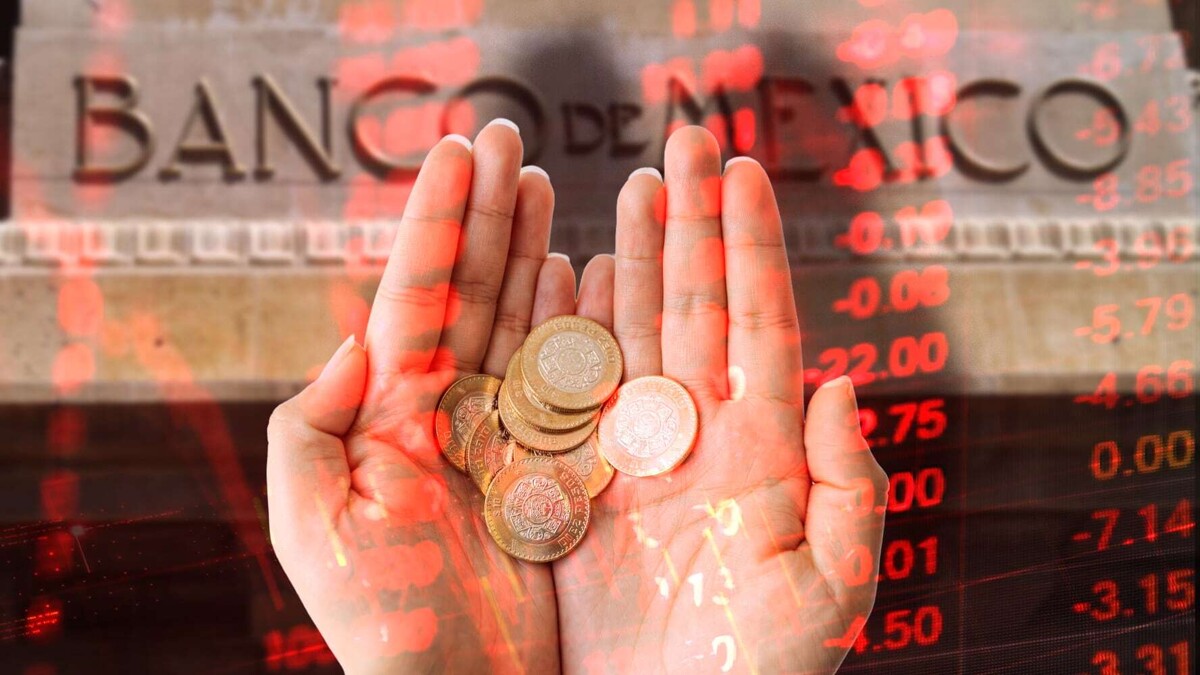
The Bank of Mexico's (Banxico) rate cut to 6.75% will put pressure on the peso, which could slow the recovery of emerging markets, analysts warned. The Mexican peso, which has outperformed almost all other developing countries' currencies over the last 12 months, fell further after the Bank of Mexico decided to cut the rate by 25 basis points. This move had been anticipated by about half of the economists surveyed by Bloomberg. What is the peso's carry trade? By lowering rates, Banxico reduces the attractiveness of the peso's carry trade. 'The cuts make the peso a more vulnerable currency in a prolonged conflict where oil prices do not fall in the coming months.' Did Banxico make a mistake by lowering the interest rate? This is what the analysts say Erick Martínez Magaña, a strategist at Barclays in New York, considered that the 25 basis point cut could call into question Banxico's 'reputation' because 'we see a growing risk that this stance will be perceived as a policy error amid rising inflationary pressures driven by energy.' The specialist added that the first signs of that pressure were already seen in the inflation figure for the first half of March, where increases in airfare and electricity prices stood out. Dan Pan, an economist at Standard Chartered Bank in New York, opined that the decision to lower the rate to 6.75 percent was 'quite a surprise, especially in an environment where global central banks have adopted additional caution in light of the energy price crisis.' Banxico's measure 'clearly marks a retreat from the recent tightening of financial conditions driven by external factors; the authorities seemed convinced that the monetary policy stance is adequate to protect against the challenges and uncertainty derived from the conflict in the Middle East.' Paresh Upadhyaya, a strategist at Pioneer Investments, warned that Banxico may be underestimating the effect of rising oil prices on inflation. 'The rate cut was not entirely unexpected, but maintaining the moderate stance was a surprise,' he pointed out. Some investors borrow in lower-yielding currencies, such as the US dollar, to invest in higher-yielding ones, such as the peso. The divided decision of the Governing Board reduces the difference between Banxico's rate (6.75 percent) and the Fed's rate (3.5-3.75 percent), making the operation less attractive. 'This should be negative for the peso and very positive for the short end of the curve,' stated Álvaro Vivanco, emerging markets macro strategist at Wells Fargo. 'This had not been fully discounted.' In the statement accompanying the decision, Banxico's Governing Board added that it is considering an additional cut at a yet-to-be-determined time, possibly at the May meeting. 'The effects of all the factors determining inflation will be taken into account, and the evolution of external conditions will be closely followed,' wrote the members of the Governing Board. 'The cut is undoubtedly exerting downward pressure on the peso, but I believe the future trajectory of the peso will really be determined by the conflict in Iran,' stated Brendan McKenna, emerging markets strategist at Wells Fargo in New York. What does that mean?