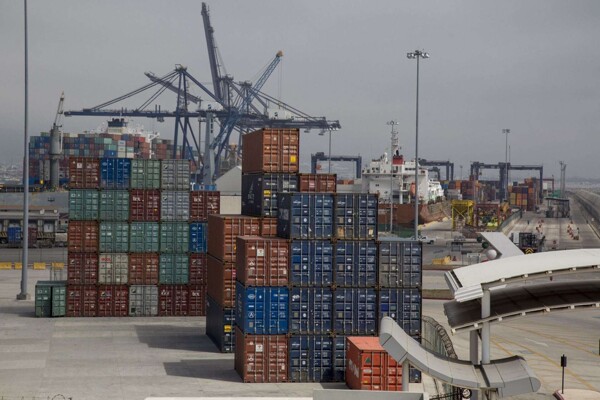
Before concluding that domestic consumption has plummeted, it is worth isolating this exchange rate variable. But this apparent balance hides a fracture: personal services grew by 17.8% in real terms—likely due to the wage increase—and current structural spending rose by 16.7%, the highest growth of all budget components. That current structural spending grew at more than triple the rate of ISR growth illustrates the asymmetry already at play in the budget: revenues advance at a moderate pace, while unavoidable commitments run much faster. To finance that inertia, physical investment fell by 44.9% in real terms, from 152.2 billion pesos in the two-month period of 2025 to just 87.1 billion in 2026. The logic is known and repeated: when unavoidable spending rises, what is cut is logically what can be cut, even though these cuts accumulate costs in the medium term. The most drastic case is Pemex. Its physical investment went from 91.8 billion pesos in January-February 2025 to a mere 21.0 billion in the same period of 2026, a real contraction of 78%. In February, the company invested 8.2 billion compared to 64.8 billion a year earlier. Pemex's financial result, paradoxically, looks positive: it recorded a positive balance of 4.9 billion in the bimester, compared to a deficit of 62.1 billion in 2025, and its total discretionary spending fell by 56.2% in real terms. But those figures do not reflect operational efficiency: they reflect that the company simply stopped. Fields without maintenance, canceled projects, infrastructure that is not being renewed. The report that the Ministry of Finance delivered to Congress a couple of days ago, corresponding to the first bimester, like many of the country's realities, has two faces. One with a positive tone and another with a challenging perception. On the one hand, revenue holds up: budget revenues grew by 2% in real terms, to stand at 1.42 trillion pesos; tax revenues advanced 2.6%, ISR grew by 4.9% and IEPS by 14.2%. The primary surplus of the public sector reached 60.6 billion pesos. And the Public Sector Financial Requirements—the broadest measure of the deficit—were reduced from 128.1 billion in the first bimester of 2025 to 23.6 billion in 2026. The picture changes when looking at the internal components. The fall in VAT—8.8% in real terms in the bimester—deserves attention. A significant proportion of this tax's collection originates in customs, on the peso value of imported goods. The average exchange rate in January-February 2025 was around 20.50 pesos per dollar; this year it was between 17 and 17.50 pesos, a nominal appreciation of around 14%. That appreciation directly compresses the taxable base of imports when expressed in national currency: the same container that previously generated VAT on twenty pesos per dollar now generates it on seventeen. Import taxes also show the effect: they fell by 7.2% in real terms, in line with that same dynamic. In other words, much of the VAT that did not arrive this bimester can be explained by a stronger currency, not a weaker economy. The distinction matters for the diagnosis and for policy. Discretionary spending practically did not grow in real terms (-0.1%). It is a transitory effect, not structural, and it will reverse if the exchange rate moves in the opposite direction. The more serious problem is in spending and its composition. The balance improved because Pemex stopped investing, and at that rate of disinvestment, the deterioration of productive capacity will advance faster than any accounting cleanup can compensate. The message of the bimester is one of real but fragile fiscal consolidation, built on an adjustment mechanism that has an expiration date. Public investment absorbs the pressure generated by rigid expenditures, and with each bimester that passes, the margin narrows. Without expanding fiscal space through revenues, the cycle will continue: more current rigidity, less investment, less future growth capacity. There is no fiscal collapse or immediate imbalance to be alarmed about. But there is no deep solution either. Mexico's public finances are walking a thin line: enough to avoid a crisis, insufficient to guarantee lasting tranquility.