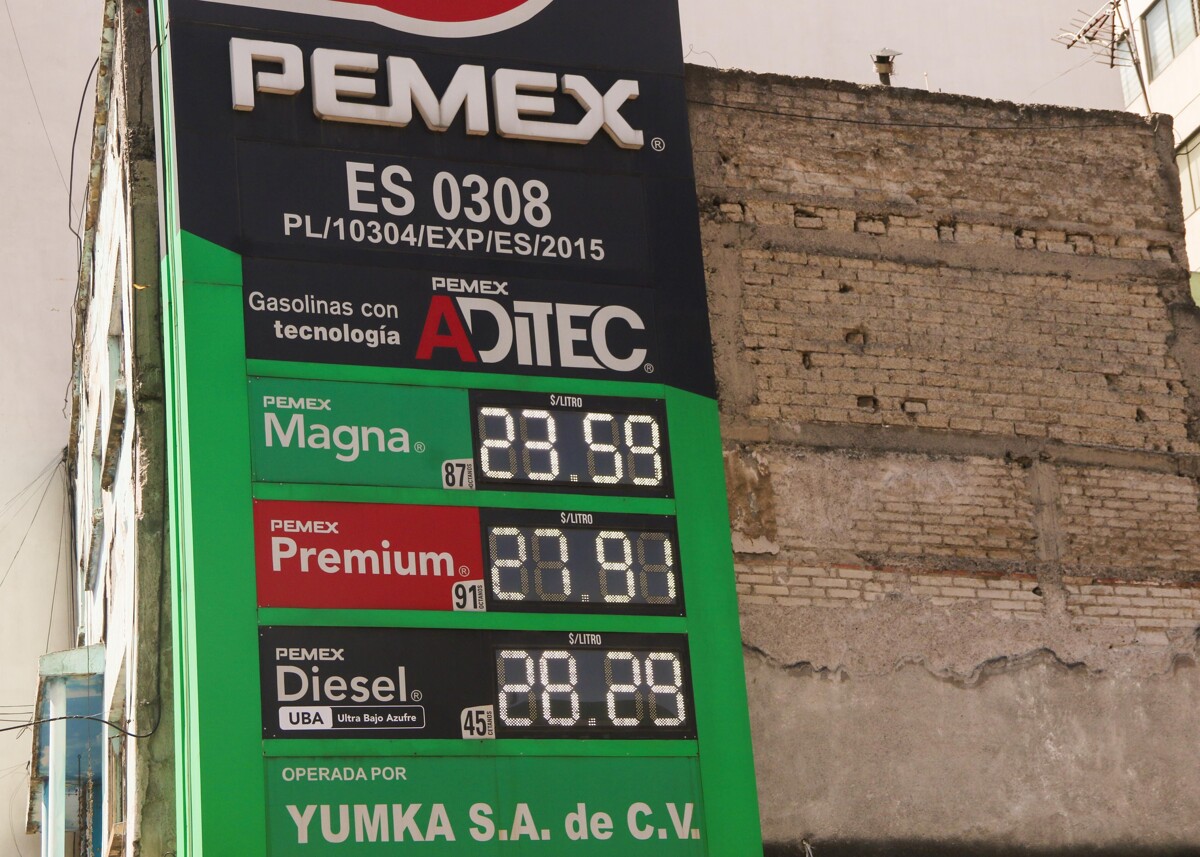
The federal government's agreement to keep the diesel price below 28.3 pesos per liter is facing difficulties to be fulfilled in most of the country, which casts doubt on its viability without greater fiscal support. In 29 of the 32 entities, the fuel is sold up to 5 percent above that level, according to data from the PETROIntelligence consultancy. The mismatch reflects the cost structure of the sector and the limited capacity to adjust commercial margins. With Pemex's wholesale prices around 26.7 pesos per liter, gas station owners would have to cut their profits by 30 to 50 percent, from two to near 1.50 pesos per liter, to align with the official target, Alejandro Montufar, CEO of PETROIntelligence, said in an interview. Furthermore, without a greater stimulus to the Special Tax on Production and Services (IEPS), the adjustment looks limited. However, sector analysts consider that without an additional increase in these supports, it will be difficult for the national average price to converge to the target set by the government. In the United States, the diesel price reached 5.490 dollars per gallon, representing a 46 percent increase in the last month. In Mexico, diesel is now only 9.2 percent more expensive than in the United States, when a year ago the price gap was 50.6 percent, according to data from the American Automobile Association (AAA). Although the agreement has the support of the Government of Mexico, Pemex, and gas station owners, it will be difficult to achieve the target in the short term if the Treasury Department does not apply more fiscal stimuli and if gas station owners are not willing to reduce their margins, indicated sector specialist Alejandro Montufar. The Federal Consumer Prosecutor's Office and the Agency for Security, Energy, and Environment will monitor gas stations that sell at high prices or fail to comply with the regulation, said Sheinbaum. The behavior of diesel has direct implications on logistics and freight costs, so its evolution represents a risk factor for inflation in the short term. For the week of March 28 to April 3, the Treasury Department applied a fiscal stimulus of 70.28 percent to diesel, equivalent to 5.1749 pesos per liter. 'There is still room to reduce between two and three pesos through the fiscal component, that is the recipe for success to reach the target price,' Montufar pointed out. The non-compliance with the agreement occurs in a context of upward pressure on international fuel prices, driven by geopolitical tensions in the Middle East, which has made diesel more expensive globally and reduced the margin for maneuver to contain prices in the domestic market. What are the states with the most expensive and cheapest diesel in Mexico? Currently, nine entities register average prices above 29 pesos per liter, with Quintana Roo among the most expensive, in part due to higher logistics costs associated with fuel transport. President Claudia Sheinbaum recognized in her press conference this Wednesday that supply in that region depends on more costly routes, although she trusted that the entry into operation of the Tren Maya for cargo will help reduce those costs. In contrast, only three states, Tamaulipas, Tlaxcala, and Baja California, remain below the target of 28.3 pesos per liter. In addition to commercial margins, the diesel market faces additional costs compared to gasoline, including financing schemes for fleets and greater investments in dispatch infrastructure, which complicates rapid price adjustments, added Montufar. In parallel, the federal government warned that it will reinforce market supervision.