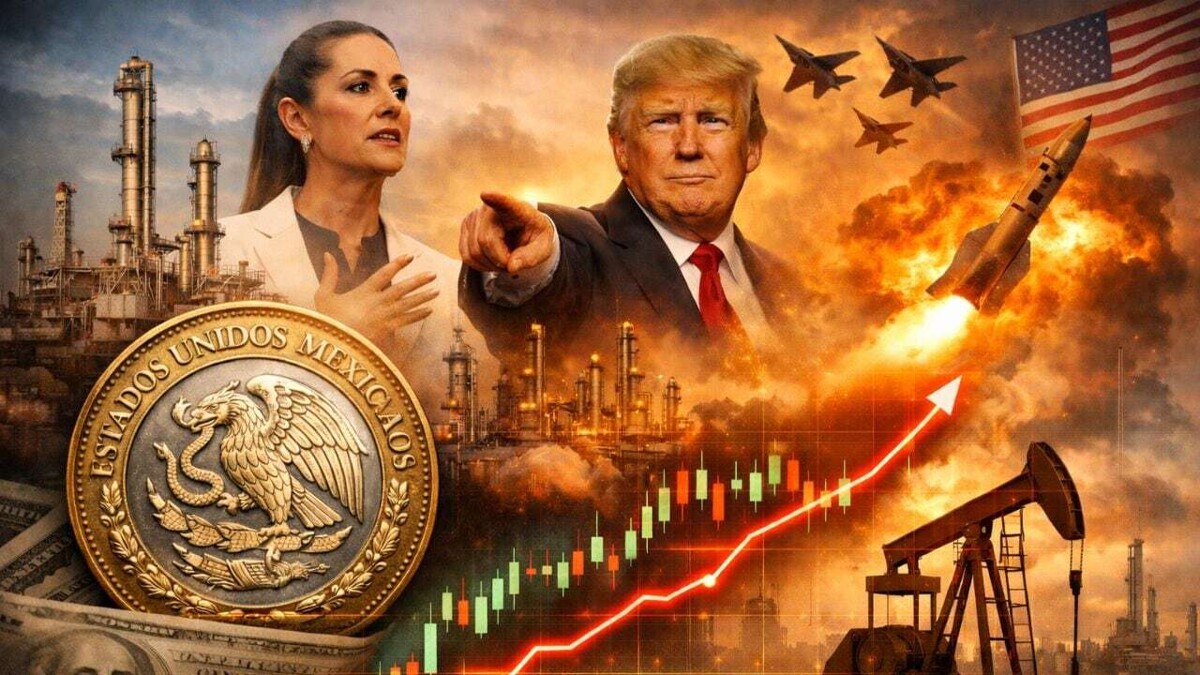
The Mexican peso started the session at 17.74 units per dollar, located in a key consolidation zone after the relief observed in the previous session and amid expectations for the resolution of a geopolitical ultimatum scheduled for tonight. According to the analysis by Felipe Mendoza, Market Analyst at EBC Financial Group, the recent strengthening of the currency below the 17.80 barrier was driven by the expectation of a possible truce in the Middle East, mediated by Pakistan, which generated a respite for the dollar index and favored the appetite for risk. However, this advance faces an important brake due to the so-called 'Factor Trump', which keeps markets on a posture of maximum caution against the possibility of direct attacks on Iranian infrastructure after the 20:00 deadline expires. In this sense, the restrictive stance of Banxico, aimed at bringing inflation to 4% by 2026, continues to be a fundamental support for carry trade. This factor partially compensates for the uncertainty generated by the downward revision in interest rate cut expectations by the Federal Reserve, which maintains a certain balance in financial markets. Scenarios for the end of the day For the rest of the day, the exchange rate faces significant resistance, where internal positive factors are overshadowed by the weight of external risk. The analysis warns that if the U.S. ultimatum leads to an open conflict, the dollar could climb to the 18.20 zone, driven by global risk aversion. In contrast, progress in diplomatic negotiations or a possible extension could allow the Mexican peso to seek levels close to 17.65, consolidating itself as one of the emerging currencies with the best performance in a de-escalation environment. 'The previous strengthening below the 17.80 barrier was driven by the hope of a truce in the Middle East... however, this advance is limited today by the 'Factor Trump,' said Mendoza. This policy aims to improve the quality of Mexican crude and reduce external dependence in the long term. Nevertheless, in the short term, the peso's behavior continues to be determined by the interest rate differential. This scenario could trigger an increase in energy prices and cause a massive migration to safe-haven assets. Mixed signals in the Mexican economy On the domestic front, the economic outlook presents contrasting indicators. This approach seeks to encourage the participation of the private sector and sustain the confidence of foreign investors. Additionally, the boost to the digitalization of the economy, with the goal of raising credit to 48% of GDP, serves as a key element to counteract the slowdown observed in the first quarter of the year. Energy and rates, keys to the exchange rate Another of the strategic pillars is the modernization of the National Refining System, whose objective is to reach a production of 1.1 million barrels per day. On the one hand, Gross Fixed Investment corresponding to January registered an annual drop of 3.3%, accompanied by a plunge of nearly 10% in machinery and equipment, which evidences a structural weakness in productive investment. In this context, the Claudia Sheinbaum administration has proposed a strategy focused on strengthening institutional certainty, supported by an ambitious plan of mixed investment in infrastructure.