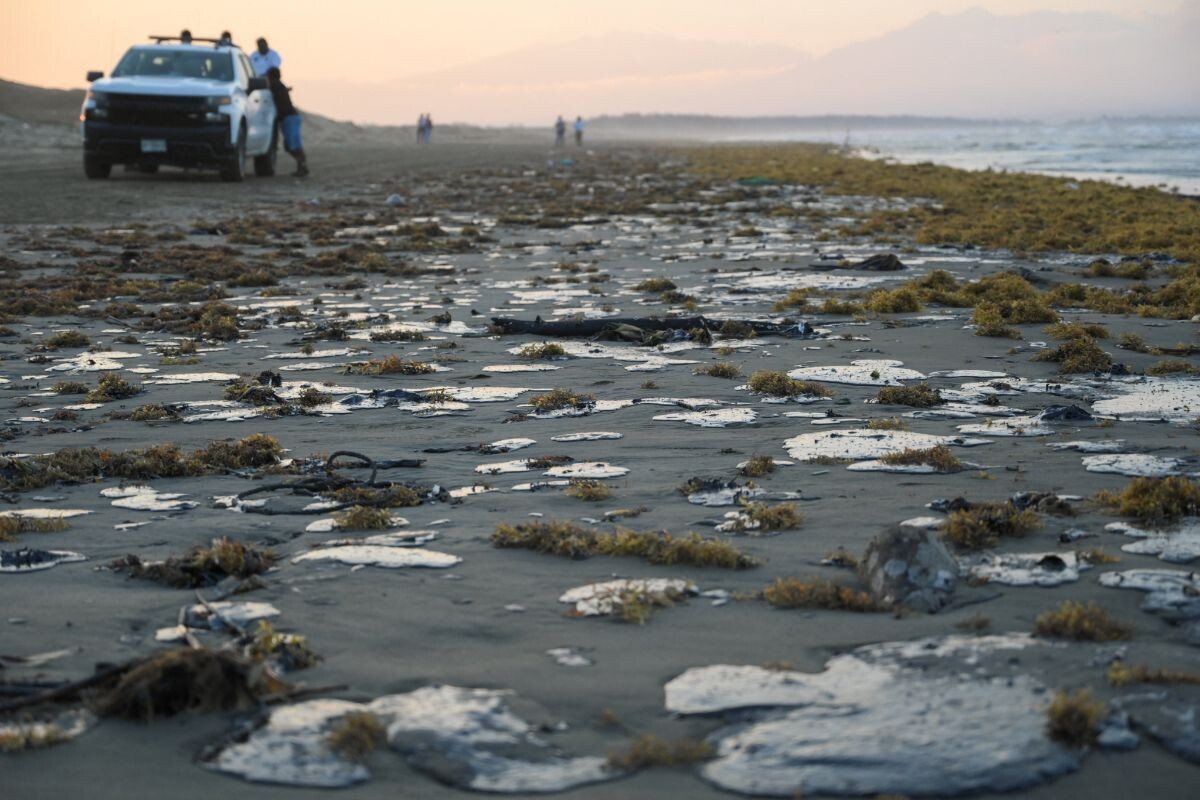
Eleven days after the start of a hydrocarbon spill on the beaches of the state of Veracruz, in the Gulf of Mexico, the federal government indicated this Friday that it maintains an analysis of currents and winds to strengthen containment actions for the slicks detected on the coasts of Veracruz and Tabasco. In a press release, the Mexican government pointed out that "due to weather conditions and variations in sea currents," hydrocarbon slicks have been detected on the beaches of the Gulf of Mexico, particularly in the areas of Alvarado and Coatzacoalcos, Veracruz, as well as on the coast of Tabasco. In the case of Dos Bocas, Tabasco, the movement of the spill has a "different evolution" than initially forecast for this scenario. The text stated that after the first reports recorded in early March, technical personnel from the Agency for Safety, Energy, and the Environment (Asea) conducted verification tours at port facilities and coastal areas. "During these inspections, no leaks were detected at terminals or infrastructure near the coast; however, on some stretches of beach, hydrocarbons with varying degrees of weathering were identified," it noted. On Thursday, the governor of Veracruz, Rocío Nahle, told the media that the hydrocarbon spill that has contaminated several kilometers of the coasts of the aforementioned states comes from an oil tanker in the waters of the state of Tabasco. "It was from a private vessel, not from Petróleos Mexicanos (Pemex), it was from a tanker from another oil company that was working off the coast of Tabasco (...) due to sea currents, it flowed to our state," she said. Despite these statements, the Mexican government pointed out in its report that to date, "the source of the contaminant is still being evaluated" and that according to the oceanographic models currently being analyzed, "it is observed that the hydrocarbon comes from the sea towards the coast." It also stated that reconnaissance flights have been conducted with aircraft and surface maritime patrols, as well as the use of drones, satellite mapping, and studies of sea currents in the ports of Alvarado, Coatzacoalcos, and on the Tabasco coast "to assess the possible expansion of the contaminant and establish containment and mitigation measures." In the case of the state-owned Pemex, it was indicated that it immediately initiated containment and cleanup actions at sea by deploying its Oil Rec vessel, with the installation of barriers and recovery work that made it possible to control the spread of the slick. In addition to Pemex, the secretariats of the Navy (Semar) and the Environment and Natural Resources (Semarnat), the Federal Attorney for Environmental Protection (Profepa), and the National Commission of Natural Protected Areas are working in the emergency response, along with the authorities of Tabasco and Veracruz, who have implemented cleanup brigades on the beaches with the support of fishermen, local authorities, and communities in the region.