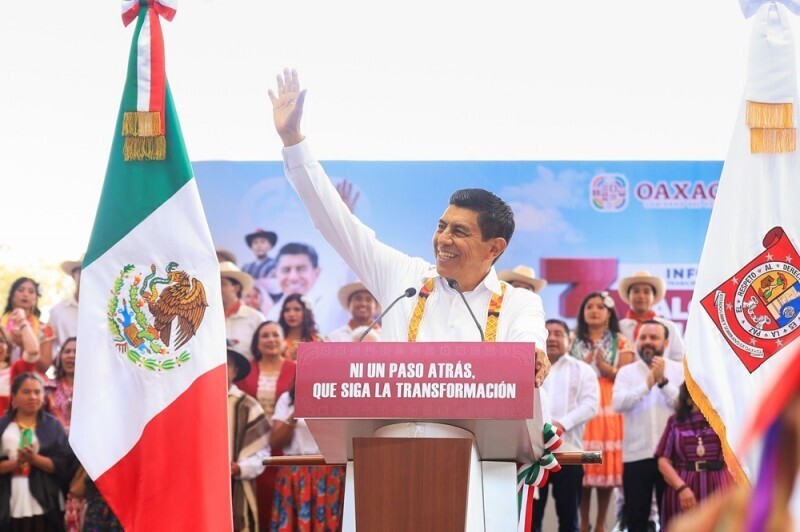
Governor of Oaxaca Salomón Jara presented his third government report this Sunday before more than ten thousand people, highlighting the achievements of his administration, known as "The Oaxacan Spring," in infrastructure, security, and well-being.
Oaxaca today has a comprehensive policy to address such issues, which has been recognized by the United Nations (UN). For the first time, three shelters were created to handle cases of extreme violence. Likewise, through the "Brigada Violeta," more than 100,000 services have been provided in the territory.
In an unprecedented event, over 2,110 million pesos were invested to boost agricultural production, supporting more than 436,000 producers.
"We are a government of the territory because Oaxaca is a country," explained the governor.
He stated that during the first three years of his government, nearly six thousand works have been carried out in the eight regions through an unprecedented investment of 16 billion pesos.
"The Fourth Transformation in our country and in Oaxaca is not just a speech; it is a change of mentality, and our model is based on the deep values of our social community system," he stated.
Before more than 12,000 people gathered at the Guelaguetza Auditorium, the governor highlighted that, alongside the honorary president of the Oaxaca DIF System, Irma Bolaños Quijano, various actions have been carried out directly in the communities in the fields of agriculture, health, education, and security, without indebting the state.
This Sunday, the governor was accompanied by the Secretary of Labor and Social Welfare of Mexico, Marath Baruch Bolaños López; the governors of Chiapas, Puebla, Tabasco, and Veracruz, Oscar Eduardo Ramírez Aguilar, Alejandro Armenta Mier, Javier May Rodríguez, and Norma Rocío Nahle García.
With the backing of the Federal Government, all medical units in the state currently have an 80% supply of medicines.
At the same time, Salomón Jara stated that the 23% reduction in the crime rate allowed Oaxaca to move from the eighth to the fifth safest state in the country.
"Oaxaca will be a precedent for the revocation of mandates in the states."
With the Food Self-Sufficiency program, a plate of food is guaranteed in Oaxacan homes through projects that bring supplies and training to those who produce in rivers, the sea, and lagoons; in apiculture and livestock.
With the Oaxacan Spring, corn cultivation increased from 500 to 800 thousand tons, representing 90% of the state's annual consumption of this grain; furthermore, the entity is the national leader in the production of mezcal, papaya, and mango.
In economic matters, the local government increased revenue from 5,500 million pesos in its first year to 7 billion in this 2025.
Additionally, with 850 million pesos, "My First Job" has propelled nearly nine thousand university graduates.
Meanwhile, 27,665 heads of families living in extreme poverty were supported with the Margarita Maza Card.
In collaboration with the Government of Mexico, the Corridor and the Interoceanic Train, as well as development poles benefiting 2.4 million people, have been promoted.
These actions have been fundamental for 280,000 people to leave poverty and 165,000 to leave extreme poverty in two years of government.
Likewise, he stated that a historic amount of 2,200 million pesos was executed in health, as more than 300 works of health infrastructure and services were carried out, among them: the construction of the Oaxacan Women's and Children's Hospital and the initiation of works for "Ciudad Salud."
"Oaxaca is in a unique moment in its history at an economic level."
In this context, he highlighted the fulfillment of the construction of the Control, Command, Communication, Coordination, and Intelligence Center (C5i); the most important security work in recent decades.
Four wastewater treatment plants are also being built.
The roads that connect the capital city with the Isthmus and Costa regions were also inaugurated; the "Mujer Solteca" dam is being built, which will bring benefits, and in the Mixteca region, with the Lázaro Cárdenas del Río Plan, roads are being built.
On the other hand, the governor stated that the money that was stolen in past administrations now reaches those who need it, as more than two million people receive one of the eight social welfare programs.
In two years, the state's economy grew by almost 50%, and exports of 2,947 million dollars were reached; also, 538 MSMEs received support for 1,000 million pesos.
In the Sierra de Juárez, with the backing of the Government of Mexico, the General Hospital of Ixtlán de Juárez was completed and equipped; the Hospital of San Felipe Jalapa de Díaz and the General IMSS-Bienestar Hospital of Tuxtepec, both in the Papaloapan Basin.
On the other hand, with an investment of 156 million pesos, 16 "Bienestar" pharmacies were launched in the eight regions of the state, which attend to more than 130,000 Oaxacans, bringing medicines, studies, and consultations with timely and humane care.
To strengthen community participation, 400 "tequios" (collective work) of reforestation, literary, and security themes were carried out, with which abandoned spaces were rescued, in addition, 11 thousand hectares were reforested and up to 12 million plants were produced.
In this context, a record was broken in private investment with more than 145,000 million pesos.
He also reported the construction of the Transfer Station and the Integral Center for Revaluation of Urban Solid Waste (CIRRSU); six kilometers of roadway that will connect the Ex Garita with the Oaxaca International Airport.
With "Zero Enrollment," each semester more than 90,000 students are benefited; the "Youth Card" allows 22,000 young people to access culture, sports, and recreation.
With dialogue and governability, 43 agrarian conflicts that had been unresolved for over 50 years were conciliated.
In a historic event, the first voluntary, safe, and dignified return of families in a situation of forced internal displacement from the agency of Guadalupe Victoria, San Juan Juquila Mixes, began.
Furthermore, more than 500 "Bienestar Roads" that connect the communities and the construction of 1,900 educational infrastructure works were executed; among them, three universities: the Afrouniversidad Politécnica Intercultural, the Politécnica and Tecnológica del Istmo de Tehuantepec, and the Intercultural del Pueblo.
He also stated that the Collective Metropolitan Transport System BinniBus has made five million trips with modern, safe, and inclusive units.
With the "Pave the Potholes" program, 250 kilometers of streets and avenues are being rehabilitated with an investment of 265 million.
Additionally, there was an 80% decrease in roadblocks and a 70% decrease in toll booth takeovers.