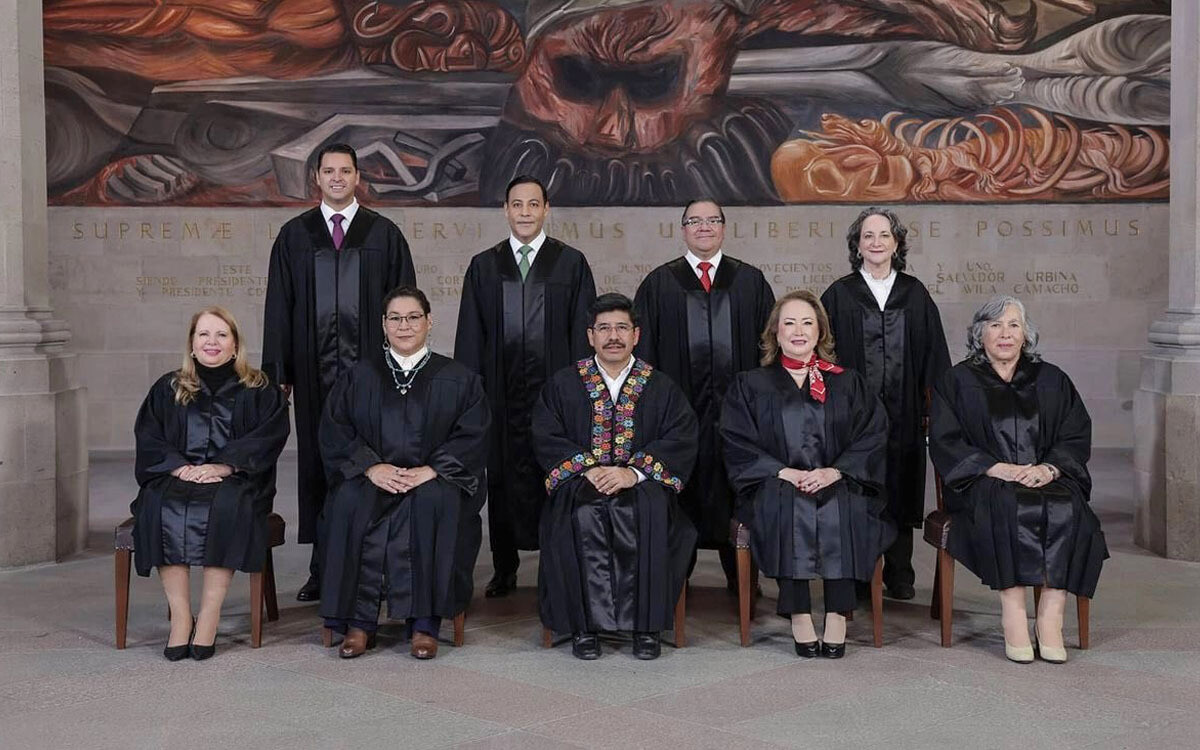
The new Supreme Court of Justice of the Nation (SCJN) has recorded a historic drop in the issuance of theses, which are the substantive parts of sentences with binding value for lawyers and judges, said Yadira García Montero, a member of the Justice Observatory. Between September 2023 and February 2024, the Court issued only 13 theses, 5.8% of the 224 registered in the same period by the previous administration, she warned in an interview for Aristegui en Vivo. «If we consider that three ministers were already in the Court, it was assumed that they knew how to carry out this work, so there is no longer any justification for this drop,» she said. The academic from the Monterrey Institute of Technology referred to the ministers Loreta Ortiz, Lenia Batres, and Yazmín Esquivel. She also highlighted that the reduction directly affects the ability of lawyers to use these theses in the defense of cases, especially in situations where fundamental rights are at stake. The Justice Observatory, of which the academic is a part, has registered this trend through graphs comparing equivalent periods between the previous and current Court. According to García Montero, the new Court has reduced the production of theses to just over two per month, a collapse that exceeds what could be explained by a learning curve for its new members. «We are obstructing access to criteria that could benefit people deprived of their liberty; it is serious, a drop of more than 90% compared to two years ago,» she warned. The academic added that the publication of the theses in the Semanario Judicial de la Federación, necessary for them to become mandatory, has also been slower, which further complicates their application. García Montero pointed out that the reform that eliminated the Court's chambers sought to increase efficiency and productivity, but «the plenary is not functioning as it should; the objective of the reform is not being met.» The theses, she explained, are fundamental for interpreting what is constitutional, protecting rights, and giving consistency to the judicial system. Furthermore, García Montero emphasized that these figures reflect a direct impact on society. «When these criteria are not generated, lawyers have fewer tools to defend their clients; this can affect any person involved in a judicial process, from citizens facing civil lawsuits to people deprived of their liberty,» she detailed. The Justice Observatory has grown considerably since its creation at the Monterrey Tech, bringing together universities, colleges, and specialists in the analysis of judicial functioning. According to García Montero, the Observatory's work allows it to point out these drops, identify procedural problems, and issue recommendations to improve the transparency and effectiveness of the Court. «It is urgent that the issuance of theses be reactivated and that their publication be expedited; each thesis represents a criterion that can protect rights and guarantee that judicial decisions are consistent and predictable,» the academic concluded. The collapse in the production of jurisprudence, she said, highlights doubts about the Court's efficiency and its ability to meet the reform's objectives, as well as about the effective access of citizens to the criteria that guide the interpretation of law in Mexico.