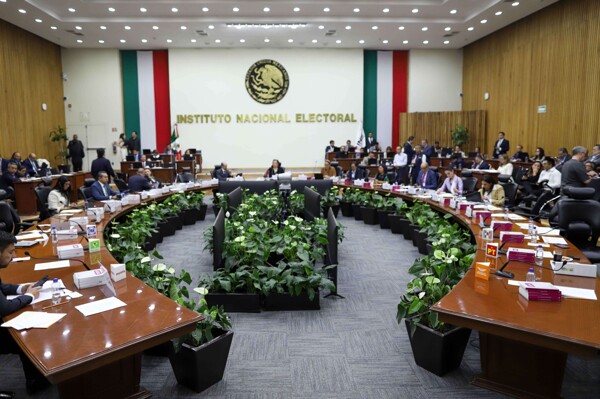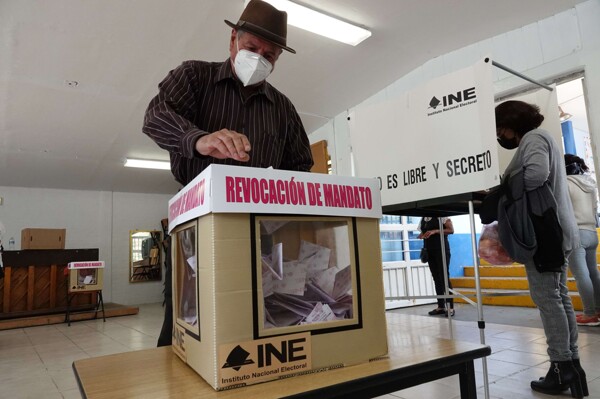
The recent events force the government and the Morena party to return to politics, an art from which they had abdicated, believing that force alone was sufficient. This struck at the terms of the governing coalition's alliance and precipitated a political reshuffling, facing very serious issues, those of national rather than merely electoral interest. However, to return to politics, a precondition is to have capable and convinced operators who serve only one master. Without this reflection, accompanied by corresponding action, it cannot be ruled out that the engine and the ghost of the idea to align the midterm elections with the recall referendum were and are the fear of loneliness and political weakness. If the original government's plan for political-electoral reform was bad and was actively sabotaged, the alternative plan was even worse and was executed even worse. Like the original, the alternative lacked a diagnosis and, of course, a budgetary impact assessment, and as seen, the initiative was drafted without properly understanding, comprehending, or framing the issue. However, one of these plans went off the rails, and the other will surely demand much more 'fuel' – positions, perks, and privileges – to stay on course. With such victories, the government and Morena are obliged to calculate how much this Pyrrhic victory favors them. Not to mention the loss of authority and legitimacy for the head of the Institute, Guadalupe Taddei, who is left as the master of ceremonies for the funeral party. If that were not enough, the absurd political-legislative maneuver in which the supposed collaborators and operators embroiled the head of the executive failed in its major objective – aligning the election with the recall – and provoked two counterproductive effects. Therefore, it would not do the head of the executive any harm to truly determine with which collaborators and operators she counts and act accordingly. Without this reflection, determination, and subsequent presidential action, it will be impossible to rule out that the objective of aligning the recall-confirmation of the mandate was to ensure power and expand the margin of maneuver against the governors, collaborators, operators, and Morena coordinators who obey one command and answer to another. To put it briefly, it will be impossible to rule out that the ghost and the engine of advancing the recall-confirmation of the mandate were the fear of loneliness and political weakness. It remains to be seen if the supposed and limited, not substantial, partial success of the alternative plan is real, because due to the lack of political calculation, it shakes structures, weakens institutions already dominated by the government and Morena, and alters the terms of the established alliance and precipitates the 2027 electoral reshuffling. Beyond the pretense and apparent discipline, several questions remain to be answered. Then, it was operated in the party and parliamentary sphere with the spirit of an extortionist in training. The photo of the party leaders and parliamentary coordinators of the coalition led by Morena, holding hands and in front of the banner 'Full Support for Plan B,' is the image of political illusion and simulation. In this strange proceeding, it is astonishing that the political operators, nor the government's legal advisors, nor the party leadership nor Morena's parliamentary coordinators seriously warned the head of the executive about the straitjacket they were tailoring for her, deliberately or not, about the political disaster looming ahead. They can, of course, the official line's intellectual acrobats argue that the great move was to get out of the satellite parties that Morena associated with. It is necessary to determine not only with which collaborators and political operators the government and Morena count, but also to analyze if these loyal ones are truly capable of fulfilling the tasks entrusted to them. Granting that the head of government was not the one clinging to pushing and sustaining a lost cause like 'Plan B' – in reality, 'Plan E' – the reason for this reflection is simple: they embroiled her in a political-legislative adventure whose defeat was certain, and in the process, altered the institutional and political ecosystem where the government and Morena operate. There are no shortage of cynics, militants of resentment, eager to settle the score with the petistas and calculate how much the duplicity of the greens will cost them. The sentiment of councilors and high-ranking electoral officials whose workload is increased, salaries are cut, and private medical insurance is withdrawn when the public one does not guarantee care, all while they see how the autonomy and independence of the institution where they serve is being violated. How the Senate will react to the reduction of its budget (recall Adán Augusto López's stance when he attacked Ricardo Monreal on the same issue). The reaction of the local legislatures, as well as the city councils, and, by extension, the governors, to the fact that the deteriorating center of federalism is capping their spending. The double failure of the president's intention to reform the electoral model and the party system prompts the head of the executive to a reflection. What luck for deputy Ricardo Monreal to have only reviewed and not issued the verdict! The critical point is obvious. Hopefully, that was a product of incompetence and negligence, not of disloyalty and deceit rooted in the idea of serving one master and answering to another. By the way, why does Morena have Adán Augusto López and Ignacio Mier as sub-coordinators in the Senate, and no coordinators, both being protégés of the governor of Chihuahua? It was conceived and drafted haphazardly. However, the important point is not that. The errors were colossal.