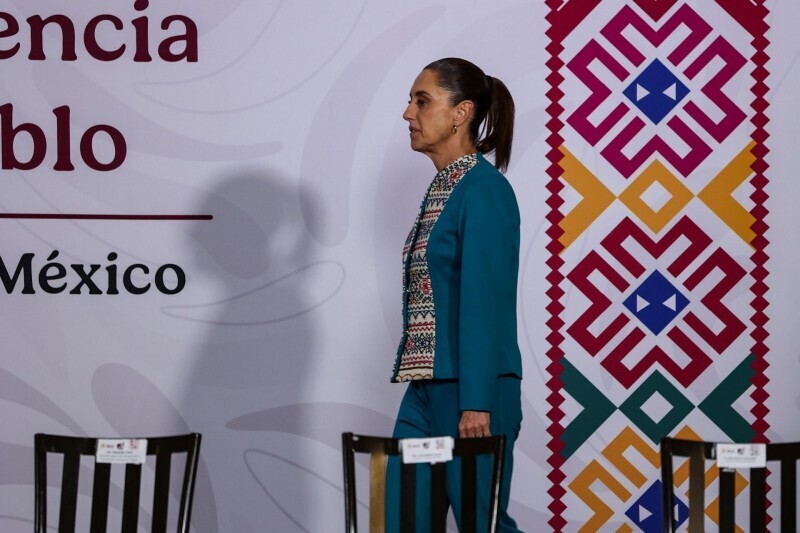
President Claudia Sheinbaum stated that in the event of an oil spill, a protocol is followed to stop it. Last week, Sheinbaum's government held the first press conference on the spill almost a month after the first reports from environmental organizations and local residents. However, yesterday three organizations questioned the initial results. Conexiones Climáticas, Centro Mexicano de Derecho Ambiental, and CartoCrítica assured that the Mexican government did not provide precise information, as they claim that since February 6, satellite images showed hydrocarbon stains in the marine area off Campeche, coinciding with the Old AK C pipeline, a 36-inch diameter active line that transports crude oil between the AkalC platform and the Dos Bocas Maritime Terminal. In the oil sector, the theory that the spill in the Gulf was due to a pipeline failure at Pemex is growing. They also claim that from February 7 to 14, 2026, the Árbol Grande vessel, specialized in pipeline repair, remained over the 'OLD AK C' pipeline of PEMEX, while satellite images showed a large oil stain in the area. President Claudia Sheinbaum assured this Tuesday that investigations into the oil spill on the Gulf coast continue, amidst growing questioning from social organizations about official reports. In her morning press conference today, the president informed that she will meet this Wednesday with the group of scientists investigating the case; she expects a new report on the facts that affected about 600 kilometers along the coast of the states of Campeche, Tabasco, and Veracruz. The focus of this investigation is Cantarell, the giant oil field located in the Campeche Sound and where one of the sources of these emissions was found. The Navy does not rule out a failure at Cantarell as the cause of the Gulf spill. In the first joint report offered by the Secretariat of the Navy, Environment, Sener, and Pemex, it was stated that the spill had three sources of origin: an illegal discharge from a vessel, for which they still do not recognize the responsible party despite it being an incident reported by the Mexican oil company since early March; and two natural emissions. One of these emissions comes from Cantarell, which aggregates about 400 crude oil wells and is an area still in operation. The hypothesis that the government maintains is that it is a natural chapopotera. However, experts have pointed out the possibility that it is a leak in some Pemex pipeline in that area, amidst a cut in resources for its maintenance. Sheinbaum explained that the group of scientists convened for this issue is reviewing these installations to determine if they are natural chapopoteras in this area or a leak from any of the installations. 'So far, no leak has been reported, and if there were, it would be repaired.' Far from alerting in time, the authorities came out almost a month later, when the spill reached the coasts, to talk about an unidentified vessel and natural chapopoteras. The available evidence refutes that version,' they assured.