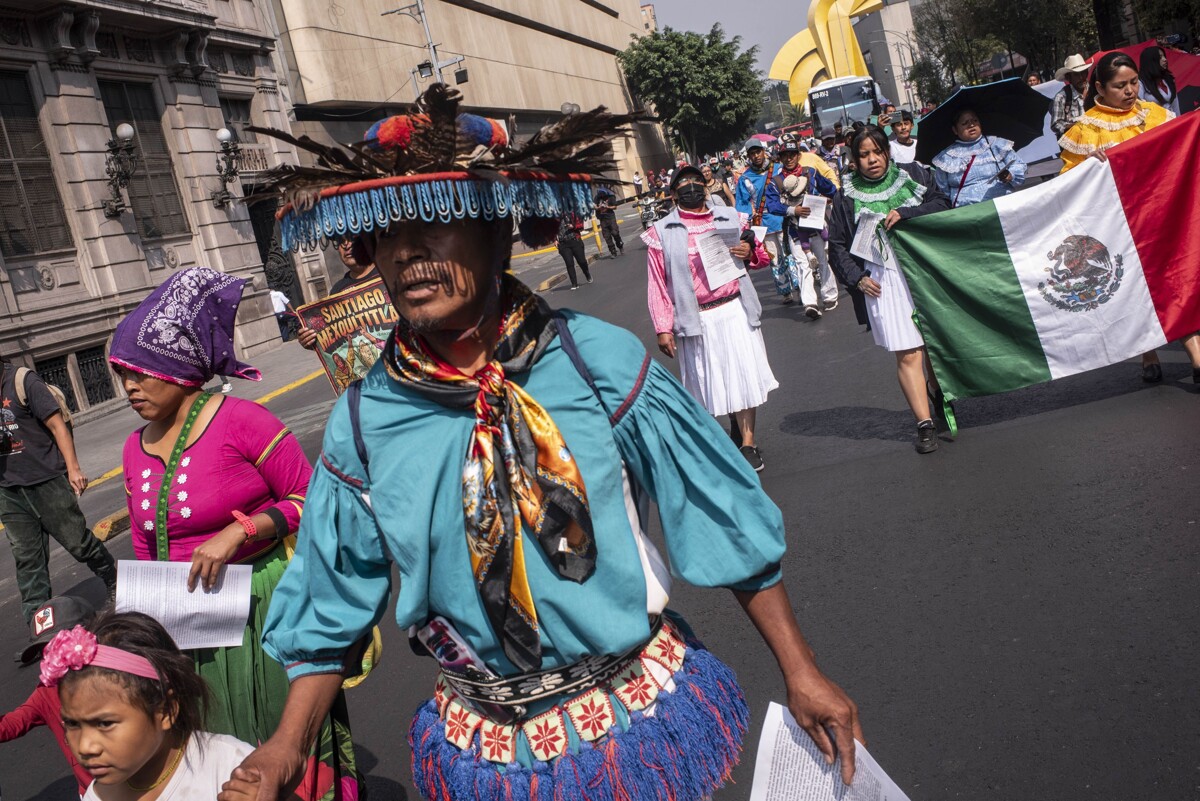
The core of the judicial argument is that if non-indigenous candidates are allowed, they could be elected in these districts. That is, in a district with 85% indigenous voters, for example, it cannot be permitted to have non-indigenous candidates because if this vast majority were to decide to give their vote to one of them to represent their interests, that election, that decision of the voters, is not considered legitimate by the authority, and therefore it is prohibited. That is, to define the general electoral right of indigenous peoples, a vast presence of them is recognized in the national territory; however, of the total number of indigenous people in whose favor districts and electoral quotas are established, only a small part can compete to represent them. The Constitution, and consequently the Mexican electoral system, recognizes different political rights to the indigenous peoples and their members. These mechanisms, however, result in strong restrictions on the right of indigenous peoples to give themselves representation through the vote. Requiring indigenous people to documentally prove their membership in a community to be nominated was the mechanism the court found in 2017 to evade the constitutional mandate to recognize rights as an indigenous person to whoever identifies as such. The right of indigenous peoples to freely give themselves representation is restricted to prevent them from mistakenly voting for someone whom the authority does not represent, even though they think otherwise. As part of this, indigenous electoral districts are established, based on the proportion of the population of Mexico's original peoples in the territory of these demarcations. In practice, the INE, based on INEGI data, has sought to establish the largest possible number of indigenous districts, on the understanding that this better guarantees the rights of these peoples. That is, it becomes the norm that the State protects indigenous people from their own vote. Unequivocally, they are treated as minors, conditioning their basic right to give themselves representation to the approval of an authority that is foreign to them. The right to be represented as indigenous is recognized for approximately 24 million Mexicans; however, the vast majority of them are stripped of the right to be voted for. Reserving federal seats for representatives elected by indigenous peoples is very relevant for them as a whole, whether they live in their communities of origin or have migrated; but this quota is not an adequate instrument to respond to the particular needs of indigenous communities. The Electoral Tribunal, for its part, has decided that, for a portion of them, only those who can prove they belong to indigenous communities can be candidates for federal deputies, under the so-called 'qualified self-identification', in order to guarantee the representativeness of the contenders. These communities require focused and very heterogeneous attention from various state agencies. In districts reserved for indigenous candidacies, they are prohibited from voting for anyone not recognized by the State as belonging to an indigenous community, regardless of who they truly are and, above all, the will of the voters to vote for people who fall outside the judicial definition of a community indigenous person. In this way, in districts with more than 70% indigenous population, only a few of them can be candidates, and when there are political and community leaders who, not being indigenous, enjoy broad support, the indigenous people themselves do not have the right to vote for them; they cannot be candidates. Since under this provision it was not possible to demand proof of indigenous status, the membership of the person involved in an indigenous community was made subject to demonstration, understood as a small locality governed by traditional authorities. With this definition, the vast majority of people recognized as indigenous by INEGI are unable to be nominated as such. Many are owed representation, but only a few, decided by the authority and not by the indigenous people themselves, have the right to claim that debt. The basic conceptual error of this legal perversion is to ignore that the indigenous population is much broader than the indigenous population that lives in indigenous towns, and that, consequently, the needs for recognition and representation of these two population segments are different.