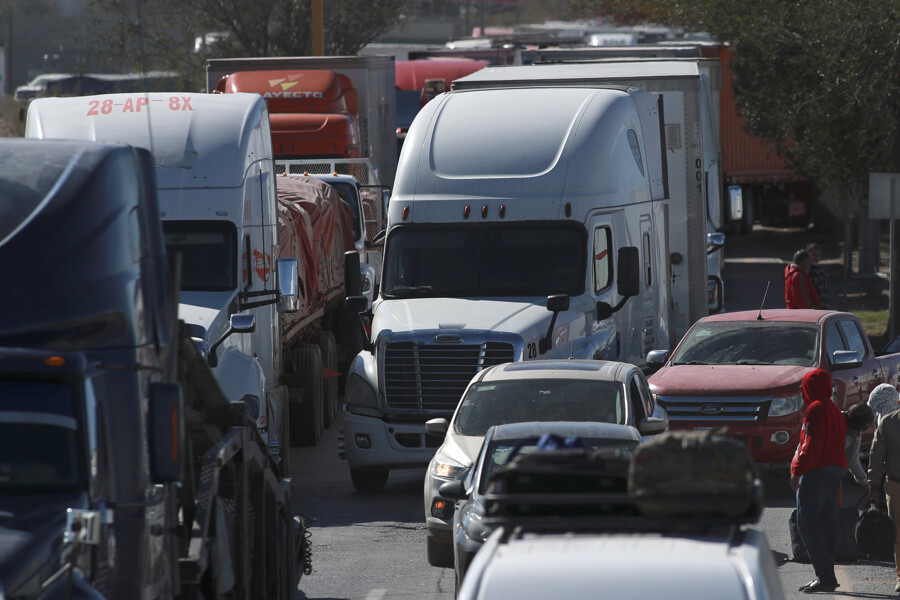
Mexican transporters and farmers announced that the nationwide strike scheduled for this Monday, April 6, remains firm, with blockades planned on highways and strategic points in 20 states, while demanding greater security, an end to extortion, and compliance with government commitments.
In a joint statement, the National Association of Transporters (ANTAC) and the National Front for the Rescue of the Mexican Field maintained that the decision to strike, which will begin at 7:00 local time (13:00 GMT), is a response to the "abandonment, insecurity, and lack of decent conditions" for those who move goods in Mexico, as well as due to the crisis threatening the supply and prices of food.
In the statement, transporters affirmed that on highways, robberies, homicides, disappearances, and extortion have already become part of the sector's daily life. They also denounced corruption at checkpoints, high operating costs—especially due to fuel—and the absence of support for the families of deceased operators.
To these demands, they added permanent security on federal highways, an end to extortion and corruption at checkpoints, fair conditions for cargo transport, support for the families of victims of insecurity, and the elimination of the special tax on production and services (IEPS) on diesel for the sector.
Meanwhile, farmers added warnings about the decline in national production due to unfair and low-quality imports, high costs, droughts, and low harvest prices, as well as the control of the market by large companies that pay producers little and sell to consumers at high prices.
Additionally, they noted increases in fertilizers, diesel, and all inputs and services derived from the war in Iran, as well as the lack of sufficient financing and support for Mexican agriculture.
Among other demands from both sectors, the creation of a specialized prosecutor's office for reporting crimes in heavy cargo transport, removing basic grains from the Mexico, United States, and Canada Agreement (T-MEC), and stopping indiscriminate imports were highlighted.
They also demanded the establishment of fair prices that allow producers to recover costs and obtain a dignified income for their families, the creation of a development bank for agriculture, and the creation of a new public policy for the development of an agri-food model that makes our agriculture and food more visible and less dependent.
It was also necessary to treat sorghum as a basic and strategic product, to restart and conclude the payment of direct supports to wheat and corn producers that are lagging since 2023, and to respond to demands presented by producers from each state on April 1.
Among the routes mentioned in various reports as possible points of blockade are the highways connecting the capital Mexico City with the states of Querétaro, Pachuca, Puebla, and the city of Cuernavaca, in the state of Morelos.
Also mentioned are the short route to Chihuahua, Federal Highway 45 Pan-American, Culiacán-Mazatlán, Salamanca-Celaya, Federal Highway 49 between Zacatecas and San Luis Potosí, the Western highway, and Morelia-Pátzcuaro.
The movement, which assures will be peaceful, states that it does not seek to confront the citizenry, but to pressure for attention to a crisis that, in their opinion, puts both transport and national supply at risk.
"Without producers and without transport, there is no food," the organization warned in its statement.