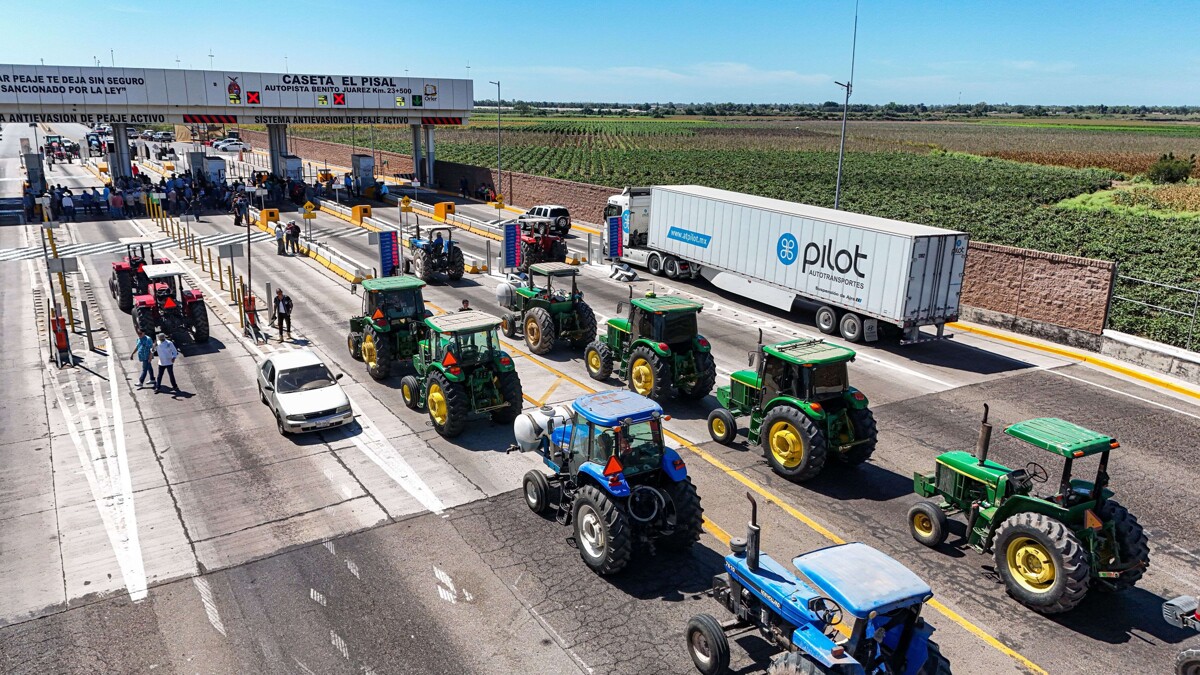
The government called on avoiding actions affecting third parties and not interrupting the operation of communication routes, the statement indicates. Both institutions detailed that of 29 requests from the transport sector, 20 have been addressed, such as the construction of 10 safe stops in coordination with the Ministry of Infrastructure, Communications and Transport, the closure of more than 700 irregular road accesses, and the implementation of monitoring and tracking systems that increase transparency and operational efficiency. Regarding the demands of farmers, they highlighted the delivery of 3,412 million pesos to 40,910 producers, as well as the expansion of the "Harvesting Sovereignty" program, which provides subsidies on interest rates and risk insurance to include products that were not previously part of the support catalog, such as sorghum and meat. On its first day of indefinite strike, the National Association of Transporters (ANTAC) and the National Front for the Rescue of the Mexican Countryside (FNRCM) blocked highways and opened toll booths in nine states to pressure the federal government into attending to their demands. As of 6:00 PM, the Ministry of the Interior indicated that blockades continued in five states: Baja California, on Federal Highway 2D Mexicali–San Luis Río Colorado; Guanajuato, on Federal Highway 110, Pénjamo–La Piedad; Michoacán, on the Mexico-Guadalajara highway (Contepec toll booth); Tlaxcala, on Federal Highway 136 of the Mexico-Veracruz route; and Morelos, on the Siglo XXI highway, at the height of Amilcingo. However, at 8:00 PM, the National Guard reported the release of the route in Baja California. Mobilizations were also registered in Mexico City, where transporters took over the La Venta toll booth on the Mexico-Toluca highway, allowing free passage intermittently; after nine hours of disruption, the road was cleared. The blockades and toll booth takeovers in Chihuahua, Veracruz, and Tamaulipas were also removed after more than five hours of blockades. The start of the mobilizations was rushed and limited compared to the mobilization announced in 20 states. The blockades were scheduled to start at 9:00 AM but began after 10:00 due to a supposed boycott by the federal government, denounced David Estévez, leader of ANTAC, in an interview with El Financiero. "There has been a lot of sabotage by the government, a lot of intimidation, we have already posted it on our social networks, there are videos where they detained some of our colleagues, but they are just setting up the blockades." What are the main demands of the transporters? The transporters demand effective security strategies on highways; direct support for transporters affected by violence; support for widows and orphans of fallen colleagues; administrative simplification, and fair conditions for the operation of cargo transport. On the other hand, the Secretariats of the Interior and of Agriculture and Rural Development highlighted, in a communiqué, the progress in addressing the demands of farmers and transporters, for which reason they said that most organizations have decided not to mobilize, and they reiterated that ANTAC and FNRCM "are acting without justification." Therefore, they called for prioritizing dialogue and avoiding economic and social harm to third parties. "The government of Mexico reiterates that the demands raised have been met punctually and that the agreements continue to be processed in accordance with administrative and operational times."