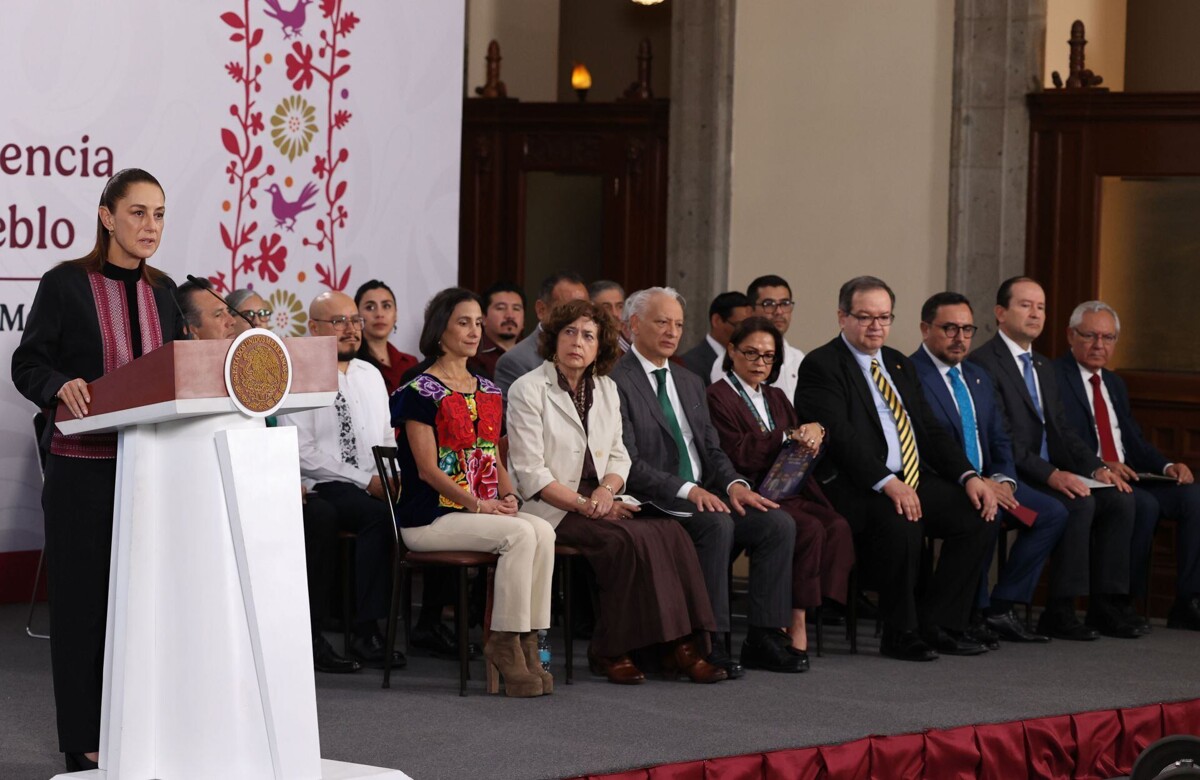
Mexico's President Claudia Sheinbaum announced a change in her stance on fracking. She acknowledged that she was previously against the technique but explained the reasons for her shift in opinion. "I was also against fracking, but when I see new technologies and the country's situation in terms of dependency, the worst I can say is no, without taking new technologies into account," she added. The president mentioned Coahuila as a pioneer in fracking due to its geological characteristics and low population density, in order to avoid affecting communities. Specialists confirmed that they are analyzing various alternatives for fracking in Mexico with the support of new technologies. The main objective will be to achieve energy sovereignty and reduce the country's dependence on gas from the United States. President Claudia Sheinbaum presented at her conference the group of scientists and cabinet members who will be in charge of analyzing the possibility of the return of fracking to Mexico. The rector of the National Autonomous University of Mexico (UNAM), Leonardo Lomelí, is one of the participants, and in his speech, he called for taking into account the environmental costs, but also the importance of energy sovereignty for the country. In addition to Lomelí, rectors and directors of public universities such as UAM, IPN, and other schools from different states will participate. Sheinbaum presented the 'dream team' for fracking in Mexico: these are the scientists. President Claudia Sheinbaum introduced the group of scientists who will analyze the possibility of fracking in Mexico. Among them are the rector of the National Autonomous University of Mexico (UNAM), Leonardo Lomelí; as well as academics from various public universities in Tamaulipas, Nuevo León, Veracruz, and Coahuila. It is expected that the first conclusions of the analysis will be presented in two months. Sheinbaum highlighted that this would occur after the investigations for the exploitation of unconventional gas and where it would be viable. "Later we will continue working with the scientists so that they continue to guide us." Other team members are: Rosaura Ruíz, head of the Secretariat of Sciences, Humanities, Technology, and Innovation of Mexico. The director of the National Polytechnic Institute (IPN), Tomás Huerta. The rector of the Metropolitan Autonomous University, Gustavo Pacheco. Dr. Carlos Herralde Monreal, a fracking specialist. Dr. Manuel Martínez Morales, a Geological Engineer from IPN. Jesús Humberto Romo, an Industrial Chemical Engineer. Samuel Alejandro Lozano, a Chemical Engineer. Dr. Blanca Jiménez, ambassador to France, a specialist in water issues. Rosa María Hernández, a Master of Science from IPN. Dr. Eric Emmanuel Luna, from the Mexican Oil Institute. Helena Centeno, a Geological Engineer from UNAM. José Alberto Morquecho, a Master of Science from IPN. Luis Fernando Camacho, a doctor in Geosciences, from the Autonomous University of Coahuila. Among the cabinet members accompanying this team are the director of Petróleos Mexicanos, Víctor Rodríguez; the Secretary of Energy, Luz Elena González; and the head of the Federal Electricity Commission (CFE), Emilia Calleja. Coahuila would be the place where fracking would begin after the analysis of the group of specialists and if the plan is approved by President Sheinbaum.