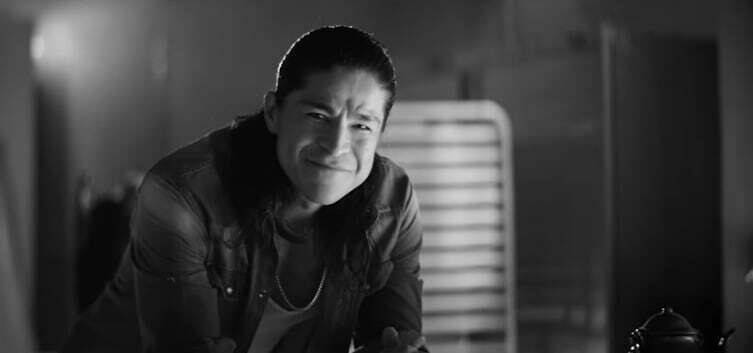
As part of the 41st Guadalajara International Film Festival (FICG), taking place from April 17 to 25, cinema once again engages in a dialogue with its essence through the 'FICG Minute.' This audiovisual proposal bets on pure narrative and cinematic emotion. To complement the festival's image, Mango Films and Eduardo Ávila developed this series of five capsules starring the Guadalajara actor, Cristo Fernández. Eduardo Ávila admitted he will face the screening of these pieces with a mix of excitement and nervousness, as it is a different format from what he usually develops. 'I don't know, because it's a different and new experience. So, to do that, we simplified it to something very basic, which is to tell a story. I think it worked very well. And what we wanted to do was to take a risk, as I told you, because it's not a traditional minute-long film, but rather it seeks to pay homage to cinema, to history, and to working with Cristo,' he revealed. Meanwhile, Cristo Fernández defines his career as a constant back-and-forth match where learning never stops. 'It's a match with many counter-attacks, many near misses. Cristo whom I knew from around, but we hadn't met in this facet of working together. Also, I say, showing this approach to cinema, to Latin cinema, to Mexican cinema, not through these stories that for many already represent a past, but for many will be a present.' For Fernández, his participation in these capsules coincides with a key moment in his career, where he combines international projects with a strong local connection. 'No, I'm very, very happy, very excited, just like the first time. And I, in reality, also thank you for the analogy, because I also see my work from the side of sports, sometimes I don't even know if I'm doing it right or wrong, I just do it. Sometimes a great goal comes out of it, but the match is not over yet.' 'And I believe that just like in sports, the same in life, sometimes you win, sometimes you lose, sometimes you draw,' he added. 'And here we decided to do it in a single shot, with a very subtle camera movement, in the case of Cronos, breaking everything that is a documentary, we turned it into a narrative.' The collaboration between the two creators flowed naturally, resulting in a creative experience that even exceeded their own expectations. 'There was good chemistry, we understood the idea well, and it was a very beautiful experience, right?' Ávila noted. 'The cool thing about soccer is that I don't just see it as one match, but as several matches.' 'There are many people who deserve opportunities, and it will make me very happy to see how this movie will catapult many of them, and it's a multicultural film with many elements, especially very Guadalajara locations, which I think is also something very beautiful,' Fernández said. From a creative direction, Eduardo Ávila opted to break the rules of contemporary advertising, taking the concept to the essential: the story. 'The concept comes from the most essential thing, which is the story, that's where a movie begins, the journey of a movie starts in the story, and what I wanted to portray is this image that forms in your head when you read the script.' 'It was something very beautiful, very significant to be part of this image, of this edition, and it fills me with a lot of pride and gratitude,' said Cristo. Currently, the FICG minutes for Cronos and Quebranto have been published, and in the coming days, the film pieces for Pelo malo, El complot mongol, and No nos moverán will be available on the festival's social networks. 'But the cool thing is that there's always another match, and there's always the opportunity to keep working hard and learning, because life, like sports, is not perfect, and like art, it's not perfect. And I think that makes it very complex,' Fernández concluded.