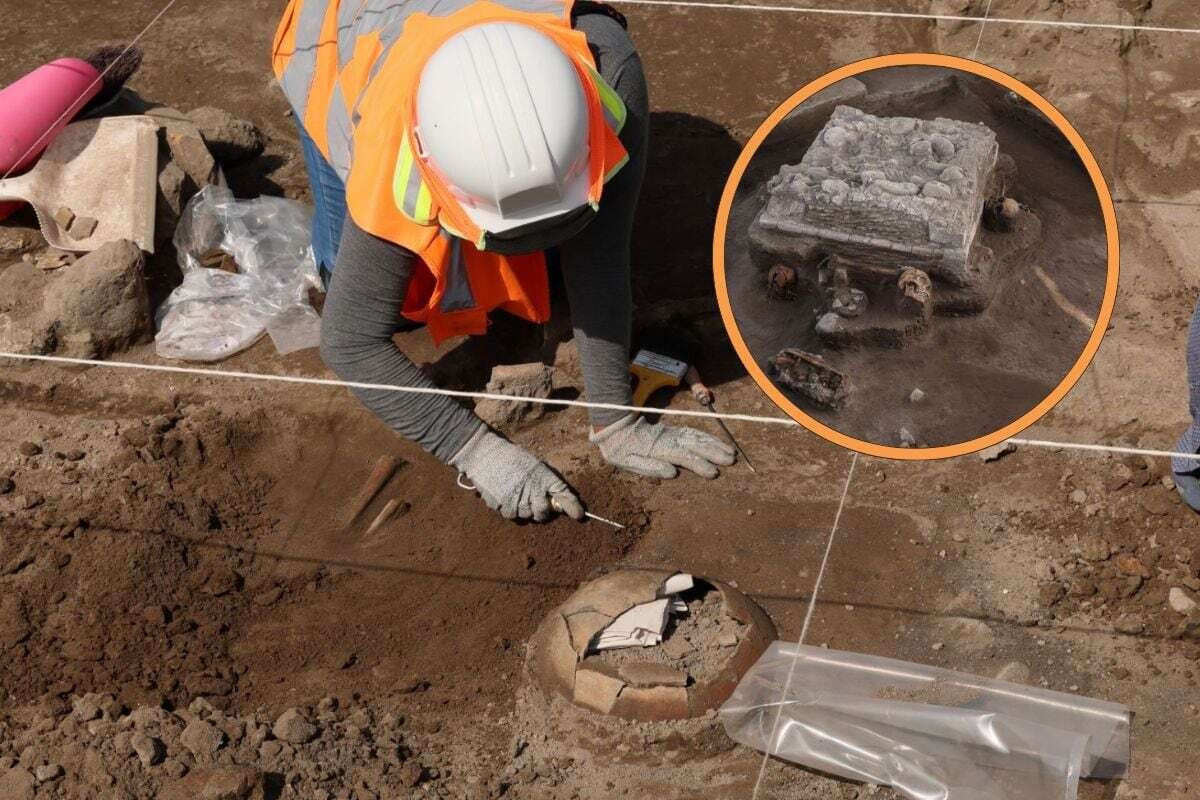
During excavations for the Mexico City — Querétaro train project, traces of a pre-Hispanic altar were discovered. The site has been secured by the National Institute of Anthropology and History (INAH) to understand the ancient capital of the Toltecs. According to official information, this find corresponds to the Tollan phase of the ancient metropolis, dating from 900 to 1150 AD, and was found near the area known as Tula Chico within the archaeological zone of Tula. Located 300 meters from the perimeter wall of the heritage site, the discovery was made during registration and excavation work on the right-of-way for Front 5, at a site identified as Site 17. What does this discovery mean? The Secretary of Culture, Claudia Curiel de Icaza, highlighted that the find confirms the importance of preventive archaeological work to protect, study, and preserve fundamental vestiges of our history. "Every discovery like this expands our knowledge of one of the great Mesoamerican civilizations and reinforces a central tenet of our cultural policy: Mexico's archaeological heritage is the memory of our peoples," she commented. Víctor Francisco Heredia, coordinator of the archaeological salvage project, detailed that the altar measures approximately one meter on each side and its construction system features a stone foundation and likely had at least three tiers. "In a one-square-meter sondage pit, we initially detected a small compacted surface, and upon extending the excavation, we found one of the altar's corners and the other vertices," he explained. On three sides of the altar's lower level, offerings of human bone remains were found, consisting of four skulls and long bones, probably femurs. Therefore, it is hypothesized that a similar offering may also exist on the fourth edge. Likewise, as part of the context, ceramic vessels (a black cajete with another inside), obsidian fragments, and blades were discovered.