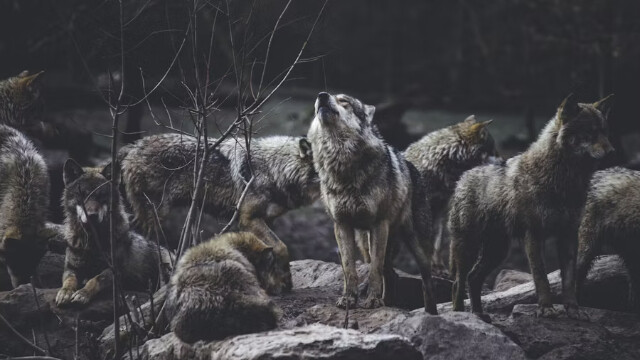
A group can watch, defend, hunt, migrate, and cry more efficiently than an isolated individual. Among the main benefits are: collective defense against threats, division of labor to optimize resources, social learning, especially in offspring, safer reproduction, and constant communication to coordinate actions. This organization does not arise by chance. They use specific sounds to coordinate movements and strategies. Many birds depend on teamwork, especially during migration, food searching, and breeding. Penguins live in large colonies, and their level of natural engineering continues to amaze science. Among mammals, group life is usually linked to protection, hunting, and care for offspring. Each species has developed its own system of collaboration, adapted to its environment and needs. Social life responds to specific needs. Their famous dances serve to indicate the location of flowers, a clear example of cooperative language. Termites build impressive structures that regulate temperature, humidity, and ventilation. They live in groups called colonies and collaborate to hunt, protect themselves, and care for injured members. This cooperation implies strong social ties and, in many cases, complex emotions. Wolves live in packs with a clear hierarchy. This relationship benefits both parties and shows how cooperation can also occur between different species. Not only the most famous animals live in groups. The young are cared for by several females, which strengthens the group. What is important is that the message is clear and timely. Observing animals that live in groups leaves clear lessons: collaboration, organization, and mutual support increase the chances of success. These rodents live in extensive underground communities. In nature, cooperation is not an exception, but an evolutionary strategy that has allowed many species to survive, adapt, and prosper. In many cases, there is a hierarchical structure, clear rules, and behaviors that are repeated from generation to generation. Insects are the clearest example of extreme cooperation. Without this exchange of information, group life would be chaotic. Some species develop complex languages, while others rely on simple but effective signals. There are lesser-known species with surprising systems of collaboration. Meerkats live in clans where some members stand guard while others look for food. They live in well-defined castes and collaborate to maintain the termite mound, feed the queen, and protect the colony. Living in a group implies communication, defined roles, solidarity, and, in many cases, surprising collective intelligence. From tiny insects to large mammals, teamwork manifests itself in complex and fascinating ways. Social animals do not group together just for company. In extreme climates, they group together to conserve heat, taking turns to protect the young. In nature, surviving is rarely a solitary effort. Animal social life shows that working together not only improves efficiency but also strengthens the group against adversity. They take turns leading, demonstrating a clear collective strategy. Crows are highly intelligent birds that collaborate to get food and warn of dangers. Their colonies function as living cities, where each individual performs a specific function. Ants live in colonies that can exceed one million individuals. From a hive to a herd, unity remains one of the most powerful tools for facing the challenges of the natural environment. This coordinated movement reduces individual risk and improves efficiency when searching for food. Some species collaborate with larger fish, cleaning them of parasites. The alert system is so precise that it allows the group to react in seconds to any threat. Beavers work together to build dams and shelters that modify the environment. They hunt in a group, which allows them to take down larger prey. In a hive, the queen bee is in charge of reproduction, while the workers collect nectar, produce honey, and protect the colony. Some look for food, others care for larvae, and others defend the anthill. Collective memory guides migrations and important decisions. There are queens, workers, and soldiers, each with defined tasks. Their empathy and solidarity make them one of the most complex social animals. Dolphins stand out for their intelligence and advanced communication. They communicate through complex sounds to warn about predators and collaborate in the maintenance of their tunnels. Life in a community offers clear advantages: greater protection against predators, better access to food, care for offspring, and shared learning. They share information and, in some cases, work together to defend resources. Fish that move as one In the aquatic environment, group life offers clear advantages against predators. Schools of fish move in sync, creating patterns that confuse predators. Chemical communication, through pheromones, allows actions to be coordinated with precision. Bees stand out for their organization and their role in pollination. Each member has a role during the hunt and food is shared, prioritizing the young. This thermal cooperation is vital to survive in frozen regions. During migration, geese fly in a V-formation, which reduces air resistance and saves energy. Communication can occur through sounds, gestures, smells, or body movements. In hostile environments, unity increases the chances of success. Coordination and loyalty are key to their survival. Elephants form family herds led by an experienced female.