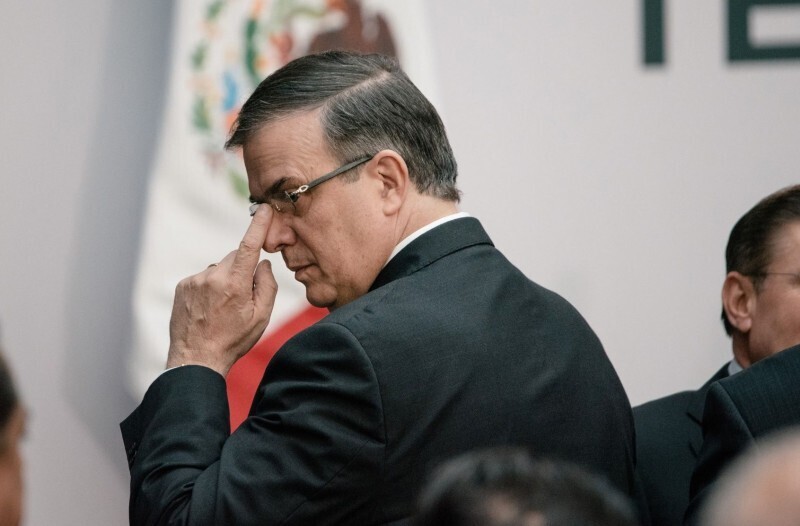
During one of her morning conferences, President Claudia Sheinbaum insisted that her government was working to prevent the trilateral agreement from breaking down. In an interview with the newspaper La Jornada, Foreign Minister Marcelo Ebrard considered Trump's threats to be part of his negotiation strategy, but emphasized the importance of trade relations for the countries and assured that during this time of negotiations, 'very good progress' has been made. In October, this newsroom revealed that a bilateral agreement scenario was gaining strength within the Business Coordinating Council (CCE), which, over the months, became a specific demand to the National Palace, especially after Trump's derogatory comments about the USMCA. At IMEF, they have a less optimistic view of this scenario, as Herrera stated, 'when you have a bilateral agreement with someone whose economy is 15 times larger than yours, you are in a losing position.' 'It is unlikely that President Trump, who has also discredited the treaty, will grant us a pass to say that we have already achieved the review and are moving forward,' said the specialist. After celebrating Carney, Sheinbaum looks to the continuity of the USMCA: 'We are working so that it is not broken.' This week, the business sector's morale was also affected by the exchange of words between Canadian Prime Minister Mark Carney and Trump during the Davos economic forum, which further encourages the possibility of a breakdown. From the National Palace, these signals regarding trade relations were minimized. When consulted by LPO about the possibility of the trilateral agreement dissolving and moving towards bilateral agreements, economist Víctor Herrera said with more conviction: 'It is a possibility.' In turn, political analyst and IMEF member Verónica Ortiz Ortega pointed out that the treaty could even become 'an obstacle' for Mexico, because the USMCA 'is the weapon that Trump uses to get results in other matters,' she said. Therefore, she considered that issues such as the non-tariff barriers that Trump demands or those of security will entangle its review. 'The best will be a trilateral agreement to avoid these constant reviews,' she said. Perhaps the scenario that will emerge is that the review is not achieved in July and we enter into an annual review scenario of the treaty. Another factor that IMEF is also evaluating against the continuity of the USMCA is that Trump is facing strong internal opposition and losing support: 'It is at that moment that he turns to the weakest and most vulnerable countries, and Mexico yields him politically,' he said. And a year into Trump's second term, executives agree that with the Republican 'there are no certainties about rationality and evidence-based reasons, but another logic.' This last week of January is expected that the Secretary of Economy, Marcelo Ebrard, will return to Washington to address trade issues, amid an escalation of tensions between the partner countries of the USMCA and a visible feeling of uncertainty about the future of the trilateral agreement in the business sector. The possibility of a fracture of the USMCA was already being raised within the Business Coordinating Council (CCE) since the end of last year, and as President Donald Trump's speeches maintain their challenging tone, this scenario is gaining strength in the private sector. At IMEF, confidence is also weakening.