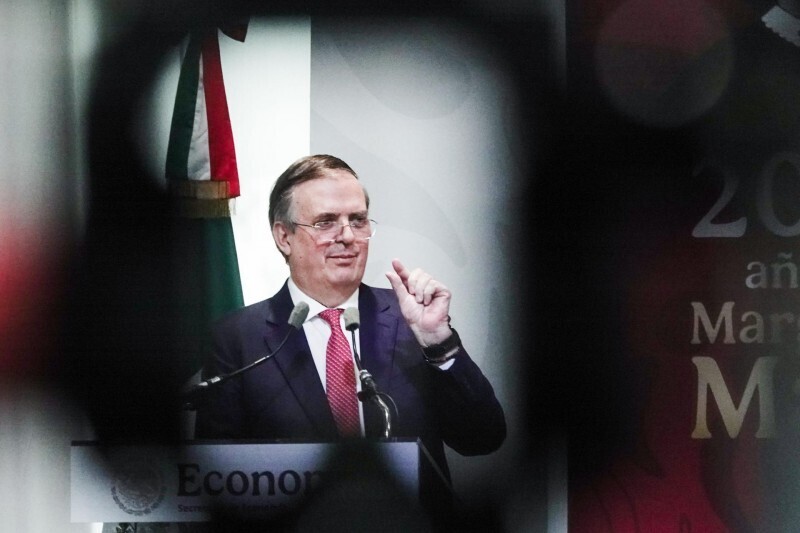
The Secretary of Economy, Marcelo Ebrard, highlighted that considering the competition with the entire Pacific basin, where countries are making medium-term decisions, it is necessary to integrate faster. He mentioned that at the APEC talks in Korea, it was clear that Asian countries are integrating more quickly, and their rules are not changing but being perfected. "We cannot be discussing basic rules all the time as it will be a self-imposed disadvantage compared to other countries in the world," he said. Ebrard explained that consultations show that businesspeople observe that other partners have a very high level of certainty. A week before the first bilateral round of negotiations towards the USMCA, the Ministry of Economy released the results of a consultation launched with entrepreneurs across the country, which highlights the demand to eliminate uncertainty and asymmetries in the trilateral agreement. The Secretary of Economy, Marcelo Ebrard, emphasized that the USMCA is perceived positively by the majority of businesspeople, over 80% of those consulted, however, they mentioned areas for improvement, particularly regarding rules of origin, labor issues, and strategies to respond to technological and environmental challenges. The official assured that the key issues to be taken to the first round of dialogues will be to flexibilize the rules of origin where there are no regional inputs, maintain consolidated supply chains, avoid triangulation and unfair competition. They also request to avoid tariffs "that go against the essence of the Treaty" and unjustified restrictive practices that increase costs and uncertainty in production chains. Mexico and the US agree to first round of USMCA negotiations this March. Ebrard also concluded that a main demand is to guarantee the principle of certainty in decisions among the three countries.