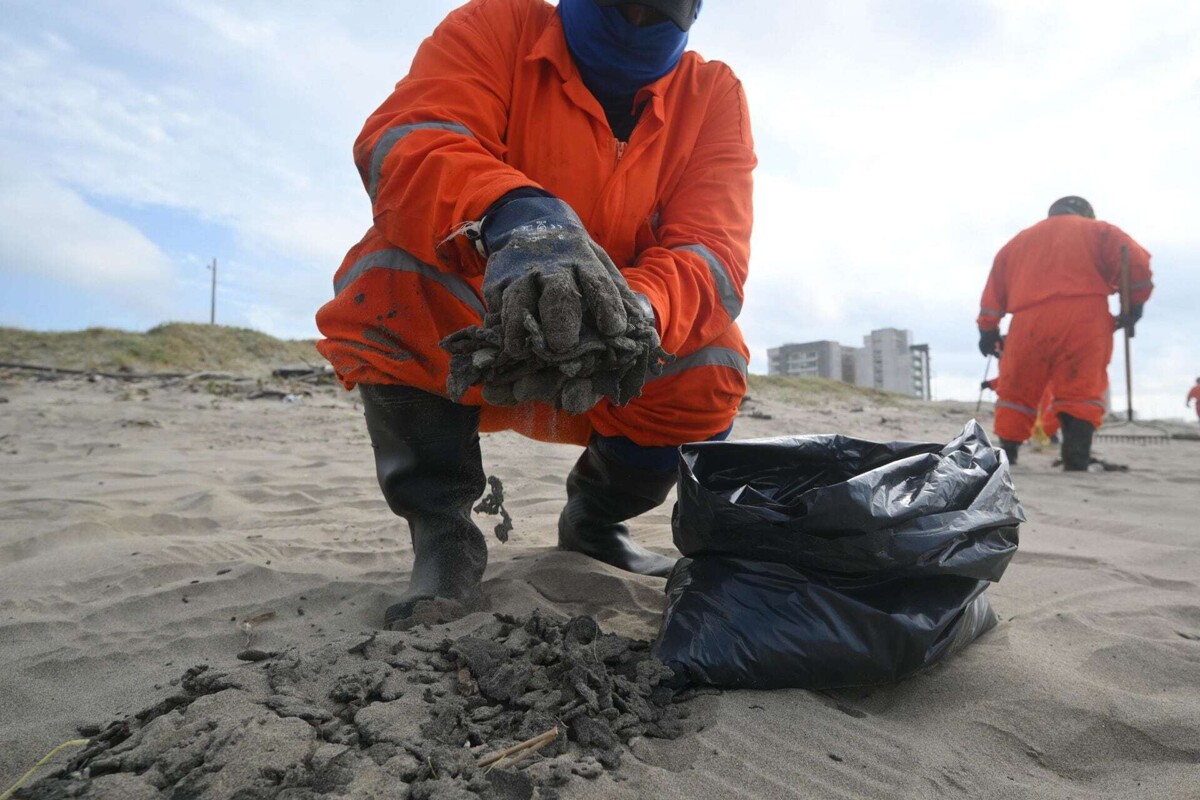
In response, Pemex has allocated 35 million pesos in support for fishermen, health services, and fuel supplies, in addition to implementing temporary employment schemes for cleanup work.
The contingency has also led to legal actions. Containment and cleanup operations due to the presence of hydrocarbons on the coasts of the Gulf of Mexico have allowed for the collection of more than 825 tons of contaminating material since March 2 to date, reported the Inter-institutional Group in charge of handling the contingency, led by the Ministry of Energy (Sener) and Petróleos Mexicanos (Pemex).
If one ton of crude oil equals 7.3 barrels, and each barrel contains about 159 liters, the magnitude of the spill is equivalent to filling 30 fuel tankers or more than 20 residential swimming pools with hydrocarbons.
In detail, 785 tons of hydrocarbons have been collected on beaches and an additional 40.6 tons at sea, reflecting the magnitude of the event and the intensity of the operations deployed in the region.
The phenomenon has mainly impacted coastal areas of Tabasco, Veracruz, and Tamaulipas, where at least 39 beaches, one mangrove, and one estuary have been attended to amidst intermittent re-entries of oily material, especially in the northern entities of the Gulf.
What is the contingency operation for the presence of hydrocarbons?
To face the contingency, authorities have deployed a large-scale operation with more than 3,000 personnel, including elements from the Secretariat of the Navy and personnel from Petróleos Mexicanos (Pemex), as well as various environmental and local agencies.
The device includes 47 vessels, seven aircraft, aerial and underwater drones, plus 1,000 meters of containment booms installed at strategic points.
In just the last reported day, 42 tons of hydrocarbons were collected on beaches and 0.6 tons at sea, while brigades attended to more than 54 kilometers of coastline, accumulating over 630 kilometers intervened since the start of the event.
Meteorological factors complicate beach cleanup
Authorities explained that meteorological factors such as cold fronts, high waves, and winds have favored the displacement of hydrocarbons towards coastal areas, complicating containment and cleanup tasks.
In parallel, Pemex reported detecting the reactivation of natural hydrocarbon emissions off the coast of Coatzacoalcos, which has forced the intensification of monitoring, containment, and remediation actions in that area.
Similarly, inspections of oil infrastructure in the Cantarell complex have begun, particularly on pipelines associated with the Akal C and Akal H centers, to verify their mechanical integrity and rule out possible leaks.
On the social front, the impact is already being felt in coastal communities, especially in activities like fishing and tourism.
The Agency for Safety, Energy, and the Environment (ASEA) filed a criminal complaint with the Attorney General's Office on March 27 for possible environmental crimes, while the investigation to determine the origin of the hydrocarbon continues.
Authorities warned that sanctions for environmental damage can reach up to nine years in prison, in addition to economic fines and the obligation to repair the damage.
Of the 13 vessels in the area at the start of the event, seven have already been inspected, and the rest remain under international follow-up to clarify their possible involvement.