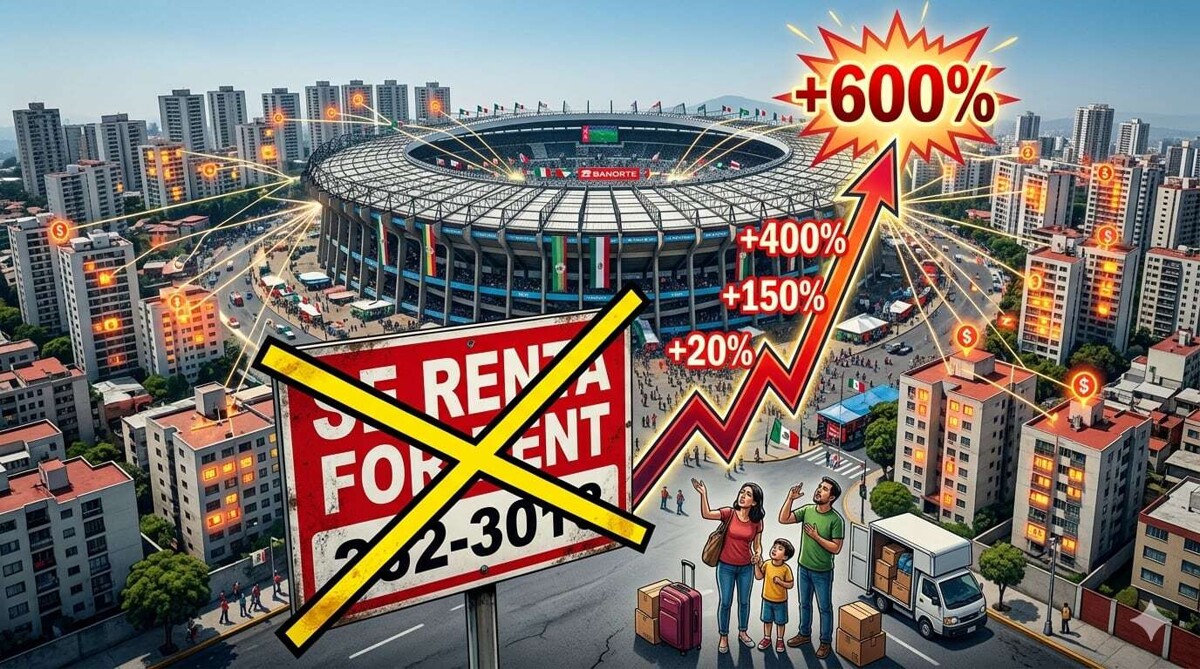
The hospitality industry is operating near its capacity in some cities, and rental prices are accumulating double-digit increases in key areas. It was reported that in CDMX, housing rental prices rose between 15% and 20% in neighborhoods near the Banorte Stadium. In Monterrey, rents around the BBVA stadium already exceed increases of 600%. While in Guadalajara, the pressure is brutal, but on hotels and short-stay models through apps, where an occupancy of up to 94% is reported and rates that have skyrocketed by 1000%. However, the impact is not uniform and will not be permanent. This factor will be seen in areas like Valle Oriente and Centro, where there is a strong supply of hotels and short-stay accommodations. An economic injection of 14 billion pesos, 12,000 temporary jobs, and the visit of 350,000 tourists is expected.
Boom in Mexico City In the case of Mexico City, the Regional Partner Mx/Centro of 4S Real Estate, Federico Jiménez, highlighted that the investments made to host the World Cup will also reactivate municipalities such as Coyoacán and Tlalpan, opening spaces for new real estate projects in the southern part of the capital. He emphasized that the investment allocated to the rehabilitation of roads and new spaces to reach the Banorte Stadium (formerly Azteca) is an opportunity for the real estate sector. The real business is what comes next: infrastructure, mobility, and new residential areas that will change the value of the host cities of the soccer cup.
The Monterrey Case The Commercial Director Mx/Northeast of 4S Real Estate, Juan Pablo Abaroa, explained that – in addition to the 600% rent increases – in the Monterrey World Cup venue, the expansion of the public transport system will open housing development opportunities in areas like Escobedo, Apodaca, and Guadalupe. He indicated that the new connectivity will turn these municipalities into attractive areas for middle-class housing from one to two million pesos and residential from two to four million, segments that are currently absent from the housing offer; since “72% of properties are concentrated in the residential plus and premium segments.” He pointed out that in the Nuevo León capital, the new elevated metro lines will activate strategic regions for the city's future growth. The expert noted that the increase in values could reach up to 1000%. “The economic impact will hit harder in sites with better commercial equipment, that is, areas like Andares and the south, where people can spend days before and after events.” And in terms of hotel occupancy, rates are expected to be much higher. The real estate consultancy 4S Real Estate revealed that rents in neighborhoods bordering the World Cup stadiums have risen significantly. And regarding Airbnb, it is projected that the number of spaces designated for short-term rental will double, he said. The Akron Stadium will host four matches with an estimated cumulative attendance of 190,000 spectators, and the number of Airbnb units—summing 6,100 spaces with an average rate of 1,261 pesos—could double to absorb the demand that the hotel industry cannot cover. For example, a 1000% increase is expected in the case of hotels. That infrastructure will revitalize other areas and help increase the value and generate affordable housing in the middle and residential segments up to four million pesos. “The phenomenon will not be isolated: other areas of the metropolitan area will also register increases, driven by the concentration of demand on specific dates. Living near the stadium is no longer a cheap option. The 2026 World Cup has not even started and rents have already skyrocketed up to six times in key urban areas of Mexico City, Guadalajara, and Monterrey. The data is clear. This type of investment will change the way to move and transport in the south of the capital. Federico Jiménez highlighted that in the country's capital a boom is expected in short-stay models like Airbnb, so the number of available spaces for this segment could increase significantly. He pointed out that the market shows a strong concentration in this last segment, which generated price increases of between 15% and 20% in some areas. During the World Cup, it is estimated that around 44,000 visitors will use short-stay platforms, which will intensify the pressure on housing availability as well as the average spending. “It must be said that in terms of rent, the World Cup came to put pressure on prices, which before and during the event will be up to five or six times higher than we are used to seeing,” the specialist reiterated.
What's happening in Guadalajara? For Guadalajara, the Regional Partner Mx/Occidente of 4S Real Estate Daniel Blum highlighted that one of the strongest effects of the 2026 World Cup is expected in hotel rates. Specialists from 4S Real Estate warned that the 2026 World Cup does not generate permanent demand, but a temporary push.