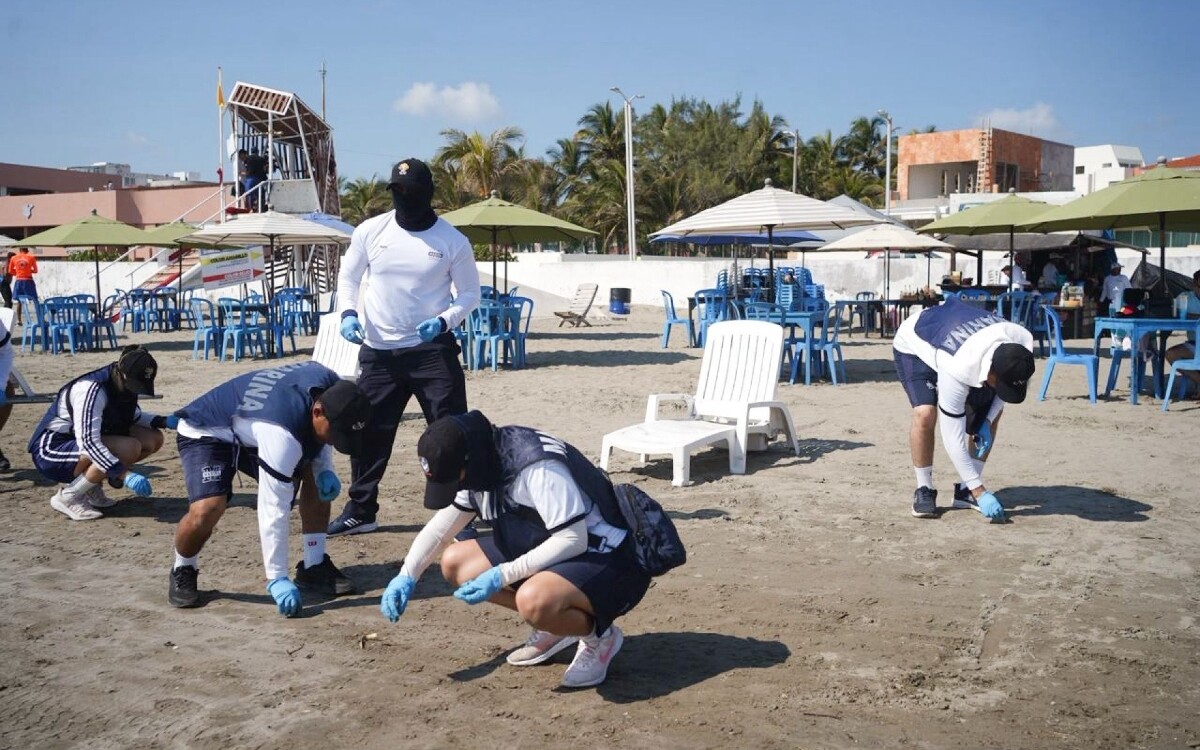
Mexico has allocated significant funds to support fishermen and protect the environment. The government has provided five dump trucks and investments of 30 million pesos (1.7 million dollars) for fishing cooperatives on the southern coast of Veracruz. In Tabasco, a laboratory for oyster seed, water purification systems, and productive equipment is also being established. Additionally, southern Veracruz municipalities, including Alvarado and Medellín, will receive emergency aid in the form of gasoline and diesel fuel, along with 100,000 liters of fuel for Pajapan. Fishermen in Tabasco will receive 1,360 liters of fuel per registered vessel. An interagency group has deployed permanent brigades on the beaches of the Gulf of Mexico to address hydrocarbon presence and protect the environment. Through coordinated actions between federal, state, and municipal authorities, cleanup work is being carried out along over 630 kilometers of coastline. For these tasks, 25 vessels, 48 land vehicles, 9 fixed-wing and rotary-wing aircraft, three aerial drones, and three underwater drones have been deployed. Starting Monday, April 6, the National Fisheries and Aquaculture Commission (Conapesca) will begin paying 15,000 pesos (833.3 dollars) to each of 3,379 fishermen in Tabasco and Veracruz, with a total investment of 50,685,000 pesos (2.8 million dollars). In the environmental front, the Ministry of Environment and Natural Resources (Semarnat) reported 93 inspections at 38 sites since March 3, and on March 31, visits were made to Punta San Juan, Pajapan, Barrillas, Laguna del Ostión, La Trocha, Escolleras de Alvarado, and the Coatzacoalcos seawall. It also maintains surveillance in nine natural protected areas in Veracruz, Tabasco, and Tamaulipas, of which eight reported minimal hydrocarbon presence and six no longer reported pollutant arrivals by March 31. State oil company Pemex reported hiring 780 workers for cleanup operations, although the cumulative effort has involved contracting 958 people through temporary and rotational schemes. Pemex also specified that it has attended to 112 kilometers of coastline and that waste is being concentrated, transported, and managed in accordance with environmental regulations. In priority areas, at least 480 meters of barriers, as well as oil-absorbent booms, mechanical dispersion systems in open sea, specialized vessels, and underwater inspection equipment, have been placed. The operation also includes support for fishing communities in southern Veracruz and Tabasco. Pemex reported the temporary hiring of fishermen and residents from Agua Dulce, Coatzacoalcos, Pajapan, Mecayapan, and Tatahuicapan in Veracruz, as well as from Paraíso and Cárdenas in Tabasco, to participate in cleanup and collection. The interagency group in charge of addressing hydrocarbon presence on the Gulf of Mexico coastline reported this Friday that it has collected 889.4 tons of the contaminant on 48 beaches in Veracruz, Tabasco, and Campeche, of which 32 are now free of new arrivals and 16 continue to be affected. The official balance was disseminated in a joint communiqué by the Secretariats of the Navy, Environment, Energy, Science and Technology, the state-owned Petróleos Mexicanos (Pemex), the Federal Attorney for Environmental Protection (Profepa), the Agency for Safety, Energy and Environment (ASEA), among other local and federal authorities. According to this interagency group, the spills reported since early March, but present since January 2026, are the result of a spill from one vessel and two natural oil emanations off the Campeche Bank. Additionally, it monitors approximately 300,000 hectares of mangrove forests and turtle nesting areas.