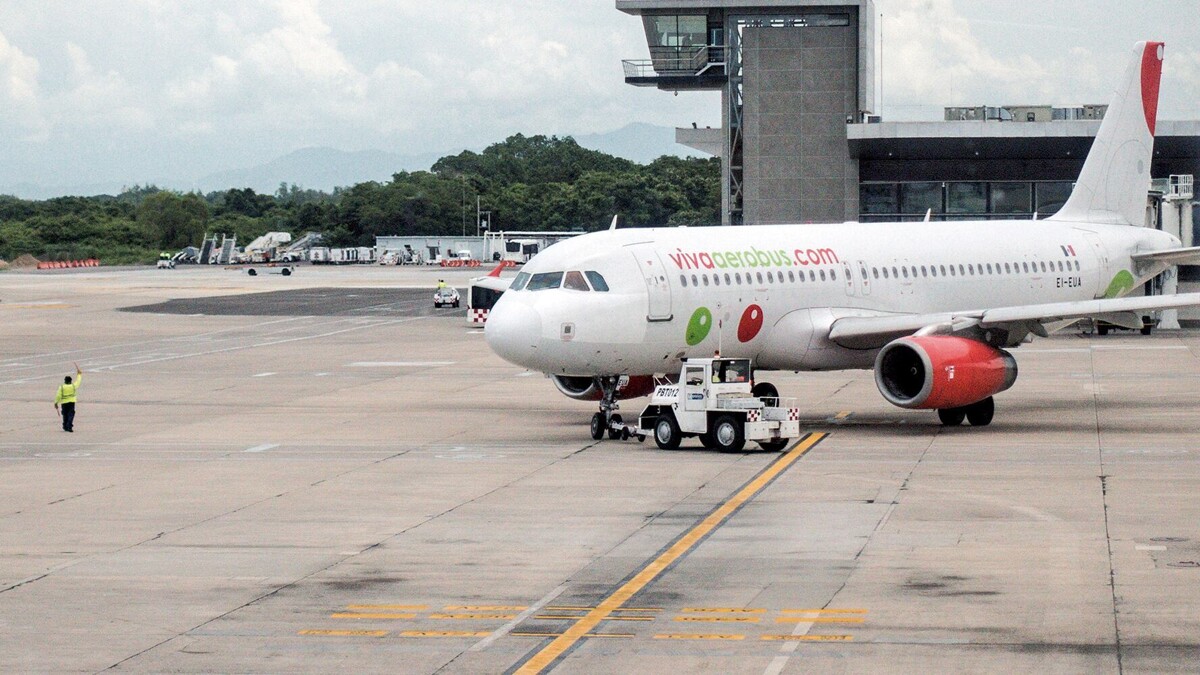
After several regional airlines went bankrupt due to the pandemic, only three major airlines are left operating nationally in Latin America's second-largest market, and it's likely that number will soon be reduced to two, raising concerns about an effective duopoly in a market that serves 63 million domestic travelers annually. Viva and Volaris, the only remaining low-cost carriers in Mexico, announced in December their merger plans. While Viva had considered the operation on a couple of occasions, it never carried it out. Volaris is today the larger of the two, with a wider fleet of 155 aircraft and recorded revenues of $3 billion in 2025. The landscape at the time was dominated by Aeroméxico and Mexicana, traditional airlines that catered to travelers with higher purchasing power. It will also analyze how potential entry barriers at those airports might affect other competitors, such as Aeroméxico. For example, it's likely the regulator will closely examine the 20 domestic routes that Bloomberg identified where Viva and Volaris are the only ones offering service. There are other routes where Aeroméxico does operate, but the new group would be significantly stronger, such as flights from Felipe Ángeles International Airport (AIFA) to Tijuana or the Guadalajara-Cancún route. The early years of the new millennium were a dream for budget-conscious air travelers in Mexico. The country's airspace, long dominated by traditional carriers Aeroméxico and Mexicana de Aviación, was flooded with a series of low-cost airlines in 2005 and 2006, with Interjet, Viva Aerobús, and Volaris competing to sell tickets, mainly for domestic flights, for a price just a bit more expensive than a bus ticket. They also believe the new airline group will have better credit metrics, which will help reduce the financing costs for both companies. Even together, the airlines will remain relatively small compared to their U.S. counterparts, says industry expert Fabricio Cojuc. 'The strategy is more about cost-cutting, not increasing revenue through price hikes.' A Viva spokesperson said the alliance with Volaris 'will be a great step towards the future of the commercial airline industry in Mexico' and will bring more domestic and international route options and 'greater ease of low-cost flying for all Mexicans.' Volaris and the regulator did not comment. Cheaper Skies The launch of Grupo Viva Aerobus SA, Controladora Vuela Compañía de Aviación SAB (Volaris), and the now-defunct Interjet catapulted the airline industry in Mexico. Aeroméxico, meanwhile, has a stronghold at Mexico City International Airport. 'The case will be a test of fire for the authority's reputation,' Tapia said. The general consensus is that it's likely the CNA will approve the transaction with certain conditions. Competition authorities around the world tend to opt for remedies that are relatively cheap and easy to supervise, Tapia noted. That's almost triple the number in 2005, the year before these airlines began operating. While Viva and Volaris have had to navigate tough times, one could say their U.S. and Latin American counterparts have fared worse. 'The group's fleet will still be smaller than Alaska Airlines's,' he noted. The company's new growth strategy will focus on routes outside of Mexico City, establishing operation hubs in secondary cities like Culiacán and Mérida, while reinforcing existing hubs like Guadalajara and Monterrey. There's also potential for international growth. 'They've done an impressive job developing domestic routes over the years, and in a way, it's a market that's not going to give much more,' Cojuc said. Looking ahead, 'they will have to look to the United States and the rest of Latin America as natural sources of growth.' In collaboration with Siddharth Philip See the latest version of Businessweek México here: That's why Pratt has, from time to time, offered compensations to the airlines. The new entity would represent 74% of Mexico's domestic air traffic and leave Aeroméxico as its only major competitor. From a business perspective, it makes sense. President Claudia Sheinbaum also praised the deal, stating it would allow the companies to continue investing in the country while attracting more tourism. Even so, there are inherent risks to having two companies—and ultimately, two boards of directors, that of Aeroméxico and that of the future parent of Viva and Volaris, Grupo Más Vuelos—controlling Mexico's national airspace. Viva's owner, Grupo IAMSA, also operates a massive bus network and was fined in 2022 for anti-competitive practices related to price manipulation and route segmentation. The deal will also serve as the first test for the recently reformed National Antimonopoly Commission, after it was integrated within the Ministry of Economy. It's a crucial moment for a sector that, most agree, has much more capacity to grow—not just for tourists going to the beaches, but for smaller cities that want to attract more investment and for families looking for faster ways to reunite. If Mexico could bring its 0.5 flights per capita in 2024 closer to Turkey's number, the market could more than double. Still, there are no shortage of headaches facing airlines worldwide. Viva's fleet is slightly smaller, with 108 aircraft, and generated annual revenues of $2.4 billion last year. This also means Volaris has more debt—around $3.1 billion compared to Viva's $1.9 billion. However, the deal is supposed to be a 'merger of equals,' as the companies stated in the press release. 'When you go from enterprise value to equity value, the relative equity contributions get much closer,' said Volaris CEO Enrique Beltranena in a December conference call to discuss the merger. 'A 50% ownership will create an equitable and balanced outcome.' Therefore, Viva shareholders will receive newly issued Volaris shares, and each shareholder group will own 50% of the new entity, Grupo Más Vuelos. The holding will continue to trade on the New York Stock Exchange and the Mexican Stock Exchange under a new ticker symbol. Both CEOs, Beltranena of Volaris and Juan Carlos Zuazua of Viva, will remain at the helm of their respective companies. The new low-cost airlines, especially Volaris, promoted flights as an alternative to buses on extremely local routes. Instead, it will focus on specific routes where Viva and Volaris are the only operators or have a dominant position, Tapia said. Avianca and Gol ended up creating Grupo Abra, a similar holding to what Viva and Volaris plan. If done right, the deal could help the new group avoid the fate of its regional competitors and get closer to what European Ryanair Holdings PLC has been doing, says Syth. The European airline focuses on flying to secondary airports and striking volume deals. 'They are leveraging their size to try to counter some of that inflation and make sure they keep costs low,' said Syth. Viva and Volaris have pointed to Turkey, another emerging market with an economy similar to Mexico's with 1.3 flights per capita, as a model to follow. The companies say the merger will connect their networks—Volaris operates mainly in the west and Viva in the east—and that passengers will have better schedule options. And the war in Iran has led to big costs like fuel being even more volatile. Last year, Viva made a net gain of $1.73 per ticket sold, while Volaris lost $3.35. Joining forces will give the new holding more negotiating power when purchasing new planes and fuel, some of its biggest costs. Beltranena has led Volaris since its inception, while Zuazua took the helm in 2010 at age 29. Roberto Alcántara, president of Grupo IAMSA, Viva's owner, will lead the new group. Both airlines' fleets are composed of Airbus SE aircraft, many of which use Pratt & Whitney turbines. While they are more fuel-efficient than the previous generation, the presence of metallic dust contamination in the geared turbofan Pratt engines has forced airlines worldwide to temporarily ground part of their A320 family fleet while components are replaced. As a result, Viva had an average of 26 aircraft on the ground in the last quarter, while Volaris had 36. Local route travel multiplied, and air travel quickly shifted from a luxury reserved for elites to an almost daily whim. Today, the situation is very different. The deal has already drawn criticism from some who fear that if approved, it will mean the end of low-cost flights in the country. The deal, which still needs regulatory approval, will keep the brands separate but will operate under a single holding. An airplane that doesn't fly is a waste of money. Spirit Aviation Holdings declared bankruptcy for a second time in less than a year, while Frontier Group Holdings and JetBlue Airways Corp. are barely making money, noted Syth. In the U.S., costs are higher, there's competition from traditional airlines, and a general passenger fatigue of preferring to pay for a full service rather than à la carte. In the rest of Latin America, pandemic-era travel restrictions and a lack of government bailouts led to LATAM Airlines SA, Avianca Holdings SA, Grupo Aeroméxico SAB, Gol Linhas Aéreas Inteligentes SA, and Azul SA declaring bankruptcy. A common measure in such cases is to order the reallocation of takeoff and landing slots, or slots, in constrained airports, like the saturated Mexico City airport. For example, in 2017, Cofece approved a joint venture between Delta Air Lines and Aeroméxico but forced them to cede eight pairs of slots in Mexico City to the competition. Grupo Más Vuelos Volaris went public in 2013. And it worked, especially on domestic flights. More than 122 million people flew in Mexico in 2025, according to official figures. Approximately 63.5 million of them did so on domestic flights. Experts say it's too early to know if that will happen. 'The question always arises: if there are fewer competitors, there's more of a chance that prices will go up,' said Savanthi Syth, an analyst at Raymond James. 'That's certainly a risk, but it's not necessarily an inevitable conclusion.' The entire sector has recently been plunged into chaos since the United States and Israel began bombing Iran on February 28. Airlines have been hit by rising fuel costs, which represent about a third of operating costs. Antitrust Approval The companies have already submitted the initial documentation to the National Antimonopoly Commission, and it's expected to rule on the merger by the end of the year. Viva and Volaris expect the merger to help them get better terms. In this scenario, he said, 'we expect that one plus one will be more than two, because they are joining two networks that don't overlap much, and thus you can do more and offer more connectivity.' Janneth Quiroz, director of economic analysis at Grupo Financiero Monex, says the deal seems geared towards helping the companies reduce costs, not increase revenues. 'These two airlines have distinguished themselves by offering low prices by betting on volume,' said Quiroz. The airline industry is brutal. As such, the CNA is now a decentralized public sectoral body within the Ministry of Economy. In its analysis of the deal, the CNA will not take into account the potential full scope of the new holding, according to Giovanni Tapia, a former commissioner of Cofece. Margins are thin. The CNA's predecessor, Cofece, was dismantled at the end of 2024 as part of a new law aimed at dismantling autonomous bodies.