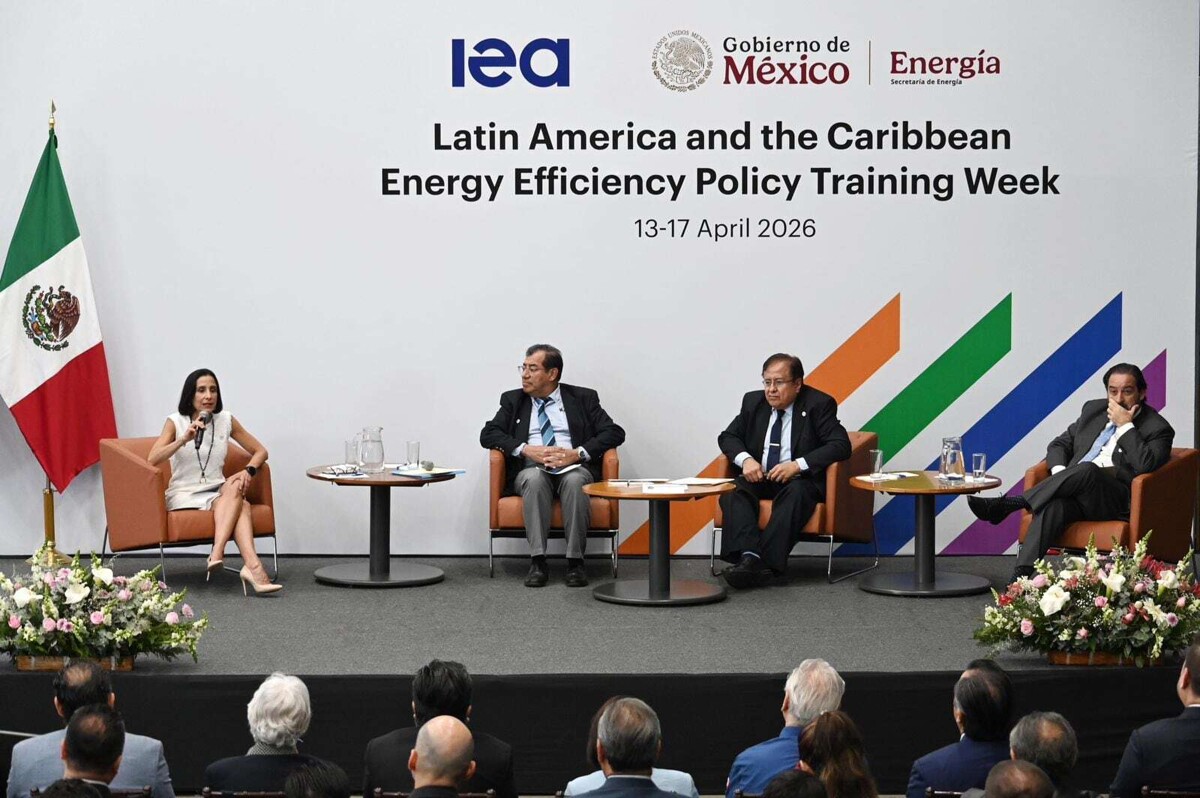
Mexico is seeking to accelerate its energy transition with a strategy that will allow it to reduce its dependence on fossil fuels, particularly imported ones, without compromising its economic competitiveness or the country's growth. The Ministry of Energy, headed by Luz Elena González, placed energy efficiency as one of the central pillars of this strategy, highlighting that a lower energy consumption intensity will allow for progress towards a cleaner, but also more internationally competitive system. During the inauguration of the 'Training Week on Energy Efficiency Policies in Latin America and the Caribbean', the head of SENER emphasized that the Mexican government aims to increase the share of renewable energies in electricity generation, raising it from the current 24% to at least 38% by 2030. This objective is part of a broader policy that seeks to reduce greenhouse gas and methane emissions in the energy sector, while ensuring a transition that is orderly, reliable, and has a social impact. The official highlighted that international experience shows it is possible to reduce dependence on imported fossil fuels without sacrificing economic growth, as long as appropriate policies are implemented and accompanied by investment in technology and infrastructure. The strategy also contemplates an increase in public and private investments for the development of energy infrastructure, as well as greater international cooperation. In this last point, SENER, together with the International Energy Agency (IEA), brought together more than 200 participants from 22 countries in an event that positions Mexico as a relevant actor in the global energy dialogue. Brian Motherway, an IEA representative, pointed out that Mexico is showing leadership by recognizing that energy is not just a productive input, but a key tool to improve competitiveness and economic resilience. The Mexican government has reiterated that this energy transition will take place under the principle of energy sovereignty, which implies maintaining a balance between strengthening state-owned companies and the incorporation of clean sources. From April 13-17, at the SENER headquarters, various discussion panels will also be held that will bring together experts from the energy sector. At the inaugural event, moderated by the General Director of International Affairs of SENER, Laila Porras, the Minister of Industry, Energy and Mining of Uruguay, Fernanda Cardona, participated virtually. Also present were the Ambassador of Guatemala, Edgar Armando Gutiérrez Girón; the Ambassador of Denmark, Kim Højlund Christensen; the Economic Counselor of the Embassy of Germany, Volker Gutekunst; the Undersecretary for Latin America and the Caribbean of the Ministry of Foreign Relations, Raquel Serur Smeke; and the Vice Minister in the Ministry of Hydrocarbons and Energies of Bolivia, Tatiana Genuzio Patzi. Also participating were the director of the Federal Electricity Commission, Emilia Esther Calleja Alor; the director of Petróleos Mexicanos, Víctor Rodríguez Padilla; as well as the Undersecretaries of SENER for Planning and Energy Transition, Jorge Marcial Islas Samperio; for Electricity, José Antonio Rojas Nieto; and for Hydrocarbons, Juan José Vidal Amaro, among other authorities and representatives of the energy sector.