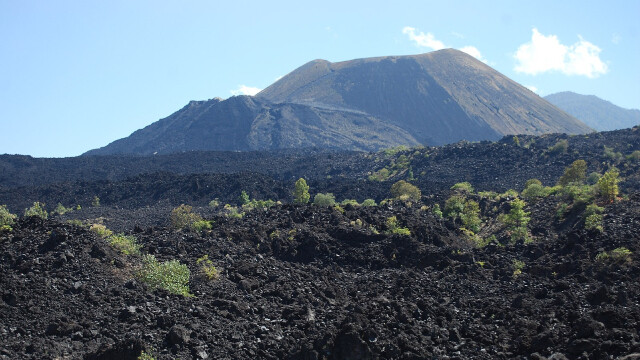
Mexico is a country marked by seismic and volcanic activity, and the Neovolcanic Axis is the best proof of this. The Neovolcanic Axis, also known as the Trans-Mexican Volcanic Belt, is one of the most important geological regions of Mexican territory, stretching from the Pacific coast to the Gulf of Mexico. The volcanism in this zone is linked to the subduction of the Cocos Plate under the North American Plate, which leads to the emission of basaltic magma and the formation of new mountains. In this context, the Paricutín volcano holds a special place. Although it is not the highest, its scientific significance is immense, as its birth was documented from the very first day. This volcano is monogenetic, meaning it had only one well-defined eruptive phase. Located in the state of Michoacán, in the Purépecha Plateau region, Paricutín has an approximate altitude of 2,800 meters above sea level. Its uniqueness lies in the fact that it formed in 1943 in a cornfield, which allowed scientists to observe its entire life cycle. The eruption of Paricutín forced the displacement of entire communities, such as San Juan Parangaricutiro, whose church, partially buried by lava, has become a historical and tourist symbol. Today, Paricutín is a popular destination for nature tourism, hiking, and environmental education. This volcano is not only part of a mountain system but also Mexico's natural and cultural heritage, reminding us of the close relationship between the Earth and its inhabitants. Its study has helped to better understand phenomena such as the formation of ash cones, the evolution of lava flows, and the impact of eruptions on nearby human communities. Paricutín confirms that the Neovolcanic Axis is not an inactive system but a living structure capable of generating new mountains and modifying the environment in relatively short periods.