The Supreme Court of Justice of the Nation (SCJN) held its first itinerant session in the municipality of Tenejapa, Chiapas, with only six of the nine ministers that make up the Plenary, in the presence of the inhabitants of the La Candelaria community, to whom they would shortly grant a ruling against the state Congress.
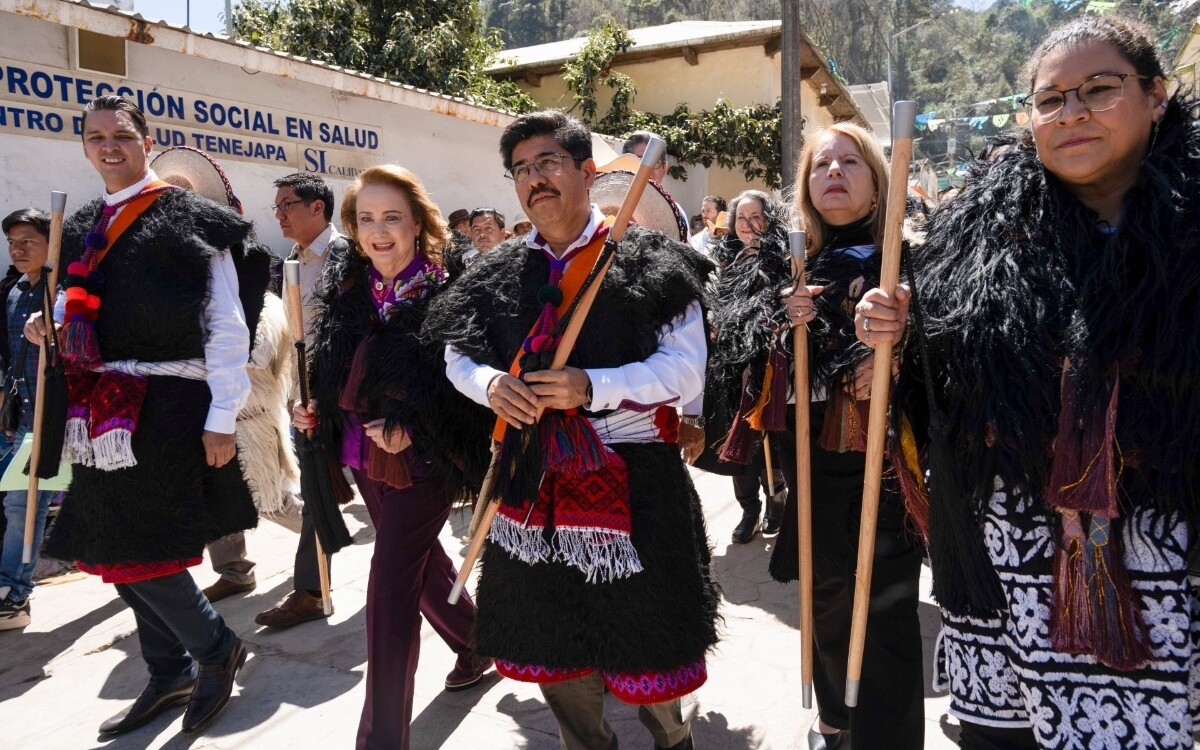
Dressed in the traditional clothing of the region, six ministers attended the so-called First Extraordinary Session in Territory, while two other ministers, Irvning Espinosa and Giovanni Figueroa, preferred to vote remotely. Minister María Estela Ríos was absent on an official mission.
For the Plenary Court session, local authorities led by the governor of Chiapas, Eduardo Ramirez Aguilar, invited and accommodated about two thousand people from neighboring indigenous communities, setting up an auditorium in the main square of Tenejapa, a Chamula indigenous community where Tzotzil and Tzeltal are spoken.
The so-called Extraordinary Public Session in Territory was attended by the presiding minister of the Supreme Court, Hugo Aguilar; with Minister Aristides Guerrero and Ministers Lenia Batres, Yasmín Esquivel and Loreta Ortiz Ahlf, author of the ruling project that was approved by the rest of the ministers.
During the session, the Plenary of the Court ruled that “the rights of peoples and indigenous communities must be translated into real conditions that allow for their effective exercise,” for which reason an amparo was granted to the La Candelaria community, which had fought a legal battle for five years to be recognized as a public law entity, with government capacity and its own budget.
The case analyzed originated when the La Candelaria community, located in San Cristóbal de las Casas, Chiapas, through its Community Assembly —the highest decision-making body— agreed to request the State Congress for the formal recognition of its community government and its character as a public law entity.
This request was presented in a letter addressed to the state legislative power.
At first, the Congress of Chiapas did not respond to the request, so the La Candelaria community filed an amparo lawsuit. During its processing, the Chiapas Legislative Power stated that the laws in force in the state were insufficient “to make effective the collective rights of the community, particularly to obtain the legal recognition of its community government and to exercise its own forms of political and social organization.”
With the support of the “Minerva Calderón” Human Rights Clinic of the Iberoamerican University Puebla Campus, the La Candelaria Community continued with the legal process to fight for the recognition of its government.
When analyzing the issue, the Plenary concluded that the Chiapas Congress had committed a legislative omission because, although there are constitutional and legal provisions that recognize the self-determination and autonomy of indigenous peoples, state laws did not contemplate “clear procedures or effective mechanisms that allow communities to constitute and obtain the legal recognition of their community governments.”
It was also unclear how the Community Assembly of a community could be a public law entity to have adequate coordination mechanisms with state and municipal authorities and to have direct access to the public resources that correspond to them.
Thus, the ministers considered that the reform to article 2 of the Constitution approved in 2024 implies a profound change in the Magna Carta that “expressly recognizes peoples and indigenous communities as public law subjects with legal personality and their own heritage,” so it should be a turning point to grant them their own legal existence and the capacity to exercise public functions directly.
Therefore, the Supreme Court ordered the Congress of the State of Chiapas to legislate within a maximum period of 180 days, from the issuance of the said General Law, which will develop the content of article 2 of the Constitution to establish clear routes for the formal recognition of community governments, criteria and procedures to recognize indigenous communities as public law subjects and entities of public interest, as well as coordination mechanisms with state and municipal authorities, in harmony with the applicable constitutional and conventional parameters.