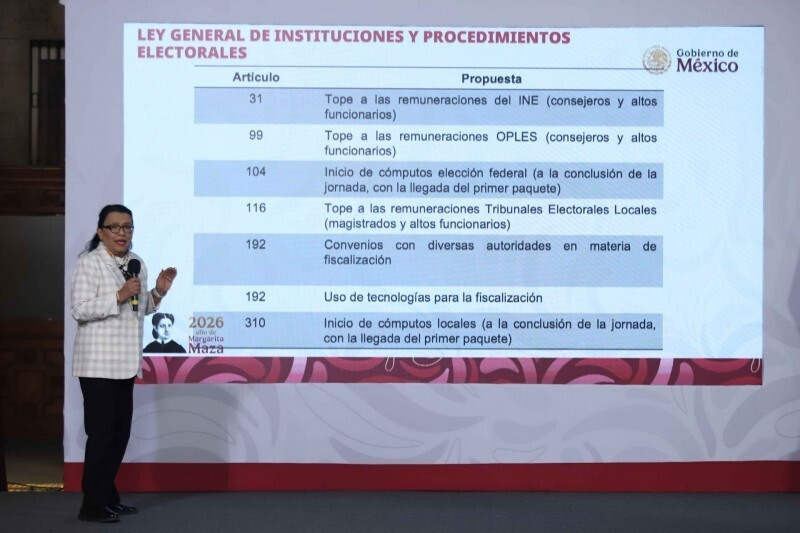
'It's about having fewer privileges and more citizen participation,' said the official. Sheinbaum achieves consensus for Plan B to electoral reform, but says she will insist on reducing party privileges. The proposal implies reducing resources to the National Electoral Institute (INE), which the government qualifies as 'privileges,' as well as to courts and electoral bodies. 'We can no longer lower the budget of political parties, but we are putting in the law that all resources must be transparent,' said Sheinbaum in the same space at the National Palace. Resources that will be destined for public works. In the case of electoral authorities, it is proposed that they do not earn more than the president and that Senate spending will be progressively reduced to reach 15%. 'We will continue to insist that the INE must lower its budget and that political parties should not allocate so many resources to the parties. This Tuesday, the government of Claudia Sheinbaum will send to congress Plan B to the original electoral reform proposal, which focuses on reducing expenses to the INE and local congresses, in addition to proposing the recall of the mandate. This did not happen,' said President Claudia Sheinbaum this Tuesday. During the Morning at the National Palace, the head of Segob, Rosa Icela Rodríguez, announced the main points that this new initiative contains, on which an agreement is expected between Morena and allied parties, after the division generated by the first initiative. In addition, bonuses, major medical expense insurance and additional income will be eliminated. Another proposal in this legislative initiative is that the recall of the mandate be carried out in 2027 or 2028. On the other hand, given the impossibility of reducing the expenses of the parties, as proposed in the president's original proposal and which was rejected in Congress, it is now proposed that party leaders must disclose their remunerations and parties have to report their financial operations in real time; illicit resources, resources from abroad and cash contributions will be prohibited. In addition, a cap of between seven and 15 councilors per municipality will be set, as well as a budgetary cap at local congresses. 'It has as a fundamental principle the reduction of privileges, excesses in the exercise of public function; we maintain the objective of reducing costs and acting under one of the fundamental principles for the fourth transformation, which is republican austerity.'